Total Pageviews

Showing posts with label Spock. Show all posts

Saturday, January 31, 2026

Kirk, Spock, and the Beastie Boys: Solved!

We learn in Star Trek (2009) and Star Trek Beyond (2016) that James T. Kirk is a fan of Beastie Boys, the American hip hop band formed in 1981. In 1998, the Beastie Boys released "Intergalactic," which included the phrase "like a pinch on the neck of Mr. Spock." 

This presents a continuity conundrum. How could the band have known about Mr. Spock, much less his famous nerve pinch, hundreds of years before Spock was born? 

Well, in the summer of 1986, the Beastie Boys were in Oakland, California, in support of their album Licensed to Ill. Right around that same time, the senior staff of the USS Enterprise were in nearby San Francisco, having travelled back in time to bring a pair of humpback whales to the future. During their visit to the past, Kirk and Spock board a city bus and gain some notoriety when Spock silences a rude punk rocker with a nerve pinch. The other passengers clap, and shortly after, Spock says, "Admiral, may I ask you a question?" 

Kirk responds, "Spock, don't call me admiral." They then proceed to have a short conversation about colourful metaphors--double dumb ass on you, and so forth. 

I propose that one or more members of the Beastie Boys were on that bus and witnessed the incident, taking note of the strange attire of the one they heard called "Spock" and his friend the admiral. The amusing memory stuck with them, and they reference the event in "Intergalactic." 

Young Kirk, when he first heard "Intergalactic" hundreds of years later, wouldn't have taken note of the "Spock" lyric. But when he met Spock at Starfleet Academy, I wonder if was taken aback for a moment. Probably not; after all, there were Spocks on Earth, such as Dr. Benjamin Spock. The first time Kirk saw Spock use a nerve pinch, though, must have made him wonder . . . 

A predestination paradox! 

Monday, October 13, 2025

Generative AI Fail for Chekov's Gun


Back when I wrote "Chekov's Gun," I tried to get Bing to generate some images of Spock, Chekov, and an alien to accompany the story. Despite many attempts, there's no sign of Chekov nor the alien I described...just the Alien alien. Human artists remain superior. 
 

Friday, April 05, 2024

What Was Chekov's Greatest Feat?


In "The Best of Both Worlds," the USS Enterprise-D arrives too late to participate in the Battle of Wolf 359. Commander Riker, Commander Shelby, and the rest of the bridge crew see the wreckage of 39 Starfleet vessels floating in space. 

"The Tolstoy...the Kyushu...the Melbourne," Shelby intones mournfully as wreckage drifts across the Enterprise viewscreen. 

The Tolstoy Shelby mentions was originally intended to be the USS Chekhov or Chekov, according to different sources. Though you never see it close enough to distinguish, the modelmakers settled the question by spelling the Springfield-class ship miniature's name as Chekov. At the last moment, though, the showrunners realized it was a pretty somber event for the name-dropping of original series character Pavel Chekov, so Shelby's dialogue references the Tolstoy instead. 

Still, this leaves continuity nerds with an interesting issue to ponder: Because the USS Chekov exists canonically (it was seen on screen in an episode, the miniature has Chekov's name on it, and it appears the majority of the creatives who worked on the episode intended for the ship to be named after Pavel Chekov). What, then, did Pavel Chekov do during his career or in his civilian life to deserve this rare honour? There is no USS Kirk, USS Spock, or USS Scott. Chekov may be a legend by association, and he played a role in saving Earth and the Federation more than once, but surely Starfleet would recognize his superior officers before Chekov himself. 

Indeed, whether or not Chekov ever rose above the rank of commander is ambiguous. The last time we see him on screen, in the opening scenes of Star Trek: Generations, Chekov wears a commander's rank, though a reporter calls him "Captain Chekov." There are two ways to take this: the reporter mistook Chekov's rank, or knew that Chekov had just been promoted or was about to be promoted, but hadn't changed his rank insignia yet. I like to imagine Chekov had the right stuff to be captain one day, so I assume the latter. Indeed, some behind-the-scenes materials assert Chekov was supposed to be a captain in Generations, but that they couldn't find any more of the metal captain rank pins to affix to his uniform. 

For the purposes of this question, I'm going to assume that Chekov did indeed reach the rank of captain and that he had adventures of his own after leaving the Enterprise-A in 2293. 

We hear nothing at all about Chekov until the third season finale of Star Trek: Picard, set in the year 2402. As that finale opens, we hear the voice of President of the Federation, Anton Chekov (played by original Chekov actor Walter Koenig), quoting his father, Pavel, that "hope is never lost" even as he warns everyone to stay away from Earth, as it's under attack by the Borg. 

Pavel Chekov never said "Hope is never lost" in any of his onscreen appearances, though he might have said it "offscreen" at any time during his career, either as a fresh young ensign or a veteran captain or admiral. (Chekov jokingly refers to himself as an admiral during the hospital chase scene in Star Trek IV: The Voyage Home.) Even so, his son Anton uses the phrase in a way that suggests many of the people in his (very large) audience will understand the reference. 

I propose that sometime after 2293, Pavel Chekov--Captain Chekov of the Federation Starship Unrevealed at This Point in Time--led his crew on a historic mission with desperate stakes and impossible odds. Maybe he saved an entire civilization from extinction; perhaps he inspired the Federation with a brave act of sacrifice; maybe he wrote a great novel that included the words quoted by his son. 

We'll likely never know. I would be shocked if Chekov is ever seen again in visual media; Koenig's voiceover role in Picard was a surprising and very welcome gift, but I'm sure that's the last we've heard of the character (and even then it was an indirect reference). 

And yet, despite poor Walter Koenig getting less accumulated screen time or character development than the rest of the original series main actors, his character definitely leaves a lasting legacy in his universe, one that rivals those of even Kirk and Spock (as measured by the in-universe impact of those legacies). 

Nice work, Pavel. We'll probably never learn what you did, but you clearly made a difference to the people of your corner of the multiverse. 


Wednesday, May 10, 2023

Chekov's Gun

The sun blazed over San Francisco, its warmth transforming the Bay into a summer playground. Blooms quivered in the breeze. Sparrows and robins darted to and fro above the vast public courtyard of Starfleet Academy, where hundreds of students, flush with youth and optimism, slowed just a little in their rush from class to class to enjoy the sunshine. 

It was a beautiful day for a breakup. 

“I’m leaving, Pavel, because I can’t bring myself to carry a phaser,” Irina said. Even after two years at the Academy, she couldn’t completely hide her Novgorod accent. She clutched a data tablet to her chest like a shield. 

“Hardly anyone in Starfleet carries a phaser,” Pavel Chekov said, his own accent thickening as his stress rose. “Statistically, less than one in 10,000 Starfleet recruits are ever assigned a phaser, and even then only temporarily, and even then some tiny fraction of that tiny group ever have to draw it, much less use it—“ 

Irina sighed and waved Chekov’s statistics away. “I’m just not willing to take the chance. I want to study life, not end it.” 

Chekov’s temper flared for a second. He wanted to protest. He wanted to tell her that he was going to serve as a navigator or science officer, that he’d spend his life exploring and discovering. 

But Irina knew all that. She wasn’t condemning him. She wasn’t even condemning Starfleet. She simply knew herself and her boundaries too well. 

She looked at him with sad eyes. He wanted to tell her that they could still have a life together. He began to reach for her hand. 

And then Irina Galliulin said the last words he’d hear from her for years to come: 

“I’m going to reconnect with Doctor Sevrin,” she said, “I’m going to become One.” 

Chekov’s face flushed. Oneness was superstition, not science. Or maybe it was just some kind of alien telepathic connection he didn’t understand. At just 032, Chekov’s esper rating was well below average, so low that some Federation telepaths couldn’t even register his presence, something he’d been gently teased about at the Academy. 

So he said nothing, not just because Irina’s face told him how she felt and how much she regretted hurting him, but because he knew the fault lay not in the stars, but in himself. Besides, Doctor Sevrin wasn’t hurting anyone. Oneness was just a different way of looking at life, just Federation pacifism taken to its logical extreme. 

He couldn’t stand her pity, and logic told him he had no good arguments to use against the woman he loved. 

One day she’ll see it was pointless to worry, he thought. But by then, they’d have moved on. 

“I understand, rodnaya,” he said. “I love you. I guess I’ll see you around.” 

He left her standing in the summer sun, the breeze tugging at her long brown hair. Heedless, a clutch of nearby students laughed at some shared joke.

TWO YEARS LATER

It was still a bit hard for Chekov to believe he was sitting on the bridge of the USS Enterprise—the same Enterprise once captained by the legendary Robert April, then Christopher Pike, and now James T. Kirk, whose own reputation was already, if not legendary, than at least widely renowned. He felt like the luckiest Academy graduate in history. 

“How’s the new kid?” Kirk murmured a couple of meters behind him—just loud enough for Chekov and his friend Sulu, seated next to him at the Helm station, to hear. Loud enough for everyone on the bridge, really. Kirk’s voice carried weight even in the quiet.

“His performance is quite satisfactory,” answered Spock. Chekov was glad his back was to the two senior officers. ‘Quite satisfactory,’ was high praise from the taciturn Vulcan, and Chekov could feel himself blushing with pleasure. He could feel Sulu glancing over at him, doubtless to shoot some kind of gentle, teasing smirk his way, so Chekov kept his gaze face-forward and diligently focused on his controls. 

“I don’t believe he’s had any landing party experience yet,” Kirk said.  

“Indeed not,” Spock replied. 

“Take him down with you when we get to Ivor Prime,” Kirk said. “He’s wearing a gold shirt, but he still looks a shade green to me.” 

“Green is a perfectly pleasant shade, Captain.” 

“Nonetheless,” Kirk said. 

“Nonetheless,” Spock acknowledged. 

TWO WEEKS LATER

Chekov arrived in the transporter room at 05:45, a tricorder slung over his shoulder, fifteen minutes before beamdown. Chief Kyle smiled, turned to the wall behind the transporter console, and retrieved a phaser from a hidden compartment, handing it to Chekov. 

“There you go. Be careful down there.” 

Chekov looked at the phaser dubiously for a moment before securing it on his hip. 

“Is this really necessary?” he said, gesturing at the phaser. 

Kyle shrugged. “Just precautionary. You never know when an alien life form will mistake you for lunch.” 

Spock entered the transporter room at that moment, briskly retrieving a phaser of his own from the wall and climbing up onto the transporter platform. Chekov hurried to join him. 

“Energize,” Spock said. Kyle nodded, pushed three levers forward on the transporter console, and Spock and Chekov dissolved into bright, flaring columns of sparkling light. 

A moment later, their bodies reformed on Ivor Prime. They found themselves standing in the foothills of a massive mountain range, with a dense jungle some about a kilometer distant. The sky was purple and cloudless, and the wind caused an eerie, alien howl to echo through the valley. 

“Mr. Chekov, please collect data in the foothills using the standard sampling protocols,” Spock said, consulting his tricorder. “I will collect samples from the jungle. Tricorder readings indicate no dangerous fauna, but exercise caution regardless. Remember your training, and stay within visual range.” 

“Aye, sir,” Chekov said. He walked through long bronze grass into the foothills, sampling as he went, scanning the dozens of different species of lichens, grasses, flowering plants, insects, fungi, xenoglyphs, perimaterna, mathemagics. He found nothing terribly unusual, and more importantly, nothing that would disqualify Ivor Prime as a destination for colonists. Chekov noted, with some bemusement, that the bronze grass had left some kind of metallic-seeming residue on his boots and pants, right up to the knee. He tried to brush it away, succeeding only in getting the residue all over his hands. 

But then a shadow passed over him, and Chekov looked up to see something riding the breeze high overhead. It resembled a box kite, much like one he’d flown in Sevastopol many years ago. He reached for his tricorder to scan the apparition, but by the time he got the instrument into position, whatever he’d seen had disappeared into the clouds. Chekov shrugged the distraction aside and turned back to his sampling routine. 

“Sampling complete,” the tricorder said some time later; Chekov had collected enough data to meet Spock’s requirements for this sector of the valley. Chekov shut down the tricorder, slung it back over his shoulder, and made his way toward the point where he and Spock had beamed down. 

Chekov’s communicator beeped twice. 

“Mister Chekov, stand by to beam up,” Lieutenant Uhura said in a voice that carried carefully controlled urgency. 

“Acknowledged,” Chekov said. He held still, anticipating the tug of the annular confinement beam that preceded transportation, but seconds passed and nothing happened. 

“Ah, Enterprise? I’m still down here . . .” 

“Chekov, we’re having trouble locking on to your signal,” Chief Kyle broke in. “Can you move out into the open?”

Chekov was taken aback. “Chief, I’m in the middle of a field . . .” 

Before Kyle could say anything more, a new voice came over his comms channel: Captain Kirk himself. 

“Mister Chekov, please—”  Kirk said, but that was all. The captain’s words were followed by a harsh blast of static and an electronic squeal that made Chekov’s ears ring. He snapped the communicator closed, grimacing.

Irrationally, Chekov looked to the skies for any sign of the ship, but of course at this distance he’d likely see nothing more than a pinprick of light, even assuming that Enterprise was on this side of the planet. 

He had to find Commander Spock. The last he’d seen him, Spock was scanning the edge of the jungle, perhaps a couple of kilometres distant. He tried contacting Spock via communicator, but whatever was had happened to shipboard communications was affecting comms on the planet, too. 

Chekov holstered his communicator and opened up his tricorder. To his surprise, it worked. He started scanning for Vulcan life forms, and the tricorder picked up Spock immediately, not far away but hidden from view by the jungle foliage. 

“Mr. Spock! I’m headed your way,” Chekov called as he jogged toward the trees, following the tricorder’s signal. There was no answer, which worried Chekov a little—Spock would certainly have heard his call. 

Chekov reached the edge of the jungle and made his way through the lush foliage, shouldering it aside as the tricorder led him closer to Spock’s position. 

“Mr. Spock?” 

Still no answer, even though his tricorder indicated he was well within earshot of the Vulcan life signs. Suddenly Chekov wished he had a medical tricorder; what if Spock was somehow incapacitated? Reluctantly, Chekov took his phaser in hand. He really didn’t believe any threats were likely—preliminary scans ruled out aggressive flora or fauna, despite Chief Kyle’s joke—but the communications blackout was unusual enough to warrant extra caution. 

The foliage was thinning out; he was approaching a small clearing. Chekov peered into the clearing, keeping himself hidden behind a dense, topiary-like bush with vibrant, needle-like leaves. 

Spock lay prone at the far edge of the clearing. He was surrounded by a half-dozen gelatinous masses—quivering jellies that had wrapped thick pseudopods around Spock’s body. 

This was no native life form. Chekov could see through their transparent bodies, and within the creatures there were clearly artificial implants of some kind. 

Spock screamed in agony. 

“Get back!” Chekov ordered. “Release him!” 

The creatures didn’t respond; at first he thought they might be too alien for the universal translator to function, but these beings didn’t seem aware of his presence at all. Chekov watched in horror as two of the creatures extended new pseudopods from their bodies and pushed them into Spock’s ears and nostrils. Spock’s entire body seized and his eyes snapped open—but they were blank, unseeing. Spock screamed again. 

“Stop what you are doing immediately, or I will stun you,” Chekov said. Again, there was no response, no indication that the creatures even knew he was there. Reluctantly, Chekov ensured his phaser was set on stun, took aim at the nearest alien, and fired. A blue beam of light flashed through the being’s mass, but the thing only quivered slightly in response. The pseudopods continued to pulse, and Spock’s thrashing worsened. 

Chekov adjusted his phaser, tuning it to heavy stun. He fired again. No effect. 

Chekov realized his heart was pounding and he was covered in a cold sweat. In desperation, he kicked the alien he’d shot, but the being just quivered a little from the impact. While it looked delicate, the being’s clear dermis was pliable and very strong. Neon-bright organs of unknown purpose pulsed within. 

His hands were shaking as he switched the phaser to its kill setting. He gripped the weapon in two hands and took a deep breath to steady himself. He fired. 

Chekov’s gun spat a glowing, crimson lance of phased particles into the heart of the alien blob. It vanished, atomized in a flash of searing light. 

The other creatures stirred, their amoeba-like masses shifting. The mechanical components in their jellied bodies rotated and blinked, but even now the aliens seemed unaware of Chekov’s killing presence. 

“Please,” Chekov said, his eyes welling. He fired again. And again. Until they were all gone, reduced to elementary particles, wafting away on the gentle breeze. 

Chekov turned away for a moment, unable to witness the carnage, even though the phaser had left no bodies behind. It took an effort of will to look back and check on Spock. The science officer was unconscious, but seemingly at rest. Chekov kneeled next to him, took at pulse, and breathed a little easier. 

“Enterprise, if you can hear me, two to beam up. Mr. Spock is injured. Emergency.” 

No response. All Chekov could do was make Spock a little more comfortable and keep watch. And worry about the ship’s fate. 

Night came, and the jungle, once silent, began to quietly sing with life. Chekov leaned against a tree and hugged his knees to himself, still clutching the phaser. 

He wondered what Irina would say about this. He wondered if she could ever understand. 

Spock moaned in the night more than once. It felt strange to offer typically human words of comfort to a Vulcan, so instead Chekov began by reporting the incident, following up with updates on their current status on the hour. Even if Spock couldn’t hear him, Chekov thought the commander would probably appreciate his approach. 

Just as the morning light crept over the clearing, their communicators chirped. Chekov answered. 

“Enterprise, Chekov here. Mr. Spock is incapacitated and needs medical attention. Please beam him up immediately.” 

“Understood, Chekov,” said a voice Chekov didn’t recognize. A second later, Spock dissolved into transporter particles. 

“Mr. Chekov, we’re still having trouble locking on to you. We’ll send down a shuttle. Stand by; should be about twenty minutes.” 

“Thank you, Enterprise,” Chekov said. 

As promised, the boxy Copernicus glided into view a short time later, gently touching down in the clearing. The port hatch opened to reveal Lieutenant Uhura, gesturing him inside. “All aboard, Pavel!” 

Chekov clambered into the shuttle, taking the co-pilot seat. 

“Thanks for the ride,” Chekov said. 

“Mister Spock is all right,” Uhura said as the hatch closed behind Chekov. “Doctor McCoy will fill you in; I’m taking you straight to him.” 

“I’m all right,” Chekov said. 

“Spock’s orders. He seems concerned that you may have suffered some trauma. Are you okay? What happened to your uniform?” 

Chekov had forgotten about the bronze pollen or dander covering his boots and pants, but that seemed so trivial now.

“I had to kill six aliens.” 

He felt Uhura’s hand on his shoulder. 

“I’m so sorry, Pavel. I know you wouldn’t have done that unless it was absolutely necessary.” 

Chekov nodded. Uhura’s touch and her words helped a little. But only a little. 

He fell asleep before they left the atmosphere. 

LATER

Chekov awoke in sickbay. Dr. McCoy was there, checking his vitals. 

“How are you feeling, Ensign?” 

Chekov rose to a sitting position. 

“I’m fine, Doctor. I was just up all night. What happened up here? We couldn’t contact the ship . . .” 

“Mmm hmm. Stay right there, Mister Chekov. Mister Spock asked me to inform him when you’re awake. Once he’s filled you in, you and I are going to set up some appointments, all right?” 

“Yes sir,” Chekov said, hiding his reluctance with little success. “But there’s really nothing wrong with me . . . it was Spock who was injured.” 

“And he’s all sorted out, thanks to you, and next we’re going to sort you out. Just relax for a few minutes, Chekov.” 

McCoy retreated to his office. A moment later, Spock arrived. 

“Ensign Chekov. At 1100 hours ship’s time yesterday, the Enterprise was approached by an alien vessel of unknown provenance. The Enterprise attempted to beam us aboard as a precautionary measure, but apparently something about the native flora interferes with transporter signals.”

“The bronze pollen on my trousers,” Chekov said. 

“Correct. Meanwhile, the aliens attacked, incapacitating nearly 80 percent of with a powerful psionic assault. Doctor McCoy later determined that crew members with high esper ratings were vulnerable to the psionic energy; accordingly, those with low ratings were unaffected. Fortunately, enough crew were left to fend off the attack and destroy the enemy.”

“My esper rating . . . it’s only 032,” Chekov said. 

“Indeed. My esper rating, on the other hand, was evidently strong enough to draw an alien landing party in search of me. McCoy believes that they were attempting to . . . feed from my psychic reservoirs when you intervened. Your lack of any latent esper abilities rendered you invulnerable, and indeed undetectable, to the alien life forms. In short, Ensign, you saved my life, and I am grateful. I have entered a commendation into your record.” 

“I’m glad I was able to help, sir,” Chekov said, bewildered by conflicting emotions.

“This is the first time you have taken a life.” 

“Yes, sir.” 

“Ensign Chekov, as a Vulcan, I am ill-suited to offering condolences. However, I hope it will be some comfort that the situation presented you with no choice, and the record reflects that. Furthermore, you preserved Starfleet’s investment in a valuable officer. 

“We do not celebrate killing, but as Starfleet officers we are sometimes called upon to defend our ship, our colleagues, and others. Doctor McCoy will help you reconcile your emotional responses to this incident.” 

“Yes, sir. Thank you, sir.” 

Spock nodded and left. 

*    *    *

That night, as Chekov lay in his bunk, his door chimed. 

“Come,” he said. 

Captain Kirk appeared in the doorway. Chekov shot out of bed. 

“Captain!” 

“At ease, Ensign. I’m just checking in.” 

“Ah, thank you, sir.” 

“Mister Chekov, every once in a while, it’s my unpleasant duty to reach out to officers who have found it necessary to use force to protect themselves or others. I want you to understand that I know what you’re going through.” 

“Thank you, sir. I knew that something like this was a possibility, but I never really believed . . . it could happen to me.”

Captain Kirk put a hand on Chekov’s shoulder and looked him directly in the eye. 

“Pavel, when you kill a living thing, you take all that they are, all that they were, all that they could have been. Every death like that is a tragedy, even when it’s that of an enemy. It’s why cultures almost universally condemn killing. 

“But the universe is a dangerous place, and unfortunately, there will always be those who kill wantonly or without purpose. We don’t know yet why these particular aliens attacked us. Perhaps, from their point of view, their actions were necessary. But we do not recognize a moral imperative to surrender our lives to those who would take it.

“You saved an officer and a friend, Mister Chekov. I’m proud to have you on my crew. You make sure to keep every appointment with Doctor McCoy, all right? He’s a little crusty around the edges, but his counsel is wise.” 

“I will, sir. Thank you. It’s just . . .” 

Kirk waited. 

“My girlfriend at Starfleet Academy. She dropped out because she couldn’t risk the possibility she’d be involved in a situation . . . well, a situation like mine.” 

Kirk nodded. “A committed pacifist. An honourable choice.” 

“Yes, sir, I agree. The relationship ended, but I still care for her, and I know that she’ll eventually hear about what I did.” 

“Pavel, I don’t know this young woman, but if she chose you for a partner, even if it’s over, I imagine she has common sense and empathy. Get in touch with her. If not face to face, send her a subspace transmission. Maybe she can help you heal.” 

Chekov nodded. “Thank you, sir. I appreciate you coming to see me.” 

Kirk patted him on the shoulder and left. 

Chekov took the seat at his desk. He stared at his personal console, thumb poised close to its activation switch. The captain was right—of all people, Irina would understand Chekov’s torment. 

But could she forgive what he’d done? 

He stared at the blank screen for a long time. And then turned away, turned off the lights, and retreated into darkness. 


Tuesday, April 26, 2022

Thursday, March 25, 2021

It's Green

"Mr. Spock, I ha' found anoother barrel." 
"Analysis, Mr. Scott?" 
"It is...er...it's green." 


Saturday, July 23, 2016

Star Trek Beyond Expectations

Beware: SPOILERS follow for Star Trek Beyond

At their best, Star Trek stories explore how the human species might one day mature into a civilization worthy of the name. This idea is what drew me to the original series, and what has sustained my love of the various shows and films, to lesser or greater degrees, for nearly half a century now.

Star Trek Beyond, the third and latest film in the so-called "Kelvin timeline" spun off from the continuity of the original show and its sequels, isn't the best of Star Trek stories, but it is the best of the three Kelvin films. And considered on its own merits, it's a solid, if not classic, episode. If its reach exceeds its grasp, then I at least salute the efforts of director Justin Lin and screenwriters Simon Pegg and Doug Jung. Star Trek Beyond is, first and foremost, a summer action blockbuster, with all that genre entails, but this time around fans also get a half-decent story to go along with the whiz-bang setpieces.

The film's opening act welcomes the audience to year three of the five year mission of the U.S.S. Enterprise. Captain Kirk and his crew have been exploring the universe for nearly 1,000 days now, and Kirk is starting to feel the vastness of the cosmos closing in on him. He's starting to wonder if he's taken on a task that can never be truly accomplished, and to make matters worse, in a couple of days he'll be older than his father ever was. We learn that Kirk may leave the Enterprise behind for a desk job.

We're shown this information via a number of well-used Star Trek tropes: the Captain's Log and a quiet conversation between Kirk and his number one confidante, Dr. McCoy. We also see that Spock and Uhura are having relationship troubles, and that some troubling news is serving as a catalyst for Spock to reconsider his life choices.

In the midst of this personal drama comes the chance to rest and recuperate at Starbase Yorktown. In perhaps my favourite sequence of the film, the Enterprise arrives at what looks like, as Dr. McCoy puts it, a giant snow globe in space. Cities, lakes, rivers, causeways, gardens and mass transit are stacked on wheels and spokes within a gravity-defying civilization of millions, a multicultural miasma of humans and alien species greater in scale and scope than anything we've seen in the Star Trek universe to this point. There's a gorgeous extended sequence of the Enterprise docking within this gigantic space city, flying into it via transparent tubes, visible to the denizens of Yorktown. It's a gorgeous piece of cinematic invention, and it truly makes the audience realize that the future humans depicted in Star Trek really are different than us; they can manipulate the fundamental forces of the universe, and with that knowledge they build wonders for the betterment not just of humanity, but for anyone around.

After this promising opening the film proceeds as summer blockbusters must, with a series of explosive action sequences. Fortunately, the action is well-choreographed and makes sense in the context of the story; aside from a couple of minor quibbles (and one major one), nothing feels forced. And through it all, we're treated to a lot of great character moments from all of the regulars and a very cool alien guest star.

The villain's motivations are murky at first, but the third-act reveal is interesting and even a little bold; I can't say more without spoiling the story. For once, instead of revenge, the villain is lashing out because of his own sense of loss and dislocation, and his actions make sense in his context - even if we and the protagonists must disagree with his chosen direction.

There's one moment in the film that had both my brother and I groaning, though much of the audience reacted positively. To be honest, I hated this sequence less than Sean, and there's one thing I do like about it quite a bit: essentially, Kirk and company use culture to fight the final ship-to-ship(s) battle. It's cheesy, but it came within a hair's breadth of being really cool - at least in my mind. Perhaps a different song might have made the difference...but I've said too much.

The film ends with a perfectly charming coda that turns Captain Kirk's birthday from something to be ignored to something to be celebrated - literally - and because of that we get a few minutes of the original series crew (millennium iteration) gathering and bonding in a way we never saw on the original show. And there is, of course, the promise of more adventure ahead.

If I sound effusive in my praise, it may be because Star Trek Into Darkness lowered my expectations to nearly zero. Make no mistake - this isn't a great film. But I think it's a pretty good one, and perhaps most importantly, it's sincere, and that's a quality I value very highly.

A digression: the film is dedicated to recently deceased young actor Anton Yelchin, who played Mr. Chekov in all three Kelvin timeline films. To my disappointment, Yelchin is underutilized in this film, though he is a consistent presence and has a couple of fun moments. I was hoping for more from Chekov this time around, both because that may have served as some comfort to Mr. Yelchin's parents and other loved ones, and because I've always had a fondness for Chekov all out of proportion to the character's prominence. In fact, in many ways he's my favourite of the original crew: he's eager, clever, dependable, but a little bit goofy and naive, as played by Yelchin and the character's original actor, Walter Koenig. I suppose I projected myself a little bit onto Chekov; I could never imagine myself as a Captain Kirk, but I could imagine myself as a Chekov, the dependable, affable guy who made sure the Kirk got what he or she needed to get the job done. To honour Yelchin, the film's producers say the role of Chekov won't be recast. I think that's the right decision, but it also means we've probably seen the last of the Chekov character for many, many years to come.

End of tangent. In summary, Star Trek Beyond is a reasonably smart summer action blockbuster with almost enough social commentary to make it feel like a good episode of the original series. Recommended for fans of clever action movies and Star Trek fans who can relax a little about the direction of these reboot films.


Tuesday, November 17, 2015

The Good of the One


Normally I'm not much for autotune and dubstep, but Melodysheep's tribute to Spock and Leonard Nimoy is pretty well done. Live Long and Prosper!

Friday, February 27, 2015

Live Long and Prosper, Leonard

From a very young age, I knew I was different. I didn't enjoy sports or roughhousing, I was afraid of dogs, I loved to read, I hated conflict of any kind. As a result of these idiosyncrasies, I endured a lot of bullying from kindergarten right up to high school.

I took solace in the love of my parents (and later my brother) and in the four-colour stories of Superman, Spider-Man and other comic book heroes. But most of all I escaped to the 23rd century, voyaging with my friends on the Starship Enterprise, including another person who was different than everyone else - Mr. Spock.

Spock was cool, dispassionate, unruffled even during moments of crisis. He endured prejudice with calm and gave as good as he got in the form of archly delivered zingers and irrefutable logic. And while the child I was gravitated to the derring-do of Captain Kirk, Spock let me know that it was okay to be a little weird.

Spock was brought to life by actor Leonard Nimoy, who died this morning. I never met the man, who by all accounts led a long and prosperous life; he would probably call himself a lucky man. And yet I'm saddened, because without knowing it Mr. Nimoy not only made my life a little easier, he also helped make it possible for me to meet some very special people.
Back in 1987, about a month after I started university, I attended a meeting of the University of Alberta Star Trek club. There I met Tony Longworth, Steven and Susan Neumann, Jim Sandercock and Ron Briscoe.

Later Jeff Shyluk, Andrea MacLeod, Paul Allen, Carrie Humphrey, Grant Mitchell, Allan Sampson and Michael Snyder would join. Those friendships led to others in turn through the 1990s, and I treasure them all.
Without Leonard Nimoy's graceful presence, I doubt Star Trek would have enjoyed its enduring popularity. Without Nimoy, there may never have been a U of A Star Trek club, and I would never have met a host of superb people.
Through his art, Leonard Nimoy and the many talented people he worked with shaped the course of my life for the better. And I'm just one of millions the man's life and work has similarly changed.

He played a man who suppressed his emotions in favour of pure logic. And by doing so, he inspired a bottomless well of love, loyalty and friendship.

He's not really gone - as long as we remember him. I'll remember Nimoy's gift from now until I, too, face the final frontier.

Saturday, July 14, 2007

It's No Joke

Sylvia just phoned to tell me that her on-call doctor at Grandview is none other than...

Dr. Spock.

I feel much better about this whole affair now.

Wednesday, September 20, 2006

Spock Must (Have) Die(d)!


I was thirteen years old when Mr. Spock died, heroically saving the ship in Star Trek II: The Wrath of Khan. It was a powerful experience; for the first time, a character I'd known my entire life had been killed. Suddenly anything was possible.

Until the next movie, of course. Turns out Spock was only mostly dead, and by end of Star Trek III: The Search for Spock, all was right in the world once more. (Well, except for the Enterprise getting blown to smithereens, but that's another kettle of tribbles.)

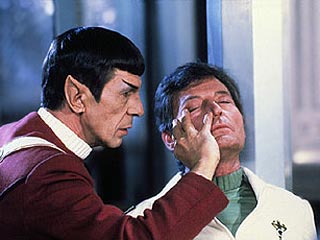
But consider the course of Spock's death and resurrection. Near the end of Star Trek II, Spock, realizing that he's probably going to die in the act of saving the ship, initiates a mind-meld with his old friend, Dr. Leonard "Bones" McCoy.

"Remember," Spock intones gravely, and enters the reactor room, ready to make the ultimate sacrifice.

We learn in Star Trek III that the mind meld transferred Spock's katra - his soul, or consciousness - into McCoy's brain, so that Spock's essence could be transferred to its rightful home on the planet Vulcan. But as we know from the third film, Spock's corpse was regenerated by the Genesis Wave, and the high priestess of Vulcan was able to reunite Spock's mind and body, and faster than you can say "ye canna change the laws of physics!", the status quo is restored.

For years Star Trek fans have accepted Spock's miraculous return as a given. But a few nights ago I sat straight up in bed and realized that it's quite possible that Spock never really returned at all. Since 1984, the Spock we've seen presented in subsequent films and television shows may have been, in fact, an imposter!

Consider the climax of Star Trek II. Here's the sequence of events:

1) The warp engines have been knocked offline and need to be fixed before the Genesis Device explodes, destroying the Enterprise.

2) Spock realizes that only he has a chance of fixing the warp drive, but that he'll have to sacrifice his life in the process.

3) Realizing this, and wanting something of his essence to live on, he mind-melds with McCoy in the engine room - transferring his consciousness to McCoy.

4) Spock then enters the reactor room, and while bathed in radiation, manages to repair the warp drive.

5) Dying, he has a final, lucid conversation with Admiral Kirk. "The needs of the many outweigh the needs of the few...or the one."

What's wrong with this picture?

At step 3), Spock transfers his soul into McCoy. How, then, can he carry out a complicated repair and then have a heartfelt, deathbed conversation with Kirk?

We are left with only three options.

A) Spock transferred a copy of his consciousness into McCoy. This copy is what was resurrected on Vulcan - the original Spock died in the reactor! For a few moments, there were two Spocks, one lodged in McCoy's mind, the other carrying out the reactor repair and deathbed heart-to-heart.

B) Somehow, Spock's consciousness embedded some kind of automatic pilot function into the body it left behind, enabling the soulless husk to carry on as if it were a conscious being for a few minutes. A zombie saved the ship, and Admiral Kirk wept over that zombie's death, never realizing that the real Spock was just a couple of metres away, inside Dr. McCoy.

C) The "real" Spock left behind a copy of himself in his original body to carry out the reactor repair.

Which option is correct? It's impossible to determine for certain, but consider this: when Spock transferred his consciousness, his aim was not to come back to life. As we learned from Spock's father, Sarek, in the next film, Vulcans transfer their katras only so that their wisdom and experience can be stored in a kind of library for the use of other Vulcans. We can infer that a copy of a Vulcan's katra would be sufficient for this purpose.

Knowing Spock's character, it is unlikely that he would create a copy of himself for the sole purpose of sacrificing itself; such an act would be akin to giving birth to a twin with a built-in death sentence.

Therefore, we must conclude that the katra in McCoy's head was but a copy of Spock's essence, and that the real Spock did in fact die for the sake of his shipmates. The Spock we saw in Star Trek III, Star Trek IV, Star Trek V, Star Trek VI and two episodes of Star Trek: The Next Generation was a biological robot of sorts - or, at best, Spock's twin.

Does it matter? Well, as Spock once said, "A difference which makes no difference is no difference." Pre- and post-Genesis Spock retained the same essential character, taking into account the passage of time and gathering of new experience, and the new Spock certainly would have passed a Turing test, or any other test of his sapience.

And yet I can't help but feel like I've been living a lie since that warm summer night in 1982...the night Spock died, and never came back.