The sun blazed over San Francisco, its warmth transforming the Bay into a summer playground. Blooms quivered in the breeze. Sparrows and robins darted to and fro above the vast public courtyard of Starfleet Academy, where hundreds of students, flush with youth and optimism, slowed just a little in their rush from class to class to enjoy the sunshine.
It was a beautiful day for a breakup.
“I’m leaving, Pavel, because I can’t bring myself to carry a phaser,” Irina said. Even after two years at the Academy, she couldn’t completely hide her Novgorod accent. She clutched a data tablet to her chest like a shield.
“Hardly anyone in Starfleet carries a phaser,” Pavel Chekov said, his own accent thickening as his stress rose. “Statistically, less than one in 10,000 Starfleet recruits are ever assigned a phaser, and even then only temporarily, and even then some tiny fraction of that tiny group ever have to draw it, much less use it—“
Irina sighed and waved Chekov’s statistics away. “I’m just not willing to take the chance. I want to study life, not end it.”
Chekov’s temper flared for a second. He wanted to protest. He wanted to tell her that he was going to serve as a navigator or science officer, that he’d spend his life exploring and discovering.
But Irina knew all that. She wasn’t condemning him. She wasn’t even condemning Starfleet. She simply knew herself and her boundaries too well.
She looked at him with sad eyes. He wanted to tell her that they could still have a life together. He began to reach for her hand.
And then Irina Galliulin said the last words he’d hear from her for years to come:
“I’m going to reconnect with Doctor Sevrin,” she said, “I’m going to become One.”
Chekov’s face flushed. Oneness was superstition, not science. Or maybe it was just some kind of alien telepathic connection he didn’t understand. At just 032, Chekov’s esper rating was well below average, so low that some Federation telepaths couldn’t even register his presence, something he’d been gently teased about at the Academy.
So he said nothing, not just because Irina’s face told him how she felt and how much she regretted hurting him, but because he knew the fault lay not in the stars, but in himself. Besides, Doctor Sevrin wasn’t hurting anyone. Oneness was just a different way of looking at life, just Federation pacifism taken to its logical extreme.
He couldn’t stand her pity, and logic told him he had no good arguments to use against the woman he loved.
One day she’ll see it was pointless to worry, he thought. But by then, they’d have moved on.
“I understand, rodnaya,” he said. “I love you. I guess I’ll see you around.”
He left her standing in the summer sun, the breeze tugging at her long brown hair. Heedless, a clutch of nearby students laughed at some shared joke.
TWO YEARS LATER
It was still a bit hard for Chekov to believe he was sitting on the bridge of the USS Enterprise—the same Enterprise once captained by the legendary Robert April, then Christopher Pike, and now James T. Kirk, whose own reputation was already, if not legendary, than at least widely renowned. He felt like the luckiest Academy graduate in history.
“How’s the new kid?” Kirk murmured a couple of meters behind him—just loud enough for Chekov and his friend Sulu, seated next to him at the Helm station, to hear. Loud enough for everyone on the bridge, really. Kirk’s voice carried weight even in the quiet.
“His performance is quite satisfactory,” answered Spock. Chekov was glad his back was to the two senior officers. ‘Quite satisfactory,’ was high praise from the taciturn Vulcan, and Chekov could feel himself blushing with pleasure. He could feel Sulu glancing over at him, doubtless to shoot some kind of gentle, teasing smirk his way, so Chekov kept his gaze face-forward and diligently focused on his controls.
“I don’t believe he’s had any landing party experience yet,” Kirk said.
“Indeed not,” Spock replied.
“Take him down with you when we get to Ivor Prime,” Kirk said. “He’s wearing a gold shirt, but he still looks a shade green to me.”
“Green is a perfectly pleasant shade, Captain.”
“Nonetheless,” Kirk said.
“Nonetheless,” Spock acknowledged.
TWO WEEKS LATER
Chekov arrived in the transporter room at 05:45, a tricorder slung over his shoulder, fifteen minutes before beamdown. Chief Kyle smiled, turned to the wall behind the transporter console, and retrieved a phaser from a hidden compartment, handing it to Chekov.
“There you go. Be careful down there.”
Chekov looked at the phaser dubiously for a moment before securing it on his hip.
“Is this really necessary?” he said, gesturing at the phaser.
Kyle shrugged. “Just precautionary. You never know when an alien life form will mistake you for lunch.”
Spock entered the transporter room at that moment, briskly retrieving a phaser of his own from the wall and climbing up onto the transporter platform. Chekov hurried to join him.
“Energize,” Spock said. Kyle nodded, pushed three levers forward on the transporter console, and Spock and Chekov dissolved into bright, flaring columns of sparkling light.
A moment later, their bodies reformed on Ivor Prime. They found themselves standing in the foothills of a massive mountain range, with a dense jungle some about a kilometer distant. The sky was purple and cloudless, and the wind caused an eerie, alien howl to echo through the valley.
“Mr. Chekov, please collect data in the foothills using the standard sampling protocols,” Spock said, consulting his tricorder. “I will collect samples from the jungle. Tricorder readings indicate no dangerous fauna, but exercise caution regardless. Remember your training, and stay within visual range.”
“Aye, sir,” Chekov said. He walked through long bronze grass into the foothills, sampling as he went, scanning the dozens of different species of lichens, grasses, flowering plants, insects, fungi, xenoglyphs, perimaterna, mathemagics. He found nothing terribly unusual, and more importantly, nothing that would disqualify Ivor Prime as a destination for colonists. Chekov noted, with some bemusement, that the bronze grass had left some kind of metallic-seeming residue on his boots and pants, right up to the knee. He tried to brush it away, succeeding only in getting the residue all over his hands.
But then a shadow passed over him, and Chekov looked up to see something riding the breeze high overhead. It resembled a box kite, much like one he’d flown in Sevastopol many years ago. He reached for his tricorder to scan the apparition, but by the time he got the instrument into position, whatever he’d seen had disappeared into the clouds. Chekov shrugged the distraction aside and turned back to his sampling routine.
“Sampling complete,” the tricorder said some time later; Chekov had collected enough data to meet Spock’s requirements for this sector of the valley. Chekov shut down the tricorder, slung it back over his shoulder, and made his way toward the point where he and Spock had beamed down.
Chekov’s communicator beeped twice.
“Mister Chekov, stand by to beam up,” Lieutenant Uhura said in a voice that carried carefully controlled urgency.
“Acknowledged,” Chekov said. He held still, anticipating the tug of the annular confinement beam that preceded transportation, but seconds passed and nothing happened.
“Ah, Enterprise? I’m still down here . . .”
“Chekov, we’re having trouble locking on to your signal,” Chief Kyle broke in. “Can you move out into the open?”
Chekov was taken aback. “Chief, I’m in the middle of a field . . .”
Before Kyle could say anything more, a new voice came over his comms channel: Captain Kirk himself.
“Mister Chekov, please—” Kirk said, but that was all. The captain’s words were followed by a harsh blast of static and an electronic squeal that made Chekov’s ears ring. He snapped the communicator closed, grimacing.
Irrationally, Chekov looked to the skies for any sign of the ship, but of course at this distance he’d likely see nothing more than a pinprick of light, even assuming that Enterprise was on this side of the planet.
He had to find Commander Spock. The last he’d seen him, Spock was scanning the edge of the jungle, perhaps a couple of kilometres distant. He tried contacting Spock via communicator, but whatever was had happened to shipboard communications was affecting comms on the planet, too.
Chekov holstered his communicator and opened up his tricorder. To his surprise, it worked. He started scanning for Vulcan life forms, and the tricorder picked up Spock immediately, not far away but hidden from view by the jungle foliage.
“Mr. Spock! I’m headed your way,” Chekov called as he jogged toward the trees, following the tricorder’s signal. There was no answer, which worried Chekov a little—Spock would certainly have heard his call.
Chekov reached the edge of the jungle and made his way through the lush foliage, shouldering it aside as the tricorder led him closer to Spock’s position.
“Mr. Spock?”
Still no answer, even though his tricorder indicated he was well within earshot of the Vulcan life signs. Suddenly Chekov wished he had a medical tricorder; what if Spock was somehow incapacitated? Reluctantly, Chekov took his phaser in hand. He really didn’t believe any threats were likely—preliminary scans ruled out aggressive flora or fauna, despite Chief Kyle’s joke—but the communications blackout was unusual enough to warrant extra caution.
The foliage was thinning out; he was approaching a small clearing. Chekov peered into the clearing, keeping himself hidden behind a dense, topiary-like bush with vibrant, needle-like leaves.
Spock lay prone at the far edge of the clearing. He was surrounded by a half-dozen gelatinous masses—quivering jellies that had wrapped thick pseudopods around Spock’s body.
This was no native life form. Chekov could see through their transparent bodies, and within the creatures there were clearly artificial implants of some kind.
Spock screamed in agony.
“Get back!” Chekov ordered. “Release him!”
The creatures didn’t respond; at first he thought they might be too alien for the universal translator to function, but these beings didn’t seem aware of his presence at all. Chekov watched in horror as two of the creatures extended new pseudopods from their bodies and pushed them into Spock’s ears and nostrils. Spock’s entire body seized and his eyes snapped open—but they were blank, unseeing. Spock screamed again.
“Stop what you are doing immediately, or I will stun you,” Chekov said. Again, there was no response, no indication that the creatures even knew he was there. Reluctantly, Chekov ensured his phaser was set on stun, took aim at the nearest alien, and fired. A blue beam of light flashed through the being’s mass, but the thing only quivered slightly in response. The pseudopods continued to pulse, and Spock’s thrashing worsened.
Chekov adjusted his phaser, tuning it to heavy stun. He fired again. No effect.
Chekov realized his heart was pounding and he was covered in a cold sweat. In desperation, he kicked the alien he’d shot, but the being just quivered a little from the impact. While it looked delicate, the being’s clear dermis was pliable and very strong. Neon-bright organs of unknown purpose pulsed within.
His hands were shaking as he switched the phaser to its kill setting. He gripped the weapon in two hands and took a deep breath to steady himself. He fired.
Chekov’s gun spat a glowing, crimson lance of phased particles into the heart of the alien blob. It vanished, atomized in a flash of searing light.
The other creatures stirred, their amoeba-like masses shifting. The mechanical components in their jellied bodies rotated and blinked, but even now the aliens seemed unaware of Chekov’s killing presence.
“Please,” Chekov said, his eyes welling. He fired again. And again. Until they were all gone, reduced to elementary particles, wafting away on the gentle breeze.
Chekov turned away for a moment, unable to witness the carnage, even though the phaser had left no bodies behind. It took an effort of will to look back and check on Spock. The science officer was unconscious, but seemingly at rest. Chekov kneeled next to him, took at pulse, and breathed a little easier.
“Enterprise, if you can hear me, two to beam up. Mr. Spock is injured. Emergency.”
No response. All Chekov could do was make Spock a little more comfortable and keep watch. And worry about the ship’s fate.
Night came, and the jungle, once silent, began to quietly sing with life. Chekov leaned against a tree and hugged his knees to himself, still clutching the phaser.
He wondered what Irina would say about this. He wondered if she could ever understand.
Spock moaned in the night more than once. It felt strange to offer typically human words of comfort to a Vulcan, so instead Chekov began by reporting the incident, following up with updates on their current status on the hour. Even if Spock couldn’t hear him, Chekov thought the commander would probably appreciate his approach.
Just as the morning light crept over the clearing, their communicators chirped. Chekov answered.
“Enterprise, Chekov here. Mr. Spock is incapacitated and needs medical attention. Please beam him up immediately.”
“Understood, Chekov,” said a voice Chekov didn’t recognize. A second later, Spock dissolved into transporter particles.
“Mr. Chekov, we’re still having trouble locking on to you. We’ll send down a shuttle. Stand by; should be about twenty minutes.”
“Thank you, Enterprise,” Chekov said.
As promised, the boxy Copernicus glided into view a short time later, gently touching down in the clearing. The port hatch opened to reveal Lieutenant Uhura, gesturing him inside. “All aboard, Pavel!”
Chekov clambered into the shuttle, taking the co-pilot seat.
“Thanks for the ride,” Chekov said.
“Mister Spock is all right,” Uhura said as the hatch closed behind Chekov. “Doctor McCoy will fill you in; I’m taking you straight to him.”
“I’m all right,” Chekov said.
“Spock’s orders. He seems concerned that you may have suffered some trauma. Are you okay? What happened to your uniform?”
Chekov had forgotten about the bronze pollen or dander covering his boots and pants, but that seemed so trivial now.
“I had to kill six aliens.”
He felt Uhura’s hand on his shoulder.
“I’m so sorry, Pavel. I know you wouldn’t have done that unless it was absolutely necessary.”
Chekov nodded. Uhura’s touch and her words helped a little. But only a little.
He fell asleep before they left the atmosphere.
LATER
Chekov awoke in sickbay. Dr. McCoy was there, checking his vitals.
“How are you feeling, Ensign?”
Chekov rose to a sitting position.
“I’m fine, Doctor. I was just up all night. What happened up here? We couldn’t contact the ship . . .”
“Mmm hmm. Stay right there, Mister Chekov. Mister Spock asked me to inform him when you’re awake. Once he’s filled you in, you and I are going to set up some appointments, all right?”
“Yes sir,” Chekov said, hiding his reluctance with little success. “But there’s really nothing wrong with me . . . it was Spock who was injured.”
“And he’s all sorted out, thanks to you, and next we’re going to sort you out. Just relax for a few minutes, Chekov.”
McCoy retreated to his office. A moment later, Spock arrived.
“Ensign Chekov. At 1100 hours ship’s time yesterday, the Enterprise was approached by an alien vessel of unknown provenance. The Enterprise attempted to beam us aboard as a precautionary measure, but apparently something about the native flora interferes with transporter signals.”
“The bronze pollen on my trousers,” Chekov said.
“Correct. Meanwhile, the aliens attacked, incapacitating nearly 80 percent of with a powerful psionic assault. Doctor McCoy later determined that crew members with high esper ratings were vulnerable to the psionic energy; accordingly, those with low ratings were unaffected. Fortunately, enough crew were left to fend off the attack and destroy the enemy.”
“My esper rating . . . it’s only 032,” Chekov said.
“Indeed. My esper rating, on the other hand, was evidently strong enough to draw an alien landing party in search of me. McCoy believes that they were attempting to . . . feed from my psychic reservoirs when you intervened. Your lack of any latent esper abilities rendered you invulnerable, and indeed undetectable, to the alien life forms. In short, Ensign, you saved my life, and I am grateful. I have entered a commendation into your record.”
“I’m glad I was able to help, sir,” Chekov said, bewildered by conflicting emotions.
“This is the first time you have taken a life.”
“Yes, sir.”
“Ensign Chekov, as a Vulcan, I am ill-suited to offering condolences. However, I hope it will be some comfort that the situation presented you with no choice, and the record reflects that. Furthermore, you preserved Starfleet’s investment in a valuable officer.
“We do not celebrate killing, but as Starfleet officers we are sometimes called upon to defend our ship, our colleagues, and others. Doctor McCoy will help you reconcile your emotional responses to this incident.”
“Yes, sir. Thank you, sir.”
Spock nodded and left.
* * *
That night, as Chekov lay in his bunk, his door chimed.
“Come,” he said.
Captain Kirk appeared in the doorway. Chekov shot out of bed.
“Captain!”
“At ease, Ensign. I’m just checking in.”
“Ah, thank you, sir.”
“Mister Chekov, every once in a while, it’s my unpleasant duty to reach out to officers who have found it necessary to use force to protect themselves or others. I want you to understand that I know what you’re going through.”
“Thank you, sir. I knew that something like this was a possibility, but I never really believed . . . it could happen to me.”
Captain Kirk put a hand on Chekov’s shoulder and looked him directly in the eye.
“Pavel, when you kill a living thing, you take all that they are, all that they were, all that they could have been. Every death like that is a tragedy, even when it’s that of an enemy. It’s why cultures almost universally condemn killing.
“But the universe is a dangerous place, and unfortunately, there will always be those who kill wantonly or without purpose. We don’t know yet why these particular aliens attacked us. Perhaps, from their point of view, their actions were necessary. But we do not recognize a moral imperative to surrender our lives to those who would take it.
“You saved an officer and a friend, Mister Chekov. I’m proud to have you on my crew. You make sure to keep every appointment with Doctor McCoy, all right? He’s a little crusty around the edges, but his counsel is wise.”
“I will, sir. Thank you. It’s just . . .”
Kirk waited.
“My girlfriend at Starfleet Academy. She dropped out because she couldn’t risk the possibility she’d be involved in a situation . . . well, a situation like mine.”
Kirk nodded. “A committed pacifist. An honourable choice.”
“Yes, sir, I agree. The relationship ended, but I still care for her, and I know that she’ll eventually hear about what I did.”
“Pavel, I don’t know this young woman, but if she chose you for a partner, even if it’s over, I imagine she has common sense and empathy. Get in touch with her. If not face to face, send her a subspace transmission. Maybe she can help you heal.”
Chekov nodded. “Thank you, sir. I appreciate you coming to see me.”
Kirk patted him on the shoulder and left.
Chekov took the seat at his desk. He stared at his personal console, thumb poised close to its activation switch. The captain was right—of all people, Irina would understand Chekov’s torment.
But could she forgive what he’d done?
He stared at the blank screen for a long time. And then turned away, turned off the lights, and retreated into darkness.

 In Dungeons and Dragons, players choose from a number of classes drawn from high fantasy tropes: fighter, thief, paladin, sorcerer, ranger, and so on. Each class has its own mechanics and flavour, with some focusing on hand-to-hand combat, others on spellcasting, still others on adventuring utilities such as tracking or finding and disarming traps, and so on.
 The bard has been called D&D's "jack of all trades" class because as a bard, you have access to decent spellcasting and martial abilities. But here's the problem: bard magic comes in the form of performance. During battle, the bard accesses their magic by singing, playing a musical instrument, or some combination of same. Yet, at the same time, bards can also enter combat with weapons such as sword, clubs, crossbows, and so on. While this is plausible in some combinations--for example, singing while using a sword--in most situations I have a hard time imagining what's happening the world if the game while the bard player is banging bongos while somehow at the same time wielding a bow and arrow.
It seems to me that bards would be much more interesting if their magic worked only while they were actively playing an instrument or singing; the moment they stop (or are stopped by enemy action), the spell effect ends.
This would require trust and teamwork among players. For example, let's say that Bardolemew Muse is a level one bard. Bardolemew has two spells: Beast Soother and Strumming Shield. The first spell puts dangerous wild animals into a sleepy, contented state while the second creates a bubble of shield energy around anyone within five feet of the bard. Both spells are activated and maintained by the bard strumming their lute/guitar/banjo/etc.
Here's how a battle might look: Bardolemew and his companions Bash, Tumbler, and Milqueboast are set upon by a group of bandits. All players and the DM roll initiative as normal, and when Bardolemew's turn arrives, he begins playing "The Ballad of Raven Nevermore," activating the Strumming Shield. The glistening, sparkling shield bubble pops into existence around Bardolemew and his friends, raising everyone's armor class to 20, assuming they stay within the bubble. Bardolemew must keep playing to maintain the shield, and his companions must stay close to Bardolemew to enjoy its defensive effects. However, they can happily engage anyone just outside the field with melee weapons, or use spells or ranged weapons on anyone further than 5 feet away. As the battle evolves, Bardolemew may choose to end the song and drop the shield should the situation warrant it; perhaps most of the bandits have been killed and Bardolemew wants to switch to using a sword to slay the last bandit, given minimal risk to the rest of their team.
Of course, for this game mechanic to work properly, you'd have to boost the power and usefulness of bard spells to overcome the handicap of needing to remain focused on playing their instrument. On the other hand, I think the mechanic could also be more inclusive of different types of performers: for example, dancers and actors might maintain their spell effects through their particular talents.
What about singers, though, and other musical talents that leave one or both hands free? I think in this case I'd probably break them out into a separate class, giving them spells less powerful than my proposed new bard class, but more powerful than the existing 5e bards. They'd still need to sing or play their one-handed instrument (harmonica, maybe?), but their hands would be free to use melee or ranged weapons at the same time.
I'm not a game designer, so of course I don't know if my bardic notions are feasible. But I think, if the mechanics could be worked out, it might make the bard class, and Dungeons and Dragons itself, a little more flavourful.


Here's my pitch for the next James Bond movie:
Set Bond 26 in the Daniel Craig continuity--that is, after the events of No Time to Die, James Bond is dead. This will require some fancy footwork from EON productions . . .
First, open with the classic John Barry/Monty Norman theme over the gun barrel opening. Only this time, the unseen assassin whose point of view we share is not slain by Bond stepping into his sights. Instead, the usual blank expanse the assassin initially sees is interrupted not by Bond, but by a British-looking man in cold weather gear, and that blank white expanse is actually a giant ice floe. The assassin shoots, and the man in cold weather gear, who we will later discover is 002, falls, soaking the snow and ice with spreading blood.
Then, transition to the usual pre-credits teaser.
M, Q, Moneypenny, Bill Tanner, Felix Leiter, all played by the same actors as in No Time to Die, attend James Bond's closed-casket funeral. There's a lovely, flower-framed portrait of Daniel Craig as Bond at the graveside. This scene exists specifically so that the marketing team can act as though Craig is back as Bond for one last, surprise appearance. "James Bond Is Back in . . . DIE AND DIE AGAIN."
As the funeral ends and the supporting characters offer their final goodbyes to Bond, M gets a call on his secure line. After a moment, his features transform from sorrowful to grim; he hangs up.
"SPECTRE," he says. He's clearly just received the bad news about 002.
The main credits begin. It is the usual spectacle of half-naked women, stylized violence, and instruments of death set against an evocative, bombastic pop song by Taylor Swift or Lady Gaga or The Weeknd. Tumbling precious metals and glittering gemstones will also be featured, along with, of course, Bond's tombstone:
Fade to end titles. And after the credits roll...


When I was a kid growing up in northern Manitoba in the 70s, I played Mom and Dad's 8-track of Lightfoot's Don Quixote over and over. I wouldn't consider myself a huge fan of folk or country music in general, but Lightfoot transcended genre with music and lyrics of great sensitivity, grace, and power. His songs told stories that rang true and evoked powerful emotion.
Regarding Don Quixote itself, the title track is exquisite, and I love "Alberta Bound," and especially "Brave Mountaineers," but "Looking at the Rain," linked above, is just...transcendently sad and mournful, soulful and gorgeous, and I can't help but sing along and cry every time I hear it. It's the song I hope survives civilization for aliens to find so that someone out there knows that humans were capable of creating something so timeless and magical.


Blogger Paul Lefebvre dug up an old issue of the Atari Computer Enthusiasts newsletter and found an Atari BASIC program by Aaron Ness that if run causes your Atari 400 or 800 to play the theme from Star Wars. Pretty good job, and you can listen on Paul's site here.
If you enjoy Star Trek, production design, or retro science fiction, lose yourself in the Roddenberry Archive's new virtual bridge tours of several starships Enterprise--including iterations never fully realized, including the enigmatic "ringship" version, the Phase II Enterprise, a live-action version of the animated series bridge, the Planet of the Titans version, and more. I've been playing around with this for hours tonight.
Thanks to Sean, here are a few more Atari 8-bit cartridges we owned back in the day:
Dig Dug
Tunnel through the earth and use your pump to blow up monsters! Another excellent arcade port.
Astro Chase
This is one of the few Atari 8-bit games with a cinematic opening of a sort, along with a really decent, if repetitive, soundtrack. You flew around the earth, using your joystick to fire laser beams in four directions. Very fluid and fast moving.
Choplifter
This was one of our favourites. Choplifter was a 2D side scroller; you flew your helicopter behind enemy lines to rescue hostages. By holding the joystick down for a second, you could rotate your chopper to face toward you and shoot missiles straight down, good for blowing up tanks, or, if you were sadistic, shooting the hostages you were supposed to rescue.
Q-Bert
Yet another arcade port, in this one you hopped around "painting" the tiles on a faux-3D pyramid while avoiding a purple snake and other hazards. Famous for "swearing" when Q-Bert dies. A fun, accurate adaptation.
Fight Night
I barely remember this one, and Sean thinks it may have been the last game he purchased for the Atari 8-bit (by that time, the 130XE). Here's a video:
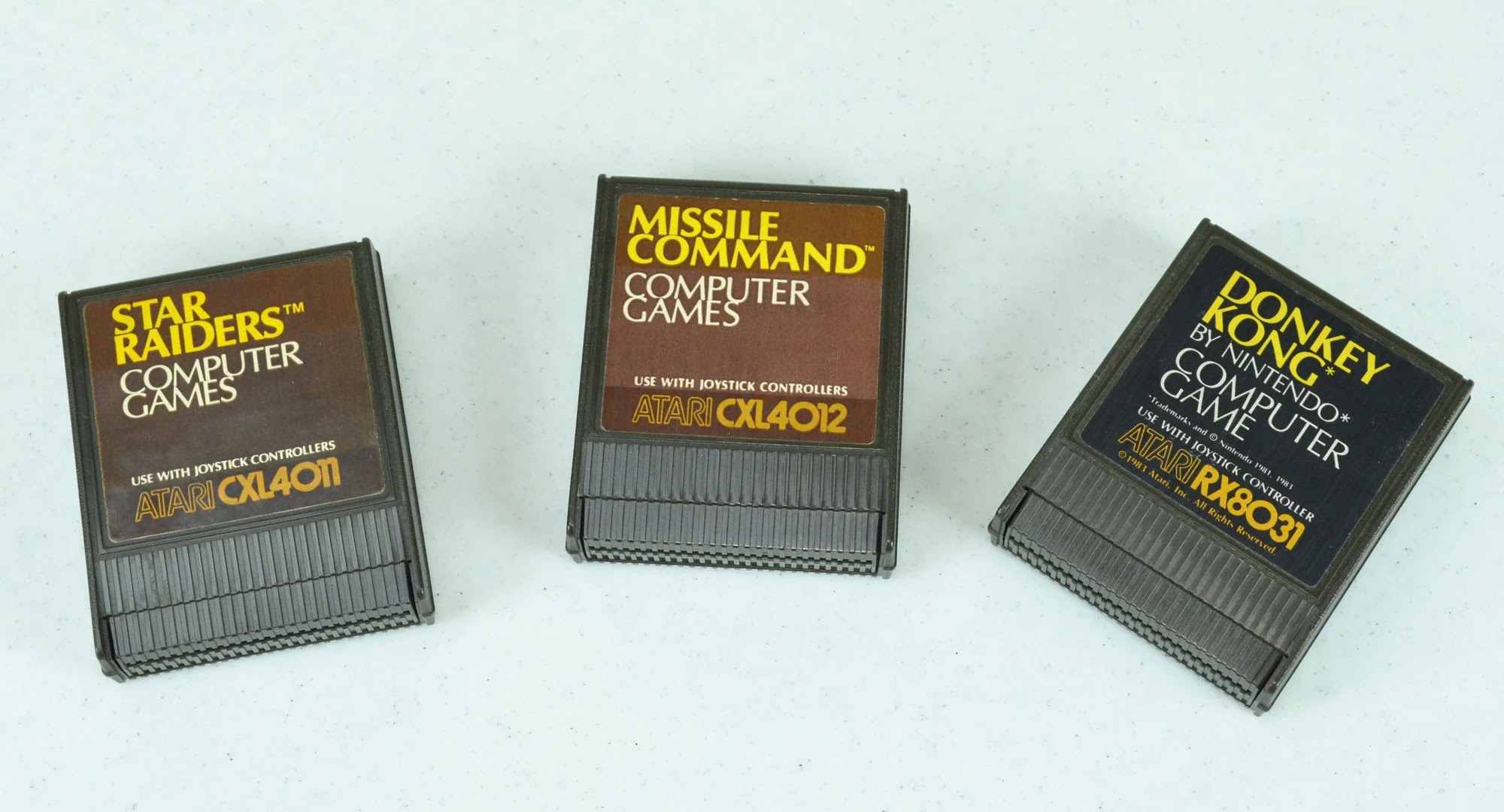
Sean and I were wondering last night, over text, if we still had any of our old Atari 8-bit cartridges. I don't think they're here, and I believe (or hope) that Sean has them. He's not sure either.
That conversation has made me wonder if I can remember all the cartridge we had. Here's a list of what I remember:
Pac-Man
One of the two games Mom and Dad gave us along with the Atari 400 for Christmas back in, I think, 1982 or so. A very faithful adaptation of the massively popular arcade game, plenty of fun.
Galaxian
The second cartridge we received that Christmas, another faithful, colourful adaptation of the space shooter.
Donkey Kong
Sean bought this in Seattle, I think. Another excellent arcade-to-Atari translation. Excellent graphics and sound effects that stand the test of time.
Donkey Kong Jr.
A few years later, one of us picked up (or was gifted) this charming sequel, in which you, as Donkey Kong Jr., climb vines to save Donkey Kong from Mario, a clever reversal of the original game's objective.
Missile Command
A very faithful adaptation of the famous arcade game in which you have three missile silos to shoot down wave after wave of nuclear warheads plummeting toward you. You always lose in the end, just like in real nuclear war.
Claim Jumper
Unlike Atari's plain brown cartridges, Claim Jumper was a semi-translucent red. The game itself was an original, not an arcade adaptation; it was a two-player wild west shoot 'em up. Each player controlled a cowboy and had to avoid tumbleweeds or snakes, and the other cowboy's bullets, while collecting gold and depositing it in the bank. While the gameplay sounds simple, it was utterly chaotic in practice in the best way; the cries of frustration were glorious, whether you were shot just before depositing your gold in the bank or zapped by a tumbleweed or snake at a crucial moment.
Joust
Players control a knight riding a flying ostrich (?) and attempt to well, joust in midair while collecting eggs and avoiding lava, among other hazards. This is another arcade translation, and an excellent one.
Eastern Front (1941)
Another original, this is an abstract, strategic wargame where you control Nazi units invading the Soviet Union during World War II. You control infantry, armour, and air support in the drive to Moscow, but you have to pay attention to supply lines, morale, the dangers of being flanked or encircled, and other complexities of war. The game was tremendously difficult, but on the upside, it's never a bad thing when Nazis lose, which I think they always did . . . at the very least, I don't remember winning the game on anything other than the ridiculously simple Novice level, which pits one German unit against one Soviet unit.
Asteroids
The arcade version of Asteroids used vector graphics, so the raster graphics of the Atari 400 couldn't possibly support a visually authentic adaptation. Still, it was fun flying around in a little white triangle while blasting space rocks in rainbow colours.
Pitfall II: Lost Caverns
"Finding the golden rope is Pitfall Harry's only hope." Sean and I spent hours on this underground exploration game, rescuing Quickclaw and Rhonda more than once, but never quite finding the correct route to the golden rope and escape. We had a lot of fun trying, though.
Miner 2049er
One of the classic original creations for the Atari 8-bit computers, in Miner 2049er players lead Bounty Bob through four levels of treacherous mines, "painting" the floors by walking across them while avoiding radioactive mutants. The level design was great, as were the death animations; you could die by touching a mutant, falling, or using too much dynamite in the cannon level and blowing yourself to kingdom come instead of the top of the screen.
Caverns of Mars
In this vertical scroller, you control a spaceship flying through the titular caverns, avoiding the walls and rockets while shooting fuel tanks to keep you flying. Once you set the reactor at the bottom of each cavern to explode, you have to fly out safely again before the big boom. Simple and highly entertaining.
Basketball
Even though Atari's Basketball supported only a maximum of four players shooting hoops, Sean and I still had great fun running around the 8-bit court, fighting over the ball. I don't remember ever playing with four players, maybe because we rarely had four joysticks working at the same time.
Blue Max
This was a diagonally-scrolling, World War I-themed shooter. Dad was a big fan of the George Peppard-led movie.
Star Raiders
Possibly the best game ever released for the Atari 8-bit line, or at the very least the best game not based on an arcade title. It's a first-person spaceship simulator with a galactic map to navigate, front and rear views and torpedoes, a variety of enemy spaceships to hunt, and space stations for repair and refuel. A wonderful game.
Star Raiders II
A few years later we picked up Atari's sequel to Star Raiders, which I recall as also fun, but not as compelling as the original. In this one, you're bombing targets on a planet.
RealSports Tennis
I don't know how they did it, but Atari found a way to make it really feel like you were in control of the ball, even though you were wielding a joystick instead of a racket. Mom and Dad liked this one, too.
Pole Position
8-bit port of the arcade game, faithful and fun, very colourful. Doesn't quite hold up today, though, unlike a lot of other games on this list.
Rally Speedway
Now this was a racing game! It supported two players racing against each other, with a top-down view of the treacherous curves. If you crashed, sometimes your driver would burst into flames and stop, drop and roll to put himself out.
We had more games than this, and I feel like I must have missed a few. Perhaps more tomorrow?
 |
| Photos from Revive Machines. |

In other words, if you have old Atari peripherals, you could use this as a replacement for your ancient Atari XL; but if not, you can still enjoy the 8-bit magic by using the modern USB and HDMI connections. Anyone who has kept their old 8-bit Atari game cartridges might find this too tempting to resist . . .

No word on the price or release date yet, so this could be vapourware in the end. But boy, what an exciting possibility!