Total Pageviews

Showing posts with label Star Trek II: The Wrath of Khan. Show all posts

Wednesday, June 17, 2020

Review: Visiting Hours (1982)


I went into Jean-Claude Lord's Visiting Hours (1982) with low expectations, but as it turns out this is a pretty effective slasher film set apart from the big slasher names of the 80s--the Friday the 13ths, the Halloweens, and the like. There are two major differences: there's not a hint of the supernatural in this story, and both villain and victims act in (from their different perspectives) reasonable and realistic ways.

Michael Ironside plays Colt Hawker, an unhinged psychopath who hates women, particularly strong women who advocate for themselves. Gradually, through a series of flashbacks spread throughout the film, we discover that Colt's mother attacked and disfigured Colt's father after suffering years of abuse from her husband. Those same flashbacks also imply, in subtle yet truly nauseating fashion, that Colt's father may have been sexually abusing their son. While this disturbing background doesn't excuse Colt's actions, it helps explain his twisted motivations.

Colt's breaking point, it seems, comes when television journalist Deborah Ballin (Lee Grant) advocates for an abused woman who was put on trial for defending herself from her husband. Station manager Gary Baylor (William Shatner) plays a supporting role as Deborah's rather ineffective boss and friend, and he's fascinating to watch, especially in contrast to his heroic turn in Star Trek II: The Wrath of Khan in the same year. Baylor is well-intentioned and advocates, somewhat weakly, for Deborah's right to speak out, but it's the women in this film who provide the strongest thematic and story opposition to Ironside's Colt.

First among them is Ballin, of course, who fights back gamely during Colt's initial attempted murder but winds up in the hospital, badly hurt and forced to endure an extended recovery before she'll be able to return to work - and to her advocacy for women's agency and rights. But interestingly, Ballin fades into the background for about the middle third of the picture, and in her place as protagonist steps nurse Sheila Munroe (Linda Purl). When Colt learns that Deborah Ballin is in hospital, he makes multiple attempts on her life in the hospital, killing other patients along the way, and he's foiled by Sheila, which puts her on his list of targets.

The focus shifts yet again as we follow Colt's grimy life outside murder, when he picks up a young woman named Lisa (Lenore Zann) and violently rapes and physically abuses her during what she thought was going to be a date. But Colt doesn't kill her, and she winds up in hospital under Shelia's care. We learn later on that Lisa took revenge offscreen by rounding up some of her friends to invade and trash Colt's apartment, an incident that occurs offscreen and is revealed only later in the film, but struck me as an interesting display of women's agency. (Perhaps even more fascinating, all three female leads are presented as single, either explicitly or via implication by absence.)

Lisa later becomes instrumental as her raid on Colt's apartment uncovers evidence of his crimes, which she hands off to Sheila. Unfortunately, Colt is one step ahead of everyone and sets a trap for her, gravely wounding the nurse and putting her, ironically, back in her own hospital. At this point, the focus shifts back to Deborah Ballin for the final confrontation. In the best traditions of the "final girl" trope, she of course dispatches Colt and sets the world right again....until the next slasher film comes out.

Many reviews of the era slammed Visiting Hours for its exploitative violence, and that's fair, particularly in Lisa's case; the scene where Colt assaults her is definitely exploitative and deeply discomfiting. On the other hand, most Lisa-like characters in this genre don't get to fight back and survive like Lisa does, which doesn't necessarily redeem the film, but I think speaks to its sincerity when it comes to the movie's central theme, that of female empowerment. I think it's very telling that none of the male characters, including alleged heroic lead Shatner (who's barely in the film, really) nor the scores of determined but hapless police officers, really contribute at all to the film's ultimate resolution. The collective bravery and actions of Deborah, Sheila, and Lisa lead directly to Colt's defeat. In effect, there are three "final girls" (and we really should be calling them "final women" if we're going to use the trope at all).

I wouldn't go so far as to call this a feminist movie (far from it!), but I think given the limits of the genre, it's more progressive than many similar films of that era. And it has other merits, of course--effective cinematography and production design, solid editing, and good performances all around, particularly from the women leads and Michael Ironside. It's no classic, but I think Visiting Hours deserves a better reputation than it has. 

Friday, January 03, 2020

Tarnished Buckle

Today Sylvia and I spent some time going through my closet to set aside clothes I'm finally forced to admit I'll never wear again. Among those items was the movie-era Star Trek costume made for me by one of the member of the Edmonton Star Trek Society. I kept the belt buckle (pictured), and the rank insignia. The uniform itself will, I hope, find a better home. 

Sunday, February 25, 2018

Wrath of Pixels


Here's something neat: animator Anson Call has created a stylized, TRON-like interpretation of the confrontation between the Reliant and Enterprise a la Star Trek II: The Wrath of Khan. Fans of the film will recognize many key moments from the film, lovingly reinterpreted with fluidic choreography. Even the soundtrack evokes James Horner's original score, but recast in a technopop mould. 

Tuesday, May 21, 2013

Medical Ethics in the 23rd Century

WARNING! This post contains SPOILERS for Star Trek Into Darkness
If you haven't seen the film, don't read this post! 

In my review of Star Trek Into Darkness, I alluded to problems with the film's story logic. My friend Steve emailed me to discuss the issue further, and in the course of that discussion I realized the film had two more glaring problems.

Near the end of the film, Kirk dies in the exact same way Spock died in Star Trek II: The Wrath of Khan. In a truly cringe-worthy moment, Spock screams "KHHHAANNNN!" and runs off to have his vengeance, beaming down to chase Khan across San Fransisco. But Doctor McCoy realizes that Khan's genetically engineered blood could be used to revive Kirk. In a bit of hit-you-over-the-head foreshadowing, earlier in the film McCoy injected Khan's blood into a dead tribble. Why? That's never clearly explained. Just as Kirk's cold corpse reaches sickbay, the formerly dead tribble, sensing a dramatic moment, begins to coo, miraculously revived. McCoy calls Spock and says "We need Khan alive! He's Kirk's only chance!"

So instead of killing Khan, Spock and Uhura knock out the bad guy, bring him back to the Enterprise and Kirk is saved.

Earlier in the film, Spock serves as Kirk's conscience, reminding the captain that it is immoral to assassinate suspects, that they must be brought to justice to stand trial. Spock's morals suddenly fly out the window when his best friend is killed, and only when he learns that Khan's blood is useful does he quell his thirst for blood...well, sort of, because he brings Khan back to the ship for a transfusion.

We don't see the medical procedure that saves Kirk. But given that Khan was unconscious when he was beamed to the Enterprise, we're left wondering if McCoy just took the blood right then and there and performed the transfusion without asking. Time was of the essence, after all, and having just tried to kill everyone on the Enterprise it seems unlikely Khan was in a giving mood. This may be why the filmmakers glossed over the actual procedure.

But consider this. Minutes ago, Spock had saved all of Khan's followers. Khan admitted earlier that Kirk seems to have a conscience, so the stage had already been set for what might have been a pretty cool scene: McCoy refuses to perform the procedure without Khan's permission. Spock orders McCoy to wake up Khan. McCoy asks for permission, Khan refuses, Spock notes that he saved all of Khan's friends and further notes that Khan must have had at least some respect for Starfleet and the Federation at some point, having worked for them for months. Khan begrudgingly agrees, saving Kirk. He's still a mass murderer, but at least this way his character gets a tiny bit more nuance and the audience isn't left wondering if their heroes only have ethics and morals when it's convenient.

Would this have messed up the film's pacing? Maybe, but the last third was such a mess that I hardly think yet another scene would have made it significantly worse. At the very least the tradeoff helps cement the point that the filmmakers tried and failed to make with this film - that good people are supposed to do the right thing even when it's hard.


Wednesday, September 20, 2006

Spock Must (Have) Die(d)!


I was thirteen years old when Mr. Spock died, heroically saving the ship in Star Trek II: The Wrath of Khan. It was a powerful experience; for the first time, a character I'd known my entire life had been killed. Suddenly anything was possible.

Until the next movie, of course. Turns out Spock was only mostly dead, and by end of Star Trek III: The Search for Spock, all was right in the world once more. (Well, except for the Enterprise getting blown to smithereens, but that's another kettle of tribbles.)

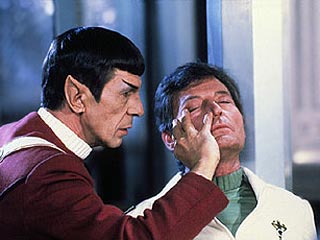
But consider the course of Spock's death and resurrection. Near the end of Star Trek II, Spock, realizing that he's probably going to die in the act of saving the ship, initiates a mind-meld with his old friend, Dr. Leonard "Bones" McCoy.

"Remember," Spock intones gravely, and enters the reactor room, ready to make the ultimate sacrifice.

We learn in Star Trek III that the mind meld transferred Spock's katra - his soul, or consciousness - into McCoy's brain, so that Spock's essence could be transferred to its rightful home on the planet Vulcan. But as we know from the third film, Spock's corpse was regenerated by the Genesis Wave, and the high priestess of Vulcan was able to reunite Spock's mind and body, and faster than you can say "ye canna change the laws of physics!", the status quo is restored.

For years Star Trek fans have accepted Spock's miraculous return as a given. But a few nights ago I sat straight up in bed and realized that it's quite possible that Spock never really returned at all. Since 1984, the Spock we've seen presented in subsequent films and television shows may have been, in fact, an imposter!

Consider the climax of Star Trek II. Here's the sequence of events:

1) The warp engines have been knocked offline and need to be fixed before the Genesis Device explodes, destroying the Enterprise.

2) Spock realizes that only he has a chance of fixing the warp drive, but that he'll have to sacrifice his life in the process.

3) Realizing this, and wanting something of his essence to live on, he mind-melds with McCoy in the engine room - transferring his consciousness to McCoy.

4) Spock then enters the reactor room, and while bathed in radiation, manages to repair the warp drive.

5) Dying, he has a final, lucid conversation with Admiral Kirk. "The needs of the many outweigh the needs of the few...or the one."

What's wrong with this picture?

At step 3), Spock transfers his soul into McCoy. How, then, can he carry out a complicated repair and then have a heartfelt, deathbed conversation with Kirk?

We are left with only three options.

A) Spock transferred a copy of his consciousness into McCoy. This copy is what was resurrected on Vulcan - the original Spock died in the reactor! For a few moments, there were two Spocks, one lodged in McCoy's mind, the other carrying out the reactor repair and deathbed heart-to-heart.

B) Somehow, Spock's consciousness embedded some kind of automatic pilot function into the body it left behind, enabling the soulless husk to carry on as if it were a conscious being for a few minutes. A zombie saved the ship, and Admiral Kirk wept over that zombie's death, never realizing that the real Spock was just a couple of metres away, inside Dr. McCoy.

C) The "real" Spock left behind a copy of himself in his original body to carry out the reactor repair.

Which option is correct? It's impossible to determine for certain, but consider this: when Spock transferred his consciousness, his aim was not to come back to life. As we learned from Spock's father, Sarek, in the next film, Vulcans transfer their katras only so that their wisdom and experience can be stored in a kind of library for the use of other Vulcans. We can infer that a copy of a Vulcan's katra would be sufficient for this purpose.

Knowing Spock's character, it is unlikely that he would create a copy of himself for the sole purpose of sacrificing itself; such an act would be akin to giving birth to a twin with a built-in death sentence.

Therefore, we must conclude that the katra in McCoy's head was but a copy of Spock's essence, and that the real Spock did in fact die for the sake of his shipmates. The Spock we saw in Star Trek III, Star Trek IV, Star Trek V, Star Trek VI and two episodes of Star Trek: The Next Generation was a biological robot of sorts - or, at best, Spock's twin.

Does it matter? Well, as Spock once said, "A difference which makes no difference is no difference." Pre- and post-Genesis Spock retained the same essential character, taking into account the passage of time and gathering of new experience, and the new Spock certainly would have passed a Turing test, or any other test of his sapience.

And yet I can't help but feel like I've been living a lie since that warm summer night in 1982...the night Spock died, and never came back.