Are pets called "pets" because you "pet" them? I'm afraid to research this question.
Total Pageviews
Showing posts with label nature. Show all posts
Tuesday, January 12, 2021
Thursday, September 19, 2019
Redwood in Shadow
Labels:
1990s,
California,
nature,
Photography,
San Francisco,
Travel
Friday, October 20, 2017
Wood Glue
The best way to stick two broken pieces of wood together -
Wood glue
But
It won't bring a tree back to life
Wood glue
But
It won't bring a tree back to life
Wednesday, November 11, 2015
Muir Woods Tree
During the closing days of World War II, the United Nations charter was signed in San Francisco. President Roosevelt didn't live long enough to see the charter signed, so the delegates travelled north, to Muir Woods, for a ceremony honouring the man. Muir Woods is one of the most beautiful places I've ever been; it makes me wish I were a better photographer. I think I've improved since 1998, though, and I think I could do a better job today.
Labels:
California,
nature,
Photography,
San Francisco,
Travel
Wednesday, July 15, 2015
A Predator's Eyes
While my crocodile video provided a decent jump scare, I find this image of a quietly watchful predator far more unsettling. The huge green eyes are beautiful but somehow alien (despite being perfectly terrestrial). It's a little creepy getting so close to such a primordial creature.
Sunday, July 12, 2015
Everybody's Got Something to Hide Except for Me and My Monkey
While on the Rio Tempisque in Costa Rica's Palo Verde National Park, we encountered some white-faced monkeys. They're very curious, and one of them hopped down to give me a high five. This shot was taken by another tourist; she turned out to be the voice actress for Zatanna in DC Universe Online, among other roles.
Saturday, July 11, 2015
A Croc in Costa Rica
While touring the Rio Tempisque in Costa Rica's Palo Verde National Park last week, our boat happened upon a small crocodile.
Friday, March 21, 2014
An Alberta Legend Passes On
CBC reports that Al Oeming, he of the Alberta Game Farm, died earlier this week. Zoos get a bad rap these days and I'm not well-informed enough to debate their merits, but as I wrote in one of this blog's most popular posts, the Alberta Game Farm left quite an impression on me. It was quite a thrill when just a couple of weeks ago Al's son Todd commented on that post, outlining some of his plans for the site; you can see what the younger Oeming is up to at www.wildsplendor.com. I'm sure Todd will build a legacy his father would be proud of.
Labels:
Al Oeming,
Alberta,
Environment,
nature,
wildlife
Thursday, May 30, 2013
Splash of Colour
It may be a cheap gimmick, but I've always liked film and photos that draw attention to a subject by desaturating everything around it. Mom or Dad took this photo of a flower near Pisew Falls, Manitoba, sometime in the last decade or so. Even in the full-colour version, this little gem stands out. So rather than leave nature be, I decided to test my Photoshop skills.
Turning a colour photo black and white with image manipulation software is easy; it's just a matter of choosing the "desaturate" command. But leaving part of the image in colour requires you to select, pixel by pixel, the image you wish to highlight. Five years ago this process would probably have taken me hours, but I've honed my selection skills enough to bring the job down to a more manageable twenty minutes. The job is especially tedious when the foreground and background colours match closely, as they often did in this image.
I also cropped Mom or Dad's original shot in an attempt to follow the rule of thirds.The final result isn't especially groundbreaking, but I'm pleased with it anyway.
All of this playing about with graphic design and photo manipulation does make me wonder why I've been developing these skills, though. I'm not pursuing a career in layout or photography, after all.
It brings me pleasure and helps me see the world in a new way. Perhaps that's enough.
Turning a colour photo black and white with image manipulation software is easy; it's just a matter of choosing the "desaturate" command. But leaving part of the image in colour requires you to select, pixel by pixel, the image you wish to highlight. Five years ago this process would probably have taken me hours, but I've honed my selection skills enough to bring the job down to a more manageable twenty minutes. The job is especially tedious when the foreground and background colours match closely, as they often did in this image.
I also cropped Mom or Dad's original shot in an attempt to follow the rule of thirds.The final result isn't especially groundbreaking, but I'm pleased with it anyway.
All of this playing about with graphic design and photo manipulation does make me wonder why I've been developing these skills, though. I'm not pursuing a career in layout or photography, after all.
It brings me pleasure and helps me see the world in a new way. Perhaps that's enough.
Labels:
Flowers,
Manitoba,
Mom and Dad,
nature,
Photography,
Photoshop,
Pisew Falls,
Plants
Wednesday, March 23, 2011
The Deadly Sunflowers
![]() |
| Sunflowers at the Etsell farm, 1974 |
Fortunately, once I grew brave enough to admit that the flowers scared me, my parents (or perhaps it was my grandparents) allowed me to harvest one of the ripe heads. I could barely lift the flowerhead; it had the same diameter as a large serving tray, and was several centimetres thick. I sat down on the grass and spent the afternoon plucking out seeds, shelling them, and snacking on them as I enjoyed the sunshine and watched the tall grass sway gently in the soft summer wind.
That was a good day.
Tuesday, March 22, 2011
Waterton Lakes, 2002
I've been fascinated by maps since childhood. One day, I came across a map showing Waterton-Glacier International Peace Park, straddling the border of Alberta and Montana. The name alone inspired me; it seemed somewhat grand and majestic, a place of importance hidden away in a forgotten corner of North America - or at least so it seemed at the time.
I didn't get the opportunity to visit until 2002, and then only the Canadian half, Waterton Lakes National Park. I'm not a great photographer, but as I hiked through the park I did snap a few shots that serve as a poor window into the area's beauty.
Waterton-Glacier is a UNESCO World Heritage Site, and it's easy to see why once you visit. I hope to return again one day soon - and next time, I'll hop over the border to visit Glacier.
I didn't get the opportunity to visit until 2002, and then only the Canadian half, Waterton Lakes National Park. I'm not a great photographer, but as I hiked through the park I did snap a few shots that serve as a poor window into the area's beauty.
Waterton-Glacier is a UNESCO World Heritage Site, and it's easy to see why once you visit. I hope to return again one day soon - and next time, I'll hop over the border to visit Glacier.
Monday, February 28, 2011
The Etsell Trees in Winter
I grumbled a little about the persistent cold today. Then I remembered how much worse it was in Manitoba during the 1970s. This image from the winter of 1972 shows the trees in the Etsell farm backyard shivering - or seeming to, at least. That's just outside Virden; northern Manitoba was typically even chillier.
I'm not sure if my parents or one of my aunts or uncles shot this photo, but I love how succinctly it captures the still silence of a Manitoba winter, especially in small-town or rural areas. It was beautiful, but harsh.
Friday, January 14, 2011
Mad Science in the Dark Heart of Africa
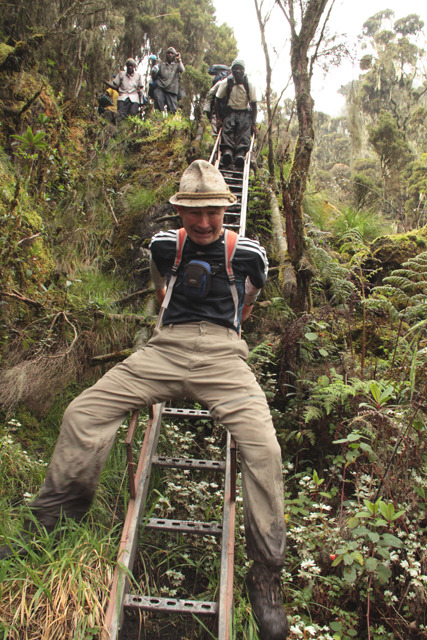
A friend of one of my cousins has started a blog named las aventuras de don ernesto. Aside from some excellent photographs of the nature and wildlife of Africa, the blog features my cousin Kevin Langergraber, a primate molecular ecologist attached to the Max Planck Institute. If you scroll through the photos, you'll see my Uncle John, Kevin's father, grinding a rail; here's a photo of Kevin himself doing the same thing.
Labels:
Africa,
Kevin Langergraber,
Max Planck Institute,
nature,
science,
Uganda,
wildlife
Subscribe to:
Posts (Atom)