Total Pageviews

Thursday, October 20, 2005

Superb Beings

UPDATED WITH BONUS PHOTO!
Earl J. Woods in one of his early secret identities: The Oscillator!

Back when I was in high school, I played Villains and Vigilantes with my friends Brent Cantelon, Dave Ticheler, Mike Parlow, and our Gamemaster, Stephen Fitzpatrick - who, incidentally, created the portrait above. Villains and Vigilantes was a tabletop roleplaying game with an unusual conceit: instead of creating characters from whole cloth, you played yourselves, only with super powers. You were supposed to estimate, as fairly as possible, your own strength, intelligence, charisma and so on, using that as the basis for your in-game avatar. Then you chose super-powers and augmented those natural characteristics with whichever abilities you thought would be most interesting.

Being young and naive, I chose the vaguely obscene Vibratory power set. Yes, as the Oscillator, I could vibrate any part of my body at super-speed. Sadly, it never crossed my mind to use this ability on scantily-clad supervillainesses, geek that I was.

In any event, fought crime by vibrating fast enough to phase through solid objects, by shooting out "vibratory waves" from my hands to stun my foes (ha ha), and I had the additional advantages of heightened strength, invulnerability, and super-speed.

One day, perhaps Steve will be good enough to tell the story of when we faced off against a nuclear bomb - he's an excellent talespinner, and it's the kind of story that needs a more objective perspective.

I will mention, though, that the Oscillator later appeared in a campaign with another group of high school friends: Paul Ravensdale, Jeff Pitts, Ray Brown, and Vern Ryan. I don't remember who the gamemaster was - I seem to think it was Jeff - but I do recall that, sick of our antics, he came up with a great way to teach us a lesson in humilty: he sent Godzilla after us, and gave him appropriately godlike stats. Invulnerable, strong enough to knock down buildings, radioactive breath - there was no way we were coming out of this encounter alive. And indeed, Godzilla did manage to knock Vern's character, Good Guy, out of the sky to his doom - he landed on a fire hydrant, as I recall.

Appalled, I told the GM my plan.

"I grab a pickup truck by the roof."

"Okay."

"I fly towards Godzilla at super-speed."

"Okay." Clearly, Jeff was thinking that I was going to use my favourite attack, a "cannonball," which consisted of hurling my nigh-invulnerable body at a villain at high speed. Usually, this was sufficient to give any foe pause, but against Godzilla, it would be a futile strategy, even with the added mass of the pickup truck I was carrying.

But that wasn't my plan.

"Okay, I phase." (Turned myself, and the truck I was carrying, immaterial.)

"Uh...okay. You fly INTO Godzilla."

"All right...as I fly through the heart, I let go of the truck."

"WHAT! WAIT!"

Naturally, letting go of the truck removed it from the sphere of influence of my phasing power - in other words, it stopped vibrating and became solid. Right inside Godzilla's heart. And, since two objects can't occupy the same space at the same time, Godzilla wound up with the world's biggest heart attack.

Worked like a charm, and I don't think Jeff's forgiven me for it, even twenty years later.

Vern Ryan, Jeff Pitts, Paul Ravensdale: Unamused

Friday, October 14, 2005

More Geek Points

Well, PlayNC has lifed their non-disclosure agreement, so I can now reveal that for the last several weeks I've been a beta tester for their Massively Multiplayer Online Roleplaying Game (MMORPG), City of Villains. City of Villains is the spinoff/sequel to City of Heroes, in which you can create superheroic alter-egos and do battle against the forces of evil. City of Villains, as the name implies, allows players to do just the opposite.

As a beta tester, my job is to play a prototype (the "beta version") of the game, and by doing so discover bugs, comment upon gameplay issues, and offer constructive criticism of all aspects of the game. I haven't had the time to do as much testing as I'd like lately, but this weekend is the first free one I've had in ages, so I'll be up to a lot of virtual calumny over the next couple of days. I haven't had the chance to rob a bank or harass innocent people yet, and I'm just itching for the chance. Muah hah hah hah!

Tuesday, October 11, 2005

The Walls Have Ears, the Doors Have Eyes

Anyone who's ever watched Star Trek has probably noticed one of the show's most influential, yet unheralded features: doors that open automatically on approach.

On the surface, this technological miracle would appear to be nothing more than a simple combination of portal and motion sensor, something we encounter every day in shopping malls and office towers. But the doors of Star Trek are much, much more; they are, in fact, sophisticated Artificial Intelligences that know when it's appropriate to open, and when they should stay firmly shut. They are, to coin a phrase, Context-Sensitive Doors.

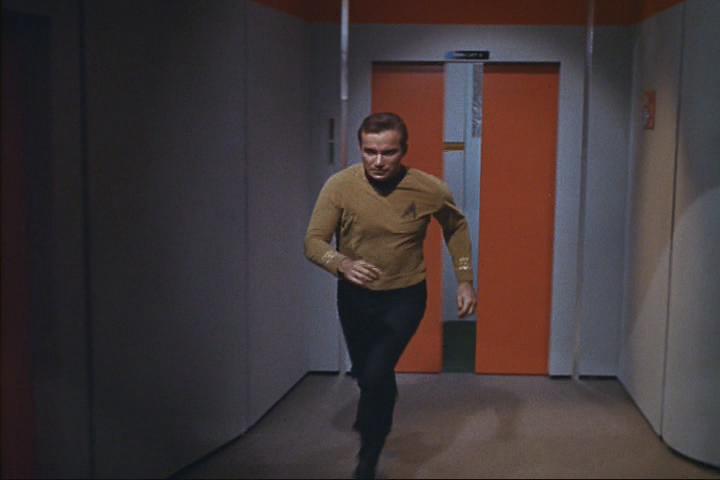
A pair of CSDs in action.

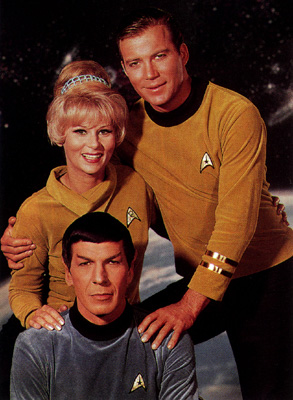
Here, Captain Kirk charges from a turbolift equipped with CSDs. Kirk's rate of speed is commensurate with the crisis he's managing, but the smart doors have no trouble opening and closing in perfect time with his passage.

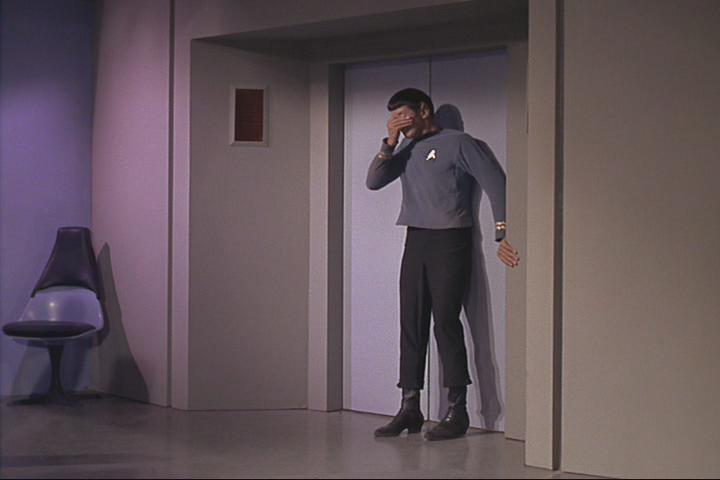
Context-sensitive doors offer a silent welcome to a distraught officer.

Meanwhile, Mister Spock must deal with an emotional crisis. Here, he emerges from a door, which quietly opens with the soft, comforting "swish" that is so identified with CSDs.

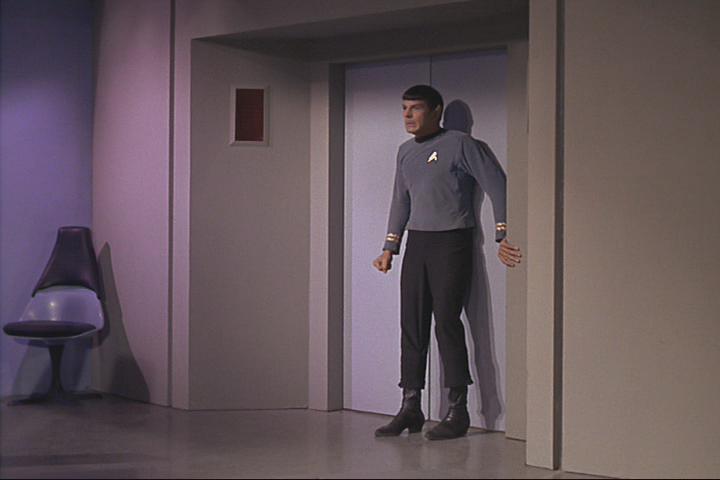
Mister Spock regains his composure - thanks in no small part to the bulwark provided by the CSDs.

Were these doors controlled via simple motion sensor, Spock's next action, pictured above, would be impossible: as soon as the first officer leaned back, the doors would open, and the stoic Vulcan would take a most undigified fall.

Even Vulcans get the blues, but a good set of doors at your back will bring the good times back.

But context-sensitive doors understand that sometimes, even Vulcans need emotional - and physical - support. Using state-of-the-art 23rd century sensors, the clever doors remain shut until Mr. Spock can regain control of his emotions.

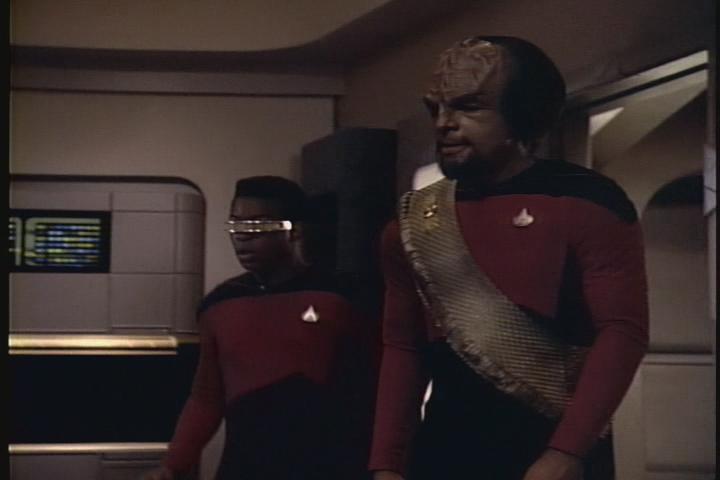
CSDs (at right) are on the job on the Enterprise-D.

Context-sensitive doors remain in active service in the 24th century. Here, we see Geordi La Forge and Mister Worf respond to a distress call. The CSDs snap open with alacrity in response to the urgency of the situation.

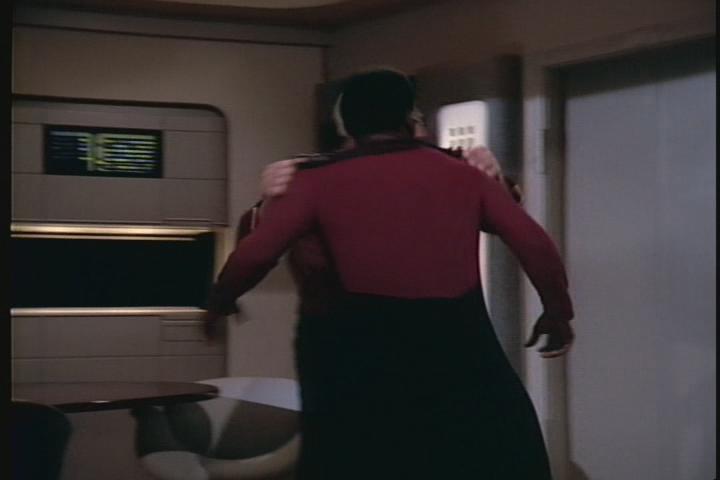
As we see in the following sequence of photos, CSDs are often called upon to make snap judgements. When an intruder infiltrates the ship and starts throwing your crew around, should you remain open or closed? Here's one door's bold decision:

The CSD prepares to make a command decision.

The intruder, inhabiting the body of a Starfleet Admiral, prepares to throw Geordi through the doors. The doors have only a split-second to assess the situation.

The CSD stands firm.

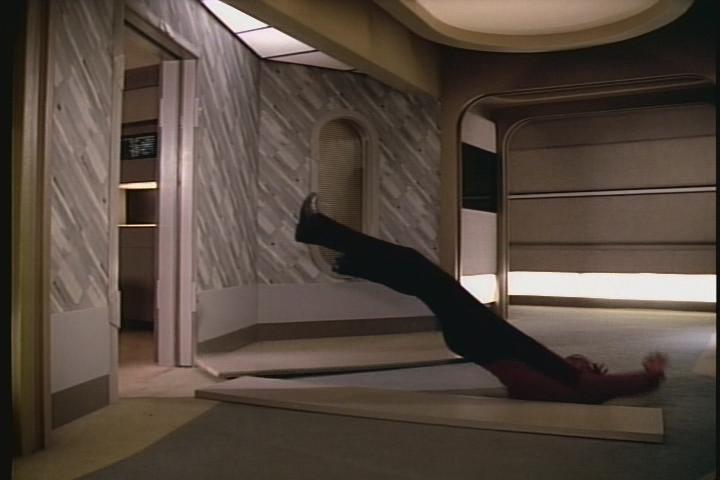
The CSD makes its choice: remain closed. The doors can absorb some of the impact of Geordi's flight, reducing the chance that the officer will be injured. But it's a choice with serious implications for the CSD, as seen in the following sequence:

In this view from the corridor, we see the CSD bulging slightly from Geordi's impact.

An instant later, the impact drives the doors from their hinges - a noble but necessary sacrifice to spare a valuable officer from serious injury.

One of the doors thrusts itself beneath Geordi's rump, saving his ass - literally!

"Thank goodness for Context Sensitive Doors!" is the thought no doubt running through Lieutenant La Forge's mind.

Just another day of service for Starfleet's unrecognized heroes: the Context-Sensitive Doors.

The stated goal of the Enterprise's mission is to seek out new worlds and new civilizations, to boldly go where none have gone before. In short, they seek out the unknown. Well, as a 20th century explorer might have said, had he lived to see the wondrous days to come, "There are things known and things unknown, and in between are the context-sensitive doors."

Monday, October 10, 2005

The Ketchup Katastrophe

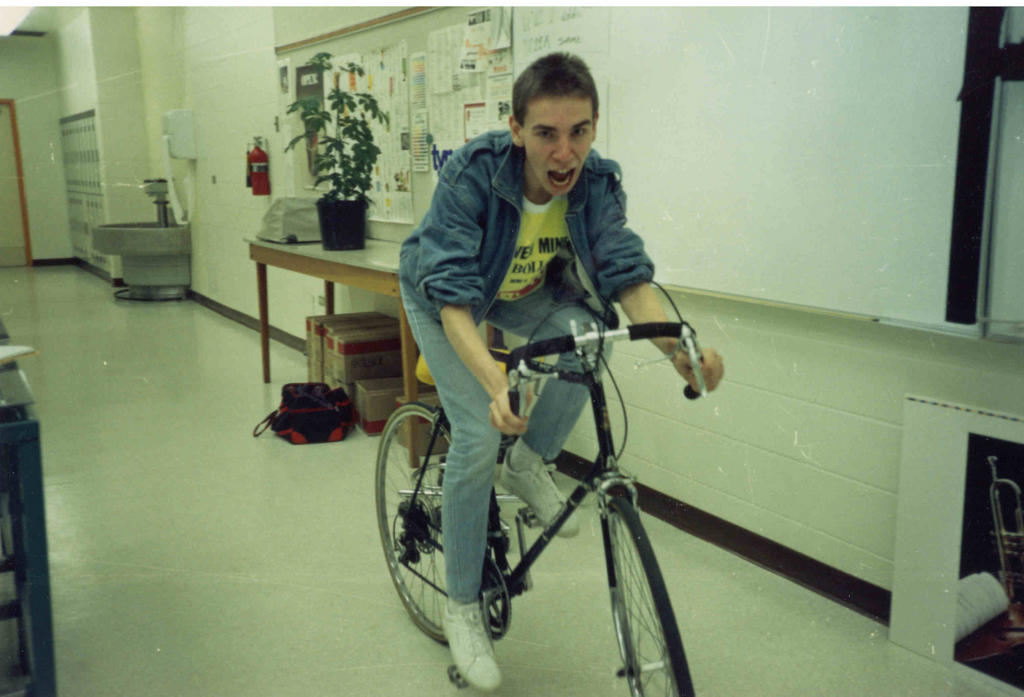
Jonathan Wright rides his bicycle through the Vis Comm lab.


Like a Polariod exposure in reverse, the best stories of our lives too often fade with the passage of time. So to keep some of my stories from fading out forever, I've decided to post them here. I like to call this story...

The Ketchup Katastrophe

Angelo's Pizza was one of the most popular hangouts of the 80s and 90s for University of Alberta students; it was right across the street from Lister Hall, offering not only excellent pizza, but unparalleled convenience. I certainly spent a great deal of time there, and even after I graduated I returned to Angelo's for the pizza and the memories.

On one such occasion, perhaps three or four years after my graduation, I popped in and saw an old friend from high school, one Jonathan Wright. Jonathan was lanky, typically sported a buzz cut, and spoke with a slightly watered-down British accent. We were in the high school newspaper club together; I was the editor, he was my production and graphic design guy.

Jonathan's table was right next to the "Please Wait to be Seated" aisle, so we started chatting while I waited for a server. Jonathan was having trouble with the ketchup, and started shaking it violently up and down as we spoke; I imagine he was trying to loosen up the contents so that they'd be easier to pour.

Unfortunately, Jonathan hadn't secured the lid tightly enough, and it popped off just as Jonathan was pumping the bottle skyward. A torrent of ketchup gushed straight into Jonathan's wide-open eyeball, and he started screaming in pain, flailing wildly.

I stood agog as Jonatahn leapt to his feet. "MY EYE!" he wailed, jumping up and down on the spot as other diners leapt for cover - to no avail. Thick streamers of ketchup flew through the air in all directions.

As if I were in a car crash, everything was moving in slow motion; Jonathan's arms, the ropes of crimson condiment briefly defying gravity. Ketchup gracefully arced across a woman's back, drawing a false wound across her white sweater. Ketchup plopped into the centre of her companion's salad. Ketchup leapt for the stars, only to have its ascent thwarted by the ceiling.

Jonathan ran to the bathroom, screaming; I can't remember if he flung the bottle down or took it with him. Seconds later, the server appeared, eyes wide, screaming "What is GOING ON?"

Strangely, I was untouched by the carnage, despite standing right beside the epicentre of the eruption. Jonathan came back, his eyeball bloodshot through and through, his face red from panic and embarassment.

I suppressed my laughter for long enough to make sure Jonathan was okay; I honestly don't remember much after that. Did I stay for dinner? Did Jonathan make amends with the other diners?

I have no idea. Should have written it down years ago. But I'll never forget how high that ketchup soared.

Tuesday, October 04, 2005

Evil Eddie and His Surly Cowpokes

Another blast from the past today as I re-present the first adventure of Evil Eddie and his Surly Cowpokes. As with yesterday's Time Trek posting, many Blahg readers may already be familiar with this material. But I'm posting it here anyway, because, well, I think it's a fun little story, and maybe having it up in public will inspire me to write the next chapter.

Evil Eddie and His Surly Cowpokes
in
"The Adventure of the Hidden Fortress"


Evil Eddie and his Surly Cowpokes were outlaws and gunslingers. In fact, they were among the most-feared villains in the Old West, and many sheriffs and deputies and bounty hunters were eager to bring them to justice, dead or alive.

Evil Eddie was a stocky, barrel-chested fellow with a quick temper and a quicker draw. His eyes were dark with all the frustrated rage of the unloved, and his five o'clock shadow was darker than the dark side of the Moon. He wore his black cowboy hat tilted low in the front, and his twin six-guns low on his hips.

He named his Cowpokes Big Brainless Bill, Slow-Witted Stu, and Plumb Dumb Slim. The Cowpokes really didn't like their names, but the truth was they all had terrible learning disabilities, and so the names stuck, even though they weren't truly dumb. To make matters worse, Big Brainless Bill was only five feet tall, and Plumb Dumb Slim was actually not slim at all, though neither was he fat. His real name was Horace, but no one called him that, not even his mother. And Slow-Witted Stu really wasn't that stupid, he just had some trouble with his times tables. Now you'd think that Bill, Stu, and Slim would resent their nicknames, but they knew that deep down Evil Eddie (who wasn't really evil) only called them those nasty names to hide his affection for them, and so they accepted the situation.

Now, it's true that Evil Eddie and his Surly Cowpokes were outlaws, and they surely sent a lot of men to their graves, but just as there are two sides to every coin, there are two sides to every story. And the truth is, Evil Eddie and his Surly Cowpokes were called outlaws because they robbed from the rich robber barons and railroad tyrants and distributed those ill-gotten gains back to the disenfranchised poor, even the Redskins and Chinamen and the Coloured folk. Evil Eddie did this because he was a proto-Marxist, though Evil Eddie didn't know it.

"The way I see it," Evil Eddie once told his Surly Cowpokes, back when they were just exploited ranch hands and not dangerous outlaws, "Is the rich is gettin' richer and the poor is gettin' poorer. And that ain't right, no sir. Seems to me it'd be right fair if each man (or even filly) worked accordin' ta his or her abilities, and received goods 'n services accordin' ta his or her needs."

Big Brainless Bill, Slow-Witted Stu, and Plumb Dumb Slim all thought this sounded fair enough, and so they formed a ragtag band, emulating the famous Robin Hood of Sherwood Forest, though none of them had ever heard the story of that Merry Man.

One day, Evil Eddie and his men robbed the First Capitalist Bank down in Tucson, and after the getaway, as was their tradition, they divided the gold in equal shares amongst the downtrodden of the Arizona Territory. And as always, the people were very grateful, and they loved Evil Eddie even though he responded to their joyous thanks only with surly silence or perhaps, if he was in a good mood, a grunt. Bill, Stu, and Slim, who were more friendly than Eddie, grinned like fools to receive the kisses of the young women and the handshakes of the struggling farmers. All in all, Evil Eddie and his Surly Cowpokes had created quite a reputation for themselves in the Arizona Territory.

After they handed out the gold, Evil Eddie and his band rode out into the desert to camp. But hot on their heels came the fiercest lackey of the bourgeoisie, Marshall Tyrone T. Boots. Marshall Boots was a very tall man, near to seven feet, and he had big muscles all over. But his eyes were squinty and his long, lean face was scarred with acne and knife wounds. His mustache was crooked and his teeth were yellow and his long blonde hair was thin and dirty. Marshall Boots was, sad to say, plain ugly. And while an ugly face can often hide a kindly soul, the face of Marshall Boots revealed the terrible truth of his character to all the world.

For Marshall Boots was a very angry, hateful man, and he wasn't shy about sharing his fierce temper with anyone, not even his own posse. Marshall Boots hated children, dogs, butterflies, flowers, and even ice cream. Marshall Boots shot harmless garter snakes for fun and let the rattlers live, and he popped the balloons of little boys and girls just so he could hear them cry. Whenever he rode into town, Marshall Boots would shoot his six-gun five times (not really caring where he was pointing it) and say, "I'm Marshall Tyrone T. Boots, and you all had better do as I say or I'll shoot your ears off and burn down your house and step on your toes and pee in your well, because I am the LAW in this town and this territory." And that's just what he did and said in Tucson, on the very day that Evil Eddie and his men robbed the bank.

Well, needless to say, no one messed much with Marshall Tyrone T. Boots or his men, who were hand-picked by Marshall Boots to be almost as mean and cruel as he was. So on the day he rode into Tucson, well, the people were so scared that not one citizen volunteered to ride into the desert to warn Evil Eddie and the Surly Cowpokes of the danger. They were ashamed of themselves for their cowardice, but wouldn't you be scared too if Marshall Tyrone T. Boots came to your town?

As luck would have it, though, way down at the far end of Main Street, a stagecoach rolled into town. And out stepped Miss Carolina Vanderbilt, a feisty young woman from New York State. Miss Carolina was as pretty as Marshall Boots was ugly. Her long red hair hung all the way down to her shapely bottom, and her big green eyes flashed with kindness and wit. Her fingers were long and thin, perfectly shaped for playing the piano or writing out letters, and she did both with skill and grace. Her legs were long and finely muscled, and they served her well, for she was an accomplished horse rider, lion tamer, and dancer. She was also a spy in the employ of the Secret World League for Peace and Justice, but no one in town knew that. As far as the people of Tucson knew, Miss Vanderbilt was to be the new schoolmarm.

When Miss Vanderbilt saw the commotion in the distance at the other end of Main Street, she stopped a passing child and asked him what was happening.

"Why, Marshall Boots has come to town, and he aims to put Evil Eddie and the Surly Cowpokes in jail!" said the little boy, whose name was Tommy Beans.

"Hmm," said Miss Vanderbilt, "It sounds as though Marshall Boots is determined to keep the town safe from robbers and bandits."

Little Tommy Beans glared at Miss Vanderbilt. "What do you know, Ma'am? Marshall Boots is the meanest man in the whole territory, and Evil Eddie gave my Ma and Pa gold so that the bank couldn't get our farm."

"I'm sure Evil Eddie seems like a nice man to you, little boy," Miss Vanderbilt said haughtily, "But if the Marshall wants to put him in jail, why then he must have done something bad. And it's 'Miss,' not 'Ma'am,'" she added.

"Evil Eddie robs from the rich and gives to the poor, and that don't sound so bad to me," Tommy Beans replied, and then he spat at Miss Vanderbilt's feet, and before she could twist his ear for being so rude, he ran away.

"Robs from the rich and gives to the poor?" thought Miss Vanderbilt. "So, this Evil Eddie fancies himself a modern Robin Hood. Perhaps this assignment will be more interesting than I first imagined." And Miss Vanderbilt gathered up her bags and made her way towards the two-room schoolhouse that was meant to serve as both her home and workplace for the next five years.

Meanwhile, Evil Eddie and his gang covered their tracks and set up camp in a little grove of old dead trees and knee-high shrubs still clinging to life. Big Brainless Bill built a cozy fire, Slow-Witted Stu fed and watered the horses, and Plumb Dumb Slim cooked some salt pork and brown beans in his rusty old frying pan. The men sat on old musty blankets and ate on battered tin plates, but they didn't mind because the food was good and the company was fine. When all the pork and beans had been gobbled up, Eddie reached into his rucksack and retrieved his favourite deck of cards. The men gathered in a circle and sat cross-legged to play and talk.

"Have ya got a three 'o clubs?" Plumb Dumb Slim asked.

"Go fish," replied Big Brainless Bill.

But before Plumb Dumb Slim could go fish, Evil Eddie raised his hand. "Boys," he said, "We've been robbing banks and trains and stagecoaches and killin' bounty hunters and crooked sheriffs for some time now, and you got to know that with each robbery and each killin' we draw more of the wrath of the rulin' class upon us. So the chances that we can go on robbin' from the rich and givin' to the poor are even slimmer than Slim, here."

"Well, sure," said Big Brainless Bill, one hand on his baby-smooth chin, "But I don't wanna go back to bein' no ranch hand. That's next to bein' a slave, just like them coloured fellas used to be."

Slow-Witted Stu said, "And I like helpin' the poor. It just don't seem right that we should quit just on account of wantin' to save our own sorry skins."

"Now hang on, Stu," said Slim, "Evil Eddie didn't say nothin' about no quittin'."

"I surely didn't," Evil Eddie said, "I just wanted to be sure you boys knew the score. So you three should make peace with whatever God you believe in and maybe write a note to yer loved ones, because I reckon sooner or later the law is gonna catch up with us."

"Gosh, Evil Eddie," said Plumb Dumb Slim, "You sure are gloomy tonight. Besides, we got to keep on, come hell or high water, because all them orphans and widows and farmers and shopkeepers is a-countin' on us to protect them from those devils with the stars on their chests and repossession notices clutched in their greedy hands."

"Ah'm gloomy because once a man gets to a certain age, he realizes that the world is about as mean as a spittin' cobra and won't give you no second chances once your number is up."

"It ain't so bad, Evil Eddie, you'll see," said Big Brainless Bill, "Why, one day I reckon the good honest folks will manage this here territory, and on that day the first thing they'll do is build a big ol' statue of you."

"And maybe a littler statue of us three," said Slow-Witted Stu.

"A nice thought, boys, but just a pipe dream. Now Plumb Dumb Slim, you have the first watch. Keep your eyes peeled for varmints. The rest of you, get some sleep."

Now as the sun settled down to rest himself a while and the shadows grew long on the desert sands, Marshall Tyrone T. Boots prowled the outskirts of Tucson, looking for clues. And sure enough, one of his men, a mean-spirited Apache scout named Broken Bottle, picked up the trail of Evil Eddie and his gang, and Marshall Boots' posse rolled out of town like a stampede of drunken buffalo.

But not far behind, dressed in her simple riding clothes of a white blouse and bluejeans, rode Miss Vanderbilt on a horse borrowed from Mr. Beans, the pa of little Tommy. What mischief blazed in her eyes no man could say, but she rode with passion, her long red hair trailing out behind her like a dancing flame. She rode far out from the posse, on a parallel course, and the growing night hid the clouds of dust kicked up by her horse. Soon, she was well ahead of the posse, heading straight for Evil Eddie's camp.

And sure enough, Plumb Dumb Slim spotted her approach and woke his pals. The men waited for the newcomer to approach, hands resting on their six-guns, cautious but unafraid. Miss Vanderbilt arrived in a cloud of dust and a thunder of hooves. As soon as the boys saw that the rider was a woman, they each took off their hats and regarded her respectfully.

"Are you Evil Eddie and the Surly Cowpokes?" she asked breathlessly.

Evil Eddie nodded. "That we are, Ma'am. Is there some reason you come ridin' up here in such a hurry?"

"Marshall Boots is on your trail, so you'd better move on, and ride hard. And it's 'Miss,' not 'Ma'am,'" she said.

"Saddle up, boys," said Evil Eddie, saving his many questions for later. He wondered how the woman had known where there camp was, and why she'd warned them—especially since she had the fine pale skin and soft, uncallused hands of the bourgeoisie. He also wondered why such an obviously cultured and beautiful woman had come to such a no-account territory as Arizona.

But there was no time for such questions now. In minutes, their belongings were gathered and the gang was in the saddle and on the run once more. Evil Eddie glanced behind them, and he saw that Miss Vanderbilt had wheeled off in the opposite direction, headed back to town. Well, that was fine—a gunfight, which was how this ride was more than likely to end, was no place for a woman. (Though he had noticed, to his bemusement, that resting upon each of Miss Vanderbilt's handsomely curved hips was a fine pearl-handled Colt .44.)

Into the night rode Evil Eddie and his Surly Cowpokes, and just a few miles back the posse of Marshall Boots thundered in pursuit.

Meanwhile, Miss Vanderbilt pulled her horse to a stop on the outskirts of town, wondering what had possessed her to tip off the outlaw band. Technically, that made her a criminal, too. But something in little Tommy Beans' eyes told her that Evil Eddie and his men were on the side of justice, just like the Secret World League for Peace and Justice. And so she had coaxed the location of Evil Eddie's camp out of Tommy Beans and rode off to deliver her warning. And once she'd seen the good-hearted innocence in the eyes of Evil Eddie's three henchmen and the steely righteousness in the face of Evil Eddie, she knew she'd made the right choice.

The only question now was, what would the consequences be?

Now, while Miss Vanderbilt was considering the larger questions of good and evil and their place in the world, Evil Eddie and his Surly Cowpokes rode across a shallow creek, through a dead forest, and into a long-lost valley, and what did they find but a hidden fortress of stone, not quite finished but still magnificent in its age and silent power. It was a perfect place to hole up, and so the boys rode through the open gates and into their unexpected sanctuary. They dismounted, and Slim and Bill closed up the gates tight. Then, all four men looked about in wonder. Even in the darkness, they could tell that the tall towers and thick, high walls of the place had been crafted long ago. Something in the air spoke of lost greatness.

"Boys," said Evil Eddie, "I believe we may have found a refuge. Our chances of carrying on our good work may have just risen by quite a piece."

"Tarnation!" cried Slow-Witted Stu, "With a place like this to run to, deep in this hidden valley, we could rob from the rich and give to the poor until we're old men!"

And as Stu made this declaration, Marshall Boots was purple with rage, for Broken Bottle had lost the trail. Marshall Boots and his posse were lost in the dead forest that hid the valley. Marshall Boots was so angry that he shot Broken Bottle five times, and the Apache scout fell dead without a sound. The blue-coated men in Marshall Boots' posse cowered cravenly, each man afraid that he would be the next target of the Marshall's wrath.

"I swear by all the gold in my home that I shall never rest until Evil Eddie and his cronies lie dead at my feet!" he cried. And his men knew that Marshall Boots meant every word, and that they, too, were helplessly committed to the cause.

And so the posse headed back to town, thwarted, angry, and fearful.

With the chase over, Evil Eddie wrapped himself in blankets and cupped his hands behind his head, looking up at the stars. His Cowpokes were close by, snoring away without a care in the world, so sure they were that the fortress was well hidden, as indeed it was. But Evil Eddie couldn’t sleep; he was distracted by thoughts of the beautiful Miss Vanderbilt. She means trouble, he thought. But some unfamiliar emotion struggled for release in his breast, and he wondered what it was.

And at that same moment, in her own bed in the two-room schoolhouse, Miss Vanderbilt considered the events of the day, and her place in what she felt would be a very interesting, if dangerous, story. She lay curled on her side, wondering if she could trust Evil Eddie with the secret of the Secret World Government, and if she had done good or ill by warning him about Marshall Boot.

It was a long time before either of them slept.

And that was how the true adventures of Evil Eddie and the Surly Cowpokes began. All that had gone before was just a prelude. Soon Evil Eddie and Miss Vanderbilt would face the Mystery of the Empty Airship, the Night the Sky Split Open, and the Quest for the Silver Rifle, among many more mysterious journeys. And on those journeys they would meet many new friends and enemies, and face many terrible perils.

But for now, rest with Evil Eddie and Miss Vanderbilt and Big Brainless Bill and Slow-Witted Stu and Plumb Dumb Slim, for cowboys and cowgirls all need rest if they are to face the challenges of the days to come.

Monday, October 03, 2005

To Every Time Travel Episode, A Seasoning

A while back, I created a guide to all the Star Trek episodes (save those of the fifth series, Enterprise) featuring time travel. Before tonight, the list has been available only to whichever lucky (?) souls received it via email. Now, let the world behold...

Time Treks
The Star Trek Time Travel Episode Guide!

Each episode is rated thusly

Time Bomb: The very worst time travel episodes.

Time Out: Pretty bad, but not a bomb.

Time Waster: Fair-to-middling effort.

Time Honoured: A good way to spend an hour.

Timeless: The very best time travel episodes.


Each series will also receive a TTQ, or Time Travel Quotient, to indicate what percentage of the show's episodes involved time travel.

PART ONE: The Original Series
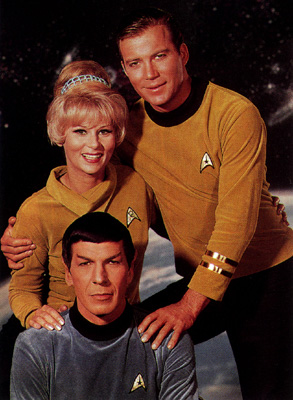

Getting ready to trek back and forth through time.

Season One

"The Naked Time"
The very first episode in the Trek canon to involve time travel, and the seventh episode of the show. However, said travel plays only a very minor role at the end of the story. It's really about a disease that drives everyone on the ship whacko. Classic moments include Kevin Riley's stirring rendition of "Kathleen," and a rock-em-sock-em-play-that-funky-fight-music battle between Kirk and Spock. And the "how did this ever make it past the censors?" moment when a sword-wielding Sulu, drunk with mania, grabs Uhura and says, "I'll protect you, fair maiden!"

Her reply: "Sorry, neither!"

Originally, the brief trip back in time - three days - was to have been a much longer jump, into the late 1960s. Originally, this episode was planned as part one of a two-part story (see "Tomorrow is Yesterday," below).

Rating: Time Honoured

"Tomorrow is Yesterday"
...in which the Enterprise is tossed back in time via a "black star." The ship has also been tossed into Earth's atmosphere, and Air Force pilot John Christopher reports the Enterprise as a UFO. Wacky shenanigans ensue, and to put things right again, Kirk must play around with time some more. During the course of the episode, we discover that 23rd century flashlights look exactly like their 20th century counterparts.

RATING: Time Honoured

"The City on the Edge of Forever"

Universally hailed as Star Trek's best episode, this is the one where Kirk must sacrifice the woman he loves for the sake of the future of humanity. "Doubtless you're wondering about my friend's ears. It's really quite easy to explain. You see, he...had an accident with a...mechanical rice picker."

RATING: Timeless

Season Two

"Assignment: Earth"

No time travel in the second season until the very last episode. Still, Kirk and company are already being a bit casual about time travel; in this episode, they journey to the 1960s purely out of curiosity, to see how the primitive humans of the day managed to avoid nuclear destruction. (They can't find this information in the history books, because "records of the period are fragmentary.")

Turns out that a Mr. Gary Seven, a human being raised by benevolent aliens, is doing most of the work to keep human history on track. He's a sort of secret agent, making sure that the Cold War doesn't turn hot, and his mission is to stop an American orbital nuclear weapons platform from becoming operational, since this would tilt the balance of power too far in America's favour and possibly trigger a nuclear war.

This episode was intended as a "backdoor pilot" for a show called Assignment: Earth, in which Gary Seven and his secretary, Roberta Lincoln (Terri Garr) would have more Cold War adventures. It never happened, which is too bad - it's an interesting premise.

RATING: Time Honoured

Season Three


"All Our Yesterdays"

Only one time travel story in season three, and it's the second last episode of the series. An unremarkable episode, falling into the mid-range of the typically disappointing third-season stories. You get to see Spock eat meat, though, because somehow, being thrown into the past makes him go nuts, theoretically because he's now closer to his savage ancestors. You're not a real scientist, are you? Still, the concept of temporal refugees, escaping a nova by traveling to the past of their own world, is pretty cool.

RATING: Time Waster

Star Trek: The Animated Series

"Yesteryear"

Yay! Cartoons! This tale returns us to the Guardian of Forever, seen in the timeless "City On the Edge of Forever." Mr. Spock visits his own childhood on Vulcan, and becomes a kind of mentor to his younger self. "Yesteryear" would have made a fine live-action episode, with its focus on growing up and making difficult choices.

RATING: Timeless

"The Counter-Clock Incident"

The Enterprise gets pulled into a universe where time runs backward, so visiting Commodore Robert April, the ship's elderly first captain, is the only one who can save the crew when everyone starts to get younger and younger...too young to run things. Restored to vigorous young adulthood, April saves the day. Cool.

RATING: Time Honoured

The Star Trek Original Series Movies
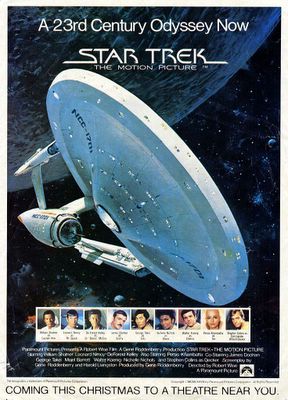

Paramount invites audiences to take a time trek of their own - to the 23rd century.

Star Trek IV: The Voyage Home

Or, "Star Trek IV: Save the Whales." Goofy fun in 1980s San Francisco, featuring "A double dumb-ass on you," "Where are the nuclear wessels?" "How do ye know he dinna invent the thing?" and many other fun bits. Despite the film's good humour and worthy conservation theme, this film hasn't aged as well as its original popularity might suggest. It's too much of a hodgepodge of elements, for one thing - a time travel story tossed into the middle of a string of serious events for the lives of our heroes, namely the death and rebirth of Spock, the death of Kirk's son, and the theft and destruction of the Enterprise. Given the gravity of the events in the previous films, the sudden turn to mirth seems a bit off-kilter. Still a fun film, though, if you're in the right mood for it.

RATING: Time Honoured

Time Travel Quotient:

Out of 107 episodes (including the animated series and the movies), only eight involve time travel, for a Time Travel Quotient of 7.47%.

RATINGS BREAKDOWN

Time Bomb: 0 episodes
Time Out: 0 episodes
Time Waster: 1 episode
Time Honoured: 5 episodes
Timeless: 2 episodes

The original Star Trek, then, has a reasonably successful time travel track record.

PART TWO: Star Trek: The Next Generation

Season One
“We’ll Always Have Paris”

A forgettable episode with a minimal time travel element.

RATING: Time Out

Season Two

“Time Squared”

Mysterious space whirlpool opens and threatens to suck the Enterprise into oblivion. Can a ranting Picard from the future avert catastrophe? Who cares? Originally intended to lead into “Q Who,” the episode that introduced the Borg.

RATING: Time Bomb

Season Three

“Yesterday’s Enterprise”

For many, this episode marks a turning point in Star Trek: The Next Generation: it’s the point where the show actually became worth watching. This is the one with the Enterprise-C and the big space battle. More importantly, it also presents Picard and his pals with a wrenching moral dilemma.

RATING: Timeless

“Captain’s Holiday”

Captain Picard goes spelunking, but aliens from the 27th century come back in time to look for a thingy that can make suns explode. An amusing romp.

RATING: Time Waster

Season Four

An amazing ZERO time travel episodes!

Season Five

“A Matter of Time”
Con man Matt Frewer uses his stolen time travel machine to steal technology. Ho hum.

RATING: Time Out

“Cause and Effect”

The Enterprise is caught in a time loop, and not one of those nice time loops when you’re having sex with a pair of twins over and over for eternity! Nope, it’s one of those time loops where your ship is lost with all hands over and over and over. How can you beat a show where, without warning, the ship explodes in the opening ten seconds of the episode?

RATING: Timeless

“Time’s Arrow”

Archeologists find Data’s head in a cave in San Francisco, only it’s five hundred years old, and besides, Data is alive and well on the Enterprise. Oh oh, sounds like some kind of paradox. An intriguing setup, with special guest stars Samuel Clemens and Jack London. Part one of two.

RATING: Time Honoured

Season Six

“Time’s Arrow, Part Two”

Meh. Disappointing resolution. Time traveling vampire snakes?

RATING: Time Waster

“Timescape”

Time is freezing, speeding up, or slowing down thanks to “temporal pockets” in space. Yikes! Picard needs to get his nails trimmed after his hand passes through a pocket and ages a few months. Ouch! Features a laugh-out-loud moment when a delirious Picard draws a happy face in the frozen cloud of vapour that signals a warp-core breach.

RATING: Time Honoured

Season Seven

“Firstborn”

Worf’s son, all grown up now, travels to the present from the future to warn his dad about something. I forget what.

RATING: Time Waster

“All Good Things…”

Okay, maybe this is just all a Q fantasy, but it’s hard to be sure. I include it as a time-travel episode anyway, since the plot relies so heavily on the interconnection of the three eras of Picard’s life on display here. A pretty good series finale, but just a couple of steps away from outstanding.

RATING: Time Honoured

Star Trek: The Next Generation Movies

“Star Trek: Generations”

Killing Kirk off in the lamest of all possible ways makes this an automatic bomb. Bah!

RATING: Time Bomb

“Star Trek: First Contact”

Action-packed race to the past to save our future! Scary Borg! Stoic Vulcans! Drunk Deanna! Grinning Riker! What more can you ask for?

RATING: Timeless

Time Travel Quotient

Out of 179 episodes (including the movies), only 13 featured time travel in any significant way. That’s a TTQ of 7.26%, only a fraction lower than the original series.

RATINGS BREAKDOWN

Time Bomb: 2 episodes
Time Out: 2 episodes
Time Waster: 3 episodes
Time Honoured: 3 episodes
Timeless: 3 episodes

In terms of quality, Star Trek: The Next Generation’s time travel record covers the entire scale fairly evenly, though slightly tilted towards quality.

PART THREE: Star Trek: Deep Space Nine

Season One

“Emissary”

Time travel plays an important role in the mythology of Deep Space Nine, since it revolves around a space station that’s situated next to a wormhole inhabited by a species of aliens who live outside linear time. We find all this out in the very first episode, an excellent beginning to an excellent series.

RATING: Timeless

Season Two

An amazing ZERO time travel episodes!

Season Three

“Past Tense, Part I”

Sisko, Bashir, and Dax are thrown into Earth’s past by a transporter accident. That’s bad enough, but it’s the early 21st century, and they’ve wound up in a sealed-off compound for the homeless during the historical Bell Riots. Fantastic commentary on real-world social problems and the widening gap between rich and poor.

RATING: Timeless

“Past Tense, Part II”

Second verse, just as good as the first.

RATING: Timeless

“Visionary”

Poor Chief O’Brien. Nothing good ever happens to this guy, and now he’s being jerked back and forth between the present and the near future. Not only that, but he discovers that the space station is about to be destroyed! Can he alter the course of the future?

RATING: Timeless

Season Four

“The Visitor”

A heart-wrenching episode: Jake Sisko is tortured by his father’s death, and spends his entire life trying to undo the past. One of only a handful of episodes to move me to tears.

RATING: Timeless

“Little Green Men”

The Three Stooges – er, make that the three Ferengi, Quark, Rom, and Nog – have a time travel accident and wind up in Roswell, New Mexico, 1947. They are, of course, responsible for the persistent rumors that aliens crash-landed there…This episode also gives a fun nod to “Past Tense” with a clever in-joke.

Rating: Timeless

Season Five

“Trials and Tribble-ations”

A villain from the past steals the Bajoran Orb of Time in an attempt to reverse a past defeat…and only Captain Sisko can save the legendary Captain Kirk from dying a decidedly untimely death. A classic.

Rating: Timeless

“Children of Time”

Another standout episode. Sisko and company must trade their own lives for 10,000 of their descendants…but the Odo of the future has other ideas.

RATING: Timeless

Season Six

“Far Beyond the Stars”

A black science fiction writer has trouble getting his stories published in the 1950s…and no wonder, considering he writes about an outlandish space station with a black man as its captain. Another high concept, winning episode.

RATING: Timeless

“Wrongs Darker Than Death or Night”

Great title, not-so-great episode. Major Kira borrows the Orb of Time to see if her mom was really a collaborating whore or not. She was.

RATING: Time Out

“Time’s Orphan”

Little Molly O’Brien wanders into a time portal and spends over a decade there, emerging as a young woman. Her parents don’t know what to do. Meh. Disappointing.

RATING: Time Out

“The Sound of Her Voice”

Time travel as plot twist. Good enough to pass the, er, time.

RATING: Time Waster

Season Seven

No time travel!

Time Travel Quotient

Out of 174 episodes, time travel plays a part in twelve episodes, for a TTQ of 6.89%, lowest of the four series.

RATINGS BREAKDOWN

Time Bomb: 0 episodes
Time Out: 2 episodes
Time Waster: 0 episodes
Time Honoured: 0 episodes
Timeless: 10 episodes

An amazing result – ten out of twelve DS9 time travel episodes are timeless classics, with only two disappointments.

PART FOUR: Star Trek: Voyager

Season One

“Parallax”

Voyager responds to a distress signal from…itself, as it turns out, trapped in a quantum singularity in the ship’s near-future. Good thing technobabble can save them!

RATING: Time Bomb

“Time and Again”

After a promising premiere episode, “Voyager” gave us two time-travel episodes in a row. “Time and Again” is the second, a heavy-handed morality play about the importance of following the Prime Directive. Voyager runs across a planet that has recently suffered some kind of technological disaster. Beaming down to investigate, Captain Janeway and Mr. Paris fall through subspace ruptures into the past, to a time just before the accident. Turns out that it was their presence in the past that triggered the disaster all along! Oops. That’ll teach you to seek out strange new worlds and new civilizations.

RATING: Time Bomb

“Eye of the Needle”

Voyager discovers a teeny-weeny wormhole that leads back to the Alpha Quadrant; into Romulan territory, to be specific. The ship can’t fit through, but at least they can send a message back to the friendly Romulan who promises to pass on the news of their survival to the Federation. But oh-oh – they discover that the wormhole is a tunnel not just through space, but also back in time fifty years. One of the few decent Voyager episodes, with a nice touch of pathos.

RATING: Time Honoured

Season Two

“Death Wish”

Well, you knew Q had to show up sometime, and you knew it was going to involve time travel. With a suicidal member of the Q on trial, the Q we know and love calls up witnesses from the past to prove that the suicidal Q’s life has meaning after all. Includes a gratuitous cameo by Commander Riker of the Enterprise.

RATING: Time Waster

Season Three

“Future’s End”

A time-ship from the 29th century Federation appears before Voyager, and its captain isn’t happy. Apparently, Voyager is about to be responsible for a catastrophe that will have far-reaching repercussions. To prevent that, Voyager must be destroyed. There’s a fight, and Voyager winds up getting flung through time and space to Earth of the year 1996…

RATING: Time Waster

“Future’s End, Part II”

In which the intrepid crew (of an Intrepid-class ship, no less) resolve the paradox and wind up right back where they started. Plus, you get to see a shuttlecraft blow up a semi.

RATING: Time Waster

“Before and After”

Kes is exposed to radiation that sends her leaping back and forth through time, right back to her very birth. A high-concept time travel episode that actually – shock – works!

RATING: Time Honoured

Season Four

“Year of Hell”

Kurtwood Smith (Red from “That 70s Show”) plays an obsessed Krenim scientist who wants to restore his fallen empire and recover his lost wife. He has a ship armed with a powerful weapon – a “temporal cannon” that erases the Krenim Empire’s enemies from history. Can Voyager stop countless billions of sentient beings from being erased?

RATING: Timeless

“Year of Hell, Part II”

The conclusion. Not quite as good as part one, if only because in the end, the famous Voyager reset button is pushed and you discover that the events of the story…never happened. Sigh. Still, the coda where Smith’s character is finally reunited with his wife is very moving.

RATING: Time Honoured

Season Five

“Timeless”

An experiment to get Voyager home goes horribly awry, and only Commander Chakotay and Ensign Kim make it back to Earth. But their failure weighs heavily, and the two surviving officers spend years figuring out how to cheat fate, traveling back in time to prevent the accident before it occurs. One of Voyager’s few good episodes, guest-starring LeVar Burton as Captain Geordi LaForge.

RATING: Timeless

“Relativity”

The 29th century Federation is back, and this time they want to know who destroyed Voyager with a time bomb! Originally titled, amusingly, “Time Bomb.” I’m almost sorry the episode is too good to warrant that rating.

RATING: Time Honoured

Season Six

“Fury”

Kes, who left the ship in the fourth season, comes back, and she’s pissed, using her telekinetic abilities to wreck Voyager. Quick! Only time travel can save us!

RATING: Time Bomb

Season Seven

“Shattered”

Holy Cow! A space-time anomaly has shattered Voyager into different eras! The bridge is set in the days before Voyager got tossed back into the Delta Quadrant, engineering is being occupied by Kazon from the second season…it’s chaos, and only Chuckles – er, that is, First Officer Chakotay – can put things right. Now you know we’re in trouble.

RATING: Time Bomb

“Endgame”

Voyager’s final episode involves the show’s two most overused elements: time travel and the Borg. In the future, we see that psychotic Admiral Janeway, celebrating the 10-year anniversary of Voyager’s arrival home (after a 23 year trip), decides that history just didn’t unfold the way it should have, and steals a time travel device from a Klingon scientist. She lost a few crewmembers along the way, you see, including Seven of Nine, and, well, damn it, erasing 33 years of history is justifiable for the sake of those lives. Holy cow! Where are those 29th century time cops when you need them? Voyager gets Batmobile armour, the Borg seem to get destroyed for all time, and future technology falls into the hands of the Federation. Oh, the big homecoming? You get ten seconds worth as the final credits roll. No resolution of character arcs, we don’t find out what happens to all those Maquis crewmembers (who are, as far as we’ve been told, still criminals in the eyes of the Federation)…oy. Possibly Voyager’s worst episode, and that’s really saying something.

RATING: Time Bomb

Time Travel Quotient

Out of 168 episodes, Star Trek: Voyager told time travel stories 14 times. That gives Voyager a TTQ of 8.33%, the highest of all four completed incarnations of Star Trek.

RATINGS BREAKDOWN

Time Bomb: 5 episodes
Time Out: 0 episodes
Time Waster: 3 episodes
Time Honoured: 4 episodes
Timeless: 2 episodes

Not surprisingly, Voyager features the fewest Timeless episodes and the most Time Bombs. Still, there are a surprisingly high number of decent Voyager time travel episodes.

PART FIVE: CONCLUSION

Thus far, there have been 628 episodes of Star Trek, not counting the newest series, Enterprise. Of these 628 episodes, 47 have featured time travel, for a complete Time Travel Quotient of 7.48%, a surprisingly low number. What about quality?

RATINGS BREAKDOWN (TOTAL)

Time Bomb: 7 episodes
Time Out: 4 episodes
Time Waster: 7 episodes
Time Honoured: 12 episodes
Timeless: 17 episodes

Surprisingly, Star Trek has been pretty successful at tackling time travel. They’ve had a few bombs – mostly thanks to Voyager – but their fair share of classics as well.

Has the time travel well, then, been dipped into too often? Only in the fullness of time shall we discover the answer…

Monday, September 26, 2005

Through a Glass, Angrily


Portrait of the Blahger as a Young Man

Saturday night I drove Sylvia down to Julio's Barrio on Whyte Avenue for her friend Norma's birthday party. As I was preparing to turn right onto Whyte from Calgary Trail South, I heard a distant banging from my left. Sylvia was talking, so I was distracted, trying to pay attention to what she was saying while also figuring out what was making the noise.

I glanced to my left and saw a young guy in his early twenties sitting in the front passenger seat of an old, grey subcompact; it had "4 Sale" signs crudely painted all over its surface, including the windows. The young man was banging on his window, and he was looking right at me with an intensely angry expression on his face. I was confused, looked away to answer a question from Sylvia, all the while trying to focus on my driving.

The banging got louder and I looked over again; the young man was practically foaming at the mouth with rage, his face twisted and bright red. I reached for the button that would have rolled my window down, but the light turned green and the car sped off, and I was free to make my turn onto Whyte. I found a spot to park, escorted Sylvia to the restaurant, and returned to my car to ponder over what, exactly, had happened to spark the other man's rage. Finding no answers, I drove home.

The incident reminded me of a similar case of unprovoked aggression, one that happened to me a couple of years ago. It was Canada Day, and I decided to check out the fireworks show, parking my vehicle on Jasper Avenue and walking down to Ezio Farone park. The fireworks were fine, and I started the walk back to my car, along with thousands of other people.

But shortly after I began my return journey, a dark-haired young man started taunting me with insults too base to justify repeating here. He was accompanied by a small cluster of like-minded friends, who pitched in on the abuse to varying degrees. They definitely wanted to start a fight, but I was too disgusted and angry to rise to the bait; I just told them that their behaviour was appalling, and that they should know better.

Looking back, I think I should have been scared, but there were plenty of people around; I could have called for help if I really needed it. But I wasn't even thinking in those terms; I was offended.

They followed me for a few blocks, trying out various forms of insult, and I started to feel very sad and sorry for them. An awful attitude, I know, to feel superior, but in that moment I did, and I immediately started to feel guilty about it. I tried to empathize, to understand the vulnerability that would lead someone to hurl abuse at a stranger.

Maybe I did begin to understand at the end, because by the time the crowd thinned out and we were alone, the ringleader shook my hand and told me "no hard feelings." Maybe it was his turn to feel superior; who knows?

Like many kids, I was a victim of bullying, though thankfully those days are far in the past. Those experiences left a powerful impression on me. What drives someone to attack a stranger, when the violence isn't in the cause of sheer survival? I can't imagine the kind of mentality it takes to behave that way. Is it a form of mental illness? Or are some people simply badly socialized?

I don't know. But I wish I could have made the guy in the car feel better.

Monday, September 19, 2005

Earl vs. the Flying Saucers


At the office today we had a short conversation about restaurant service, and the different expectations of customers. Some people seem to expect a lot from servers, and I can understand that attitude to an extent; no matter what the job, you should always strive to do your best.

But when it comes to food service workers, I'm always pleasantly surprised when the servers are friendly and competent. Frankly, given their wages and low social status, I'm very surprised that they don't spit in our food out of spite, and yet most servers do their very best to put on a smile no matter how much they hate their job.

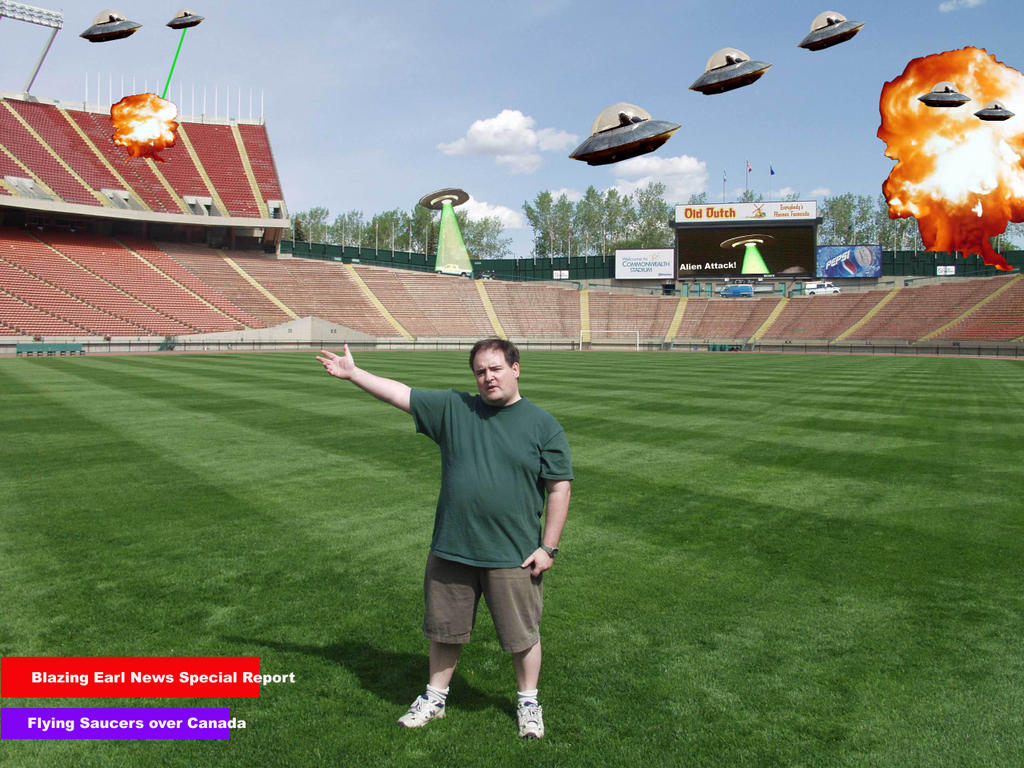
So give your server, pizza delivery person, or clerk a break. They don't get them very often. And besides, you never know when they could be vaporized by aliens.

Thursday, September 15, 2005

Rewriting Future History: Theodore Judson's Fitzpatrick's War


Cover of the mass-market paperback edition of Fitzpatrick's War (2005)

Fitzpatrick’s War, the first novel by Theodore Judson, takes the form of a memoir, also named Fitzpatrick’s War, now being republished in its second edition in the year (very much of our Lord) 2591. The memoir’s author, one Sir Robert Bruce, venerable and guilt-ridden former officer of the world-spanning Yukon Confederacy, has put pen to paper to set the record of his master Fitzpatrick’s conquests straight.

In the book-within-a-book, Bruce relates the eventful years of his youth, from his teenage years as a common solider fighting on the Mexican frontier through his meeting with future conqueror Isaac Fitzpatrick and the war they waged together against a nearly helpless world.

Bruce’s story is compelling enough, with its futuristic and yet somehow nostalgic tales of war waged with steam-powered jet aircraft, zeppelins, and “firesticks,” which seem to be some sort of portable napalm that melts terrain and enemy alike into glass. Bruce’s world overflows with treachery, intrigue, male bonding, beautiful women, mad scientists, snappy uniforms, exotic but gallant Noble Savages; if "Tarzan" and "John Carter of Mars" creator Edgar Rice Burroughs were alive today, he may have written something quite like this…with one important difference: he would not have included the editorial notes that give the memoir its vital context.

As we are told in the “Introduction to the Annotated Edition,” this version of Fitzpatrick’s War is being published on the fiftieth anniversary of the first edition – not to bring a celebrated work back into print, but to expose the memoir as a treacherous lie. For the editor of Bruce’s work puts himself firmly on the side of orthodoxy in a decades-long controversy over the veracity of Bruce’s claims. In the world of 2591, Fitzpatrick is venerated, his short rule a Golden Age, his war the high point of an empire’s proud history. Bruce’s work calls this version of history into question, and since it’s too late to suppress the book, it must at least be smeared as a pack of lies.

This unusual construction means that the book has two audiences: the audience of the real world of 2005, who read a rousing SF adventure story, and the imaginary audience of 2591, reading a controversial historical record, engaged in a one-way “conversation” with the work’s editor, named only once as “Ro.” We, the audience of reality, are invited, indeed almost forced, by this construction to consider the reactions of the fictional reader, the one constantly assured and patronized by the editor, the one who must perhaps read the book, if not in hiding, than at least with a sense of a man reading a comic book on a subway: embarrassed, guilty pleasure.

The book raises a number of interesting issues, most especially the power that publishers have over authors. Thanks to the ever present editor’s footnotes, we are constantly reminded that “this passage was not included in the 2541 edition,” or “Bruce is obviously lying here; see Gerald, page 541.” And yet, the essential, terrible truth of Bruce’s account is all too clear to any but the dullest reader: not only was Fitzpatrick’s global war an unjust atrocity, a holocaust, the reader himself must be aware that he is living in a repressive, if not wholly bleak, society. We are even led to wonder whether this 2591 edition is truly the unexpurgated text or if, as in the 2541 edition, several passages have been Bowdlerized or outright omitted?

Or is this, in fact, the editor’s true purpose? While the text is studded with footnotes that constantly call into question Bruce’s character, a deeper reading reveals that the mysterious Ro may, in fact, be playing a very dangerous and subversive game. Bruce’s account is permeated with the ring of truth, since Bruce himself is merciless with regards to his own weaknesses and his participation in Fitzpatrick’s peerless atrocities. His love for his wife Charlotte, his empathy for the Chinese, Indian and African citizens he encounters while at war (whom in his neo-Victorian culture are seen as subhuman), his attempts to mitigate the effects of Fitzpatrick’s war, his loyalty to his friends and even his inevitable, justified betrayal of Fitzpatrick all encourage the reader – both of 2005 and 2491 – to see Bruce’s record as true. The editor’s constant attacks on Bruce’s text become more and more transparent and serving of the current ruling regime with every page.

Therefore it is reasonable to wonder if the anonymous editor is in fact using Bruce’s text as a tool, a means of forcing his fellow citizens to question their sanitized view of history. In the Introduction, the editor states,

“When it became generally known among my colleagues at St. Matthew’s University that I was preparing a new edition of the liar’s book, the Lord Dean of the History and Other Literatures Department took me aside one day during afternoon tea and asked me man to man, ‘Look here, Ro, do you really need to be blowing new cinders into old holocausts?’

Therefore, let me declare before I sojourn too far in res I most certainly do not accept the whole or any part of Bruce’s account as Historic fact. Unlike real Historians, Bruce consistently strives for sensation and does not instruct his readers in virtue.”


A very telling passage, for it reveals that the role of history itself has been subverted in this culture; its purpose is to uphold virtue, presumably those virtues held in esteem by the current ruling class.

Ro continues:

“Why then, as the freshman in the famous anecdote demands, should we read this book? The answer of course is that just as Plato taught us that pleasure comes from having known pain, and as St. Augustine demonstrate (sic) that redemption arises from knowing sin, the great philosopher and Historian Murrey has shown that knowing truth comes from being familiar with lies; indeed, truth could not exist without its opposite…

Even novice scholars must start with the premise that there are certain master thinkers who cannot be challenged, but only appreciated and, in rare instances, improved upon. Therefore, by confronting Bruce’s outlandish exaggerations we can discern the excellence of the accepted accounts of Fitzpatrick’s life.”


Ro is taking great pains to explain why he has undertaken what is obviously seen as a dubious enterprise, one questioned by his academic peers. He doth protest too much, it seems, and it is in the book’s afterword that Ro’s true purpose can be divined. Ro rants for a time about Bruce’s supposed lies, and yet he gives the final word to the account of a humble fisherman, Edward Tolde, who knew Sir Robert and his family in their later years and told his story to a magazine writer named Cather.

“I think I only need to quote the simple fisherman as he speaks in the article to give us an accurate picture of what sort of man Bruce was. I will conclude my commentary with what Tolde said to Cather, which speaks for itself:


Sir Robert was a peculiar sort of chap in the village, sir. I mean to say, he was more approachable and kinder to people than you would think a man of his position would be. He had his general’s pension when he was old, and he and his wife always sent off a portion of what they got each month to an orphanage in Grand Harbor or else they gave it to anybody in the village they thought needed some help.”


The fisherman goes on to relate how the aged Bruce saved some Nipponese sailors from a lynching, and details some of his “scandalous” behaviour with his wife – scandalous in that he was known to dance with her or kiss her palms in public, lewd and unseemly acts in the Yukon Confederacy. It is a wholly sympathetic portrait, completely undermining all Ro’s words, cementing in the readers’ minds the truth of Bruce’s account.

So in the end, we are left to wonder: is the world of 2491 so repressive that Ro actually believes every word he writes about Bruce, without irony, unaware that some of his readers (at least the “real” readers of 2005) will be compelled to take a viewpoint to which he is ostensibly opposed? Am I, as one of those readers of 2005, merely imprinting my cultural mores on the imaginary editor?

Or is there reason to hope that the world of 2491 is at last beginning to change, to question its own history? Is Ro a fundamentally honest historian, bringing a controversial work back into the public eye in the only way he can, given the restrictions of his time?

Only one thing is certain: history, yet again, has been written by the winners. But it can be rewritten, the truth brought back to the fore, if some of those winners can follow the dictates of their conscience.

A Little-Known "Reserve Activation Clause"

...or in other words, Captain sir, they drafted me.

That is, Sean drafted me to pick winners in his NFL Death Metal challenge, a no-holds-barred grudge match to see who has the best NFL football acumen. Sean battles In the Now's Liam Johnstone (who is not Stone Cold Steve Austin), while I, with my dearth of football knowledge, serve as a "control factor," to use Sean's terms.

Well, I made my picks, and what they may lack in accuracy, I hope they make up for in humour. And even if they don't, Sean's blog has several new and very funny posts, well worth reading, particularly the Comments sections. Sean is using comment spam as a source of ribald (to put it mildly) wit, with excellent results.

So for some off-site Blahg-style Earlisms and the inimitable mirth only Sean can bring you, visit Sean's blog now!

Monday, September 12, 2005

The True Secret of Rich Corinthian Leather

Remember those old car commericals in which Richardo Montalban extolled the virtues of the car's "rich Corinthian leather?"

Well, check out this string of comments on Sean's blog. Click above, on the title of this blog posting, and all will be revealed.

Thursday, September 08, 2005

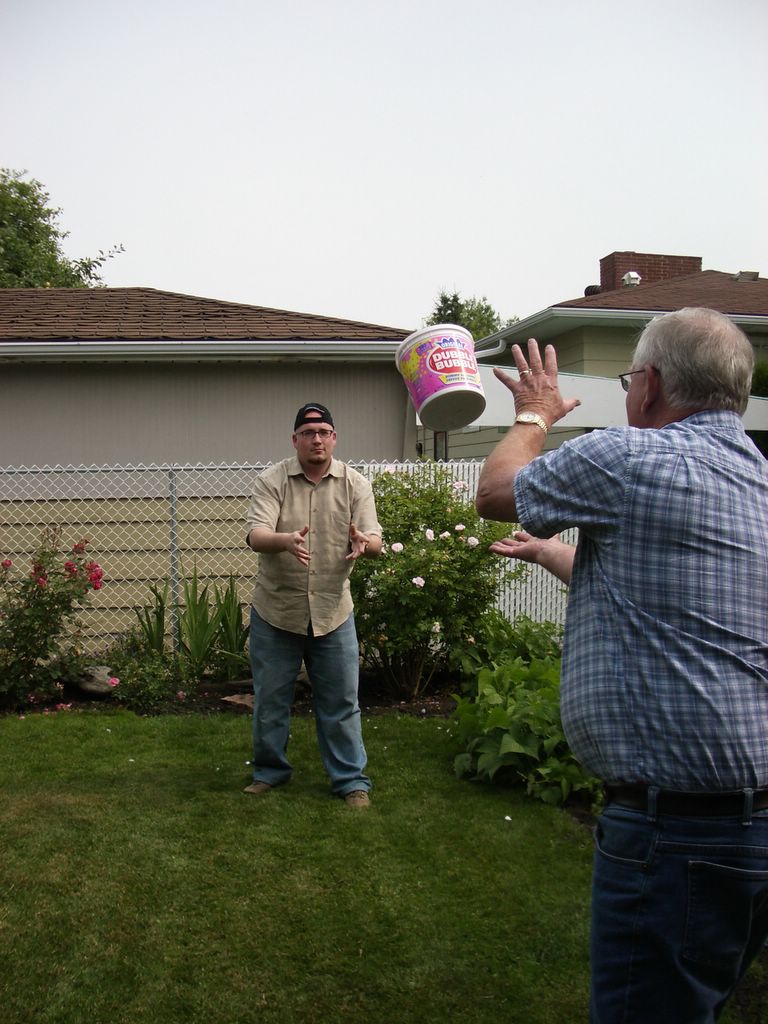
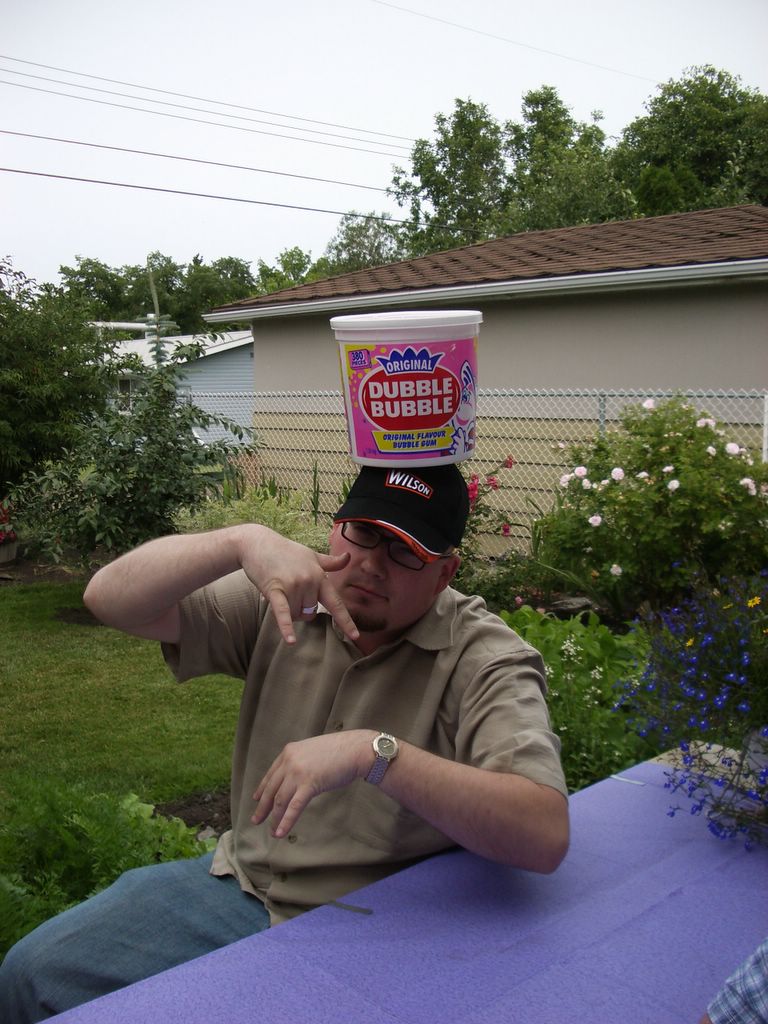
The Strange Case of Mr. Woods and the Bubblegum Trap, or, An Evening with the Flagpole Impalers


What Gummed Up Earl's Works

I knew that opening the trash can was a mistake, but I had a receipt to throw away. So I flipped open the lid, and POW - buckets of bubble gum exploded into my face, leaving me stunned. The circus music that normally plays over and over in my head was suddenly replaced by George Harrison's "What is Life," and it seemed oh-so-appropriate - what is life? Life is when the garbage spits buckets of bubble gum in your face.

And yet, that was only the beginning of my troubles.

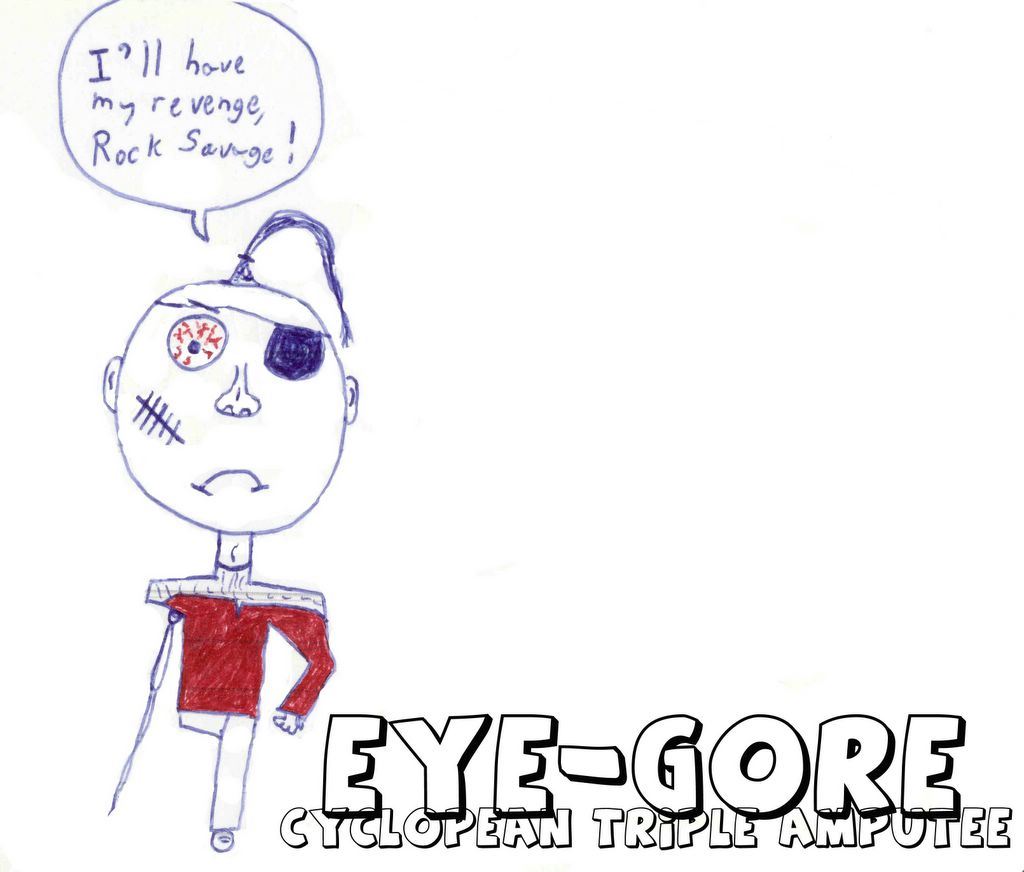
ORDER/CHAOS SUPPORTING CHARACTER FILE: EYE-GORE


The sinister visage of...EYE-GORE!

Little is known of Eye-Gore, Cyclopean Triple Amputee. Though, like many residents of Earth-69, he possesses paranormal abilities, Eye-Gore has yet to choose a side in the neverending battle between Chaos and Order. (However, he is known to have a somewhat adversarial relationship with ORDER stalwart Rock Savage.)


Wooed by both sides for his incredible combat skills and iron constitution, Eye-Gore is a man to watch, and could tip the balance between good and evil.

Tuesday, September 06, 2005

I Axe You

Like me, you've probably seen commercials for those "body sprays" for men, Axe and Tag and Zap and Moo and whatever. In the ads, a good-looking guy tries out the product in a store or sprays it on before going out, and suddenly gorgeous, often scantily-clad women leap upon him, sexually enraged, hormones throbbing, too warm for his form to control themselves.

So it occurred to me: what happens if you spray a female with one of these sprays? Do buxom, scantily-clad, sex-crazed vixens suddenly pop out of the woodwork for some impromptu, unrestrained Sapphic action?

If so, I'm buying a can or two.

Monday, September 05, 2005

Bring Me the Head of Earl J. Woods


Over the weekend, Colin, Mike, Pete and I went over to Jeff's place to watch some movies. First, we watched Appleseed, a beautiful but somewhat sterile anime; then, Star Wars; and then...Bring Me the Head of Alfredo Garcia.

One of these things is not like the others...

I brought it over, because a), the awesome title, and b), it was directed by Sam Peckinpah, director of The Wild Bunch, perhaps the last great western until Clint Eastwood revived the genre with Unforgiven. (Peckinpah also directed Convoy, a byproduct of the CB radio craze of the late 70s, but nobody's perfect.)

The film's pace is...somewhat slower than modern audiences are accustomed to. In fact, it's fair to say that the film consists of many scenes of the bartender and his girlfriend talking (with many pauses) and driving along dusty Mexican roads, punctuated by the occasional gunfight. At one point Kris Kristofferson, playing a biker, attempts to rape the protagonist's girlfriend, and even that scene is so measured and laid back that Pete exclaimed, "Jesus Christ! They can't even make a rape dramatic!"

It's a fair criticism, and we started skimming the film at about the halfway point, watching the final scene only to see how it ended. But I watched the film properly yesterday, front to back, and I discovered that even though the film is far from Peckinpah's best, it does have something important to say about violence. At one point the protagonist, a bartender who digs up Alfredo Garcia's head for the promise of a ten thousand dollar cash payout, demands to know why the head is so important.

"Sixteen people have died for this," he screams, genuinely anguished, even though some of those people were thugs who were trying to kill him. And later on, when he has the chance to take home a cool million for the head, he turns down the money and metes out brutal justice instead...and then, at the last minute, goes back for the money, and of course is gunned down in the end.

The irony is this: Alfredo's head was wanted so badly because he impregnated, out of wedlock, the daughter of a rich Mexican crime boss. The mobster wants him Garcia killed, but Garcia dies in a car accident before a single bounty hunter can collect. Of course the mobster isn't told this, and the bloodbath over the corpse ensues, and twenty five people die for nothing by the film's end. The bartender loses his girlfriend, his self-respect, and his life, all for the prospect of a lousy ten thousand dollars...and even when that reward climbs to a million, he hardly seems to care, and indeed seems pretty fatalistic about his prospects when he takes the cash.

What I find interesting is that Peckinpah, who's been called a fascist, a misogynist, and a glorifier of violence, made such a point of showing how stupid the whole affair is. The lone voice of reason, the bartender's sympathetic prostitute girlfriend, is dragged along for the ride, trying to talk her man out of his folly, but of course she fails and dies at the hands of rival bounty hunters. We aren't shown how she's killed; it happens off camera, which is unusual for Peckinpah, who has been criticized for his depictions of casual violence against women. (Watch Straw Dogs for perhaps the most horriflying example, and even in Alfredo Garcia, women are slapped around for the most minor of offences - one is even knocked unconscious for no reason at all.) The prostitute even appears somewhat saintly in her shallow grave, which is appropriate since she's the only sympathetic character in the movie.

The film ends, as several Peckinpah films do, with a massacre that leaves scores of dead, the good, the bad and the innocent alike; the final image is that of a machine gun barrel, blasting away at the audience, perhaps Peckinpah's not-so-subtle critique of his fans, who come, after all, for the bloodshed. (I don't excuse myself from this crowd; violence may be the lazy writer's most versatile and dependable tool, but there's a reason for that: it's exciting.)

I have to wonder what Peckinpah would think of today's hyperviolent films, in which scores of people are blasted to atoms by aliens, crushed beneath tidal waves, or obliterated by unstoppable serial killers from beyond the grave, without a single thought given to the lives of the disposable characters. At least Peckinpah's sacrificial lambs usually had a bit of backstory, even if it consisted of only a costume choice or a single line of dialogue, to make us care about the characters as human beings, rather than meat for a cinematic abbatoir.

I'm not trying to excuse Bring Me the Head of Alfredo Garcia - it's not a great film, or even a good one - but I think it is important as part of Peckinpah's body of work, and unlike many of today's exploitation pictures, it at least tries to make the viewer think a little. The 70s were good for that.

Wednesday, August 31, 2005

My Girlfriend the Geek

Early in our relationship, Sylvia noticed that I enjoyed Star Trek. I had all the DVD sets, and when we first started dating, I was working my way through Deep Space Nine, the second spinoff of the original series. Just after I started watching the third season, she decided that the show looked interesting, and we've been watching it together on and off since then.

We just started the seventh and final season. At this point in the show, the curmudgeon with a heart of gold, Mr. Worf, is mourning the death of his wife, Jadzia Dax. There's a touching scene in which Worf demands a holographic crooner (don't ask) to sing "their song." The singer balks, but Worf insists, and so the song is played and Worf, of course, loses it, yelling and smashing furniture as Klingons are wont to do.

While I'm enjoying all the mayhem, I notice that Sylvia's lower lip is quivering, and that tears are forming in her eyes. I was a little shocked.

"Are you...crying?"

"Poor Worf!" she sobbed.

Sylvia Boucher. Fashion maven, girly-girl...Trekkie.

Heh, heh, heh. You cannot resist the POWER of the Dork Side...

Tuesday, August 23, 2005

Syllabus Shocker

Today at work I Googled my co-author Jim Hole's name to see if there were any new reviews of his latest book, What Grows Here? Volume Two. I found a couple, but way more interesting was the link found at Oakland University in Rochester, Michigan. The syllabus for their Master of Liberal Arts programs includes a quote from a piece Jim and I wrote for last year's issue of Spring Gardening. Here's the relevant excerpt from the syllabus:

LBS 511: Topics in Literature and Language: The Writer in the Garden

Special Instructor Linda McCloskey, Dept. of English mccloske@oakland.edu
MW 6:30 - 9:50 p.m.
In his essay, "The Art of Interpretation," Jim Hole states, "Even the most modest garden is a work of art in its own right, if you've imbued it with your own personal vision." In this course, we will explore the garden in literature as both literal and symbolic, including each writer's personal vision and expression of his or her relationship with nature, from the Biblical Garden of Eden through the secret garden of children's fiction to the contemporary garden essay. Emphasis will be placed on the connection between personal reflection and universal meaning. Students may investigate interdisciplinary depictions of the garden in painting, sculpture, film and history as well. A visit to the gardens at Cranbrook is planned as part of the course. Students will learn to hone their literary/personal essay writing skills, and garden essays will be gathered to produce a collection at the semester's end. Course requirements also include regular attendance and active participation in class discussions. Required texts:

Frances Hodgson Burnett, The Secret Garden. (The Modern Library Classics
edition)
Roger Evans, The Writer in the Garden.
Jane Garmey, editor, The Writer in the Garden.
Jamaica Kincaid, My Garden (Book)
Bonnie Marranca, American Garden Writing: An Anthology.
Michael Pollan, Second Nature: A Gardener's Education.
Charles Dudley Warner, My Summer in a Garden.

I'm so psyched. I know it's silly, but I really feel like this helps validate the work I've been doing for Hole's. Sure, it's likely that the instructor was just searching for something reasonably quotable for the syllabus description, but it's still darn cool that she picked something I wrote. Woo woo!

Monday, August 22, 2005

Hububble: A PostModern/PreSpec Rap by E.J. Gummy Sean


What Up, Gum
Dubble Bubble, Toil and Trubble


Tossing Rubber Through the Rubble like I got a


telescope called Hubble


Fo' Shizzle the Floating Hubub of the Bubble


The works all gummed, irreason rules


More precious than the family jewels


Like gumballs flyin' through the air


balder than if you shampooed with Nair, yo


I'm a supplicant to plastic gods


My prayer's a shout-out to all the rods


that burst the bubble, Yo Yo Bubble
What up Gum, I'm Dubble Trubble

Tuesday, August 16, 2005

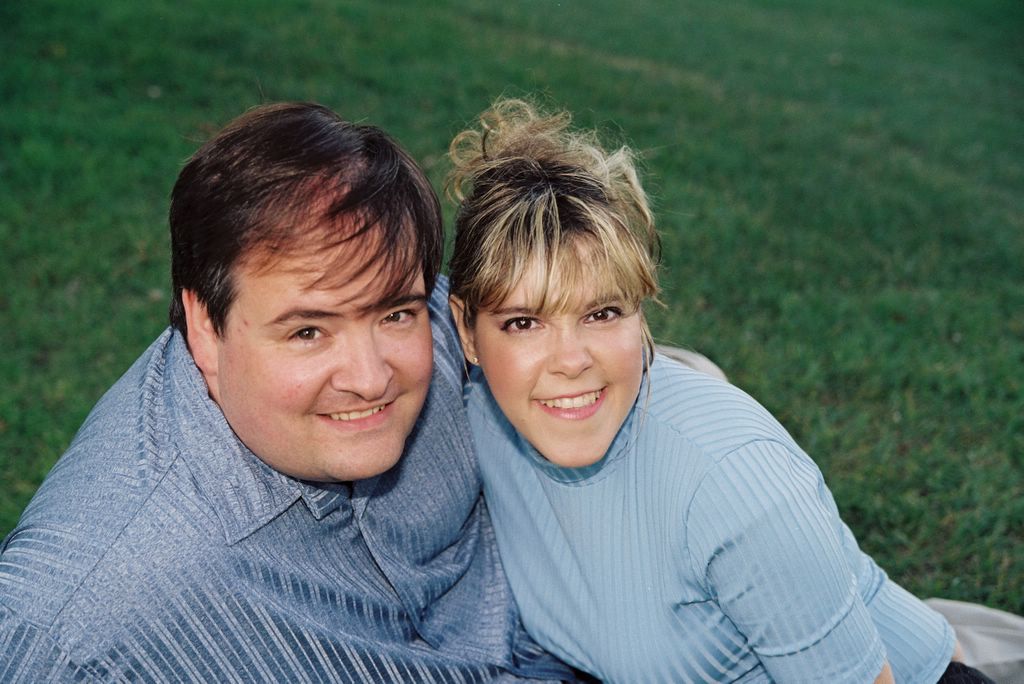
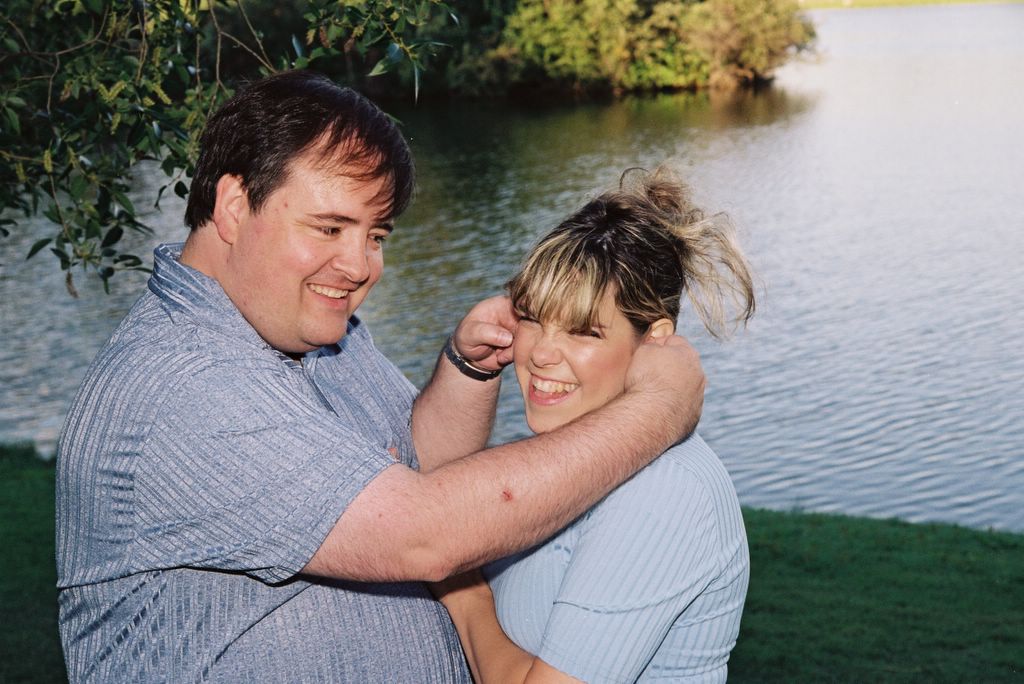
More Engagement Photos


All Photos by Akemi Matsubuchi

I'm feeling too lazy to provide an entry with any substantiative comment tonight, so for your amusement I'll post a few more engagement photos of Sylvia and me. Don't forget to Click to Embiggen!

Thursday, August 11, 2005

Market Forces Again

Well, I finished Market Forces over lunch today, and I'm very pleased. Not the ending I may have expected, but logical and satisfying nonetheless. Morgan has a way of making you care about even the most despicable characters that's quite unnerving - you find yourself rooting for the guy who regularly cheats on his wife, or the one who just murdered a colleaugue in the most brutal fashion possible.

Here's yet another book in which Canada survives a future crisis, one of the last lights of hope in a decaying world. It really is a theme, or at least a significant bit of background, in plenty of postapocalyptic and distopian literature, and I'm beginning to wonder why so many authors, most of them not Canadian, choose Canada as "the place that made it through." In Market Forces, there are only a couple of references to Canada, but it's implied that Canada is one of the few nations that still tries to participate in humanitarian aid, as well as one of the last with a free and independent fourth estate. Pretty cool - I only hope the author's optimism is warranted.

Tuesday, August 09, 2005

The Only Logical Choice


Photo by Akemi Matsubuchi

Sylvia and I will be getting married on August 4, 2007! Will our pairing be as classic as Nick and Nora? Green Arrow and Black Canary? Buffy and Angel? The Professor and Mary Ann? Gumby and Pokey? Charlie Brown and the Little Red-Haired Girl? It's impossible to say, but I look forward to finding out what kind of future we build together.

A little over two years ago, before I met Sylvia, I couldn't imagine ever being in this situation, and I suppose I can expect some ribbing for all the skepticism with which I treated romance. But now that the shoe is on the other foot, I'm happy to dine on some humble pie and enjoy my terrific fortune. Sylvia's a great catch, and I'm very glad that I took a risk when I met her and decided to be open to all the possibilities she offered.

Now the planning begins. Sylvia wants a girly wedding, while I want something a little more...eccentric. There's going to be a little give and take, pushing and pulling, and in the end I think we'll come up with something unique. In any event, it's going to be one heck of a party, and I know I'll be checking out Andrea's site more carefully for clues and tips on how to proceed.

Wish us luck!

Monday, August 08, 2005

Market Forces

I'm only a little over a hundred pages into Richard Morgan's Market Forces, but I've already found a lot to like. It's a near-future SF novel in which the corpratist agendas rule the world, with departments like Conflict Investment and Emerging Markets exploiting war and the third world, respectively. Society is more sharply divided than ever into haves and have-nots, with the poor walled into special risk zones. The well-heeled can enter these zones if they like, at their own risk, and they're entitled to use whatever means of self-defence they find necessary. Naturally, this tends to pretty cavalier use of force - modern armaments against crowbars and zip guns, and the law often turns a blind eye to the excesses of the rich.

The book is satirical, which allows for suspension of disbelief when it comes to the author's vision of climbing the corporate ladder: executives must take to the roads in souped-up cars to perform autoduels against rival partners and associates. It's an idea I remember from an old Harlan Ellison story, only taken to even more ridiculous extremes, and so far it works; the matches are often televised, and winning executives can become quite famous.

What's interesting is that the main character, Chris Faulkner, is clearly conflicted over his participation in the system. Like many limosuine liberals, Chris does the job because it's what he's good at, yet he's mocked by his partners because he's too soft - he often merely incapacitates the losers of his duels, rather than killing them.

Here's what Chris' boss has to say about Conflict Investment:

"Conflict Investment is the way forward!

Yes, yes, we've heard it called risky, we've heard it called impractical, and we've heard it called immoral. In short, we've heard the same carping voices that free-market economics has had to drag with it like a ball and chain from its very inception. But we have learnt to ignore those voices. We have learnt, and we have gone on learning, piling lesson upon lesson, vision upon vision, success upon success. And what ever success has taught us, and continues to teach us, again and again, is a very simple truth. Who has the finance...has the power.

Human beings have been fighting wars as long as history recalls. It is in our nature, it is in our genes. In the last half of the last century the peacemakers, the governments of this world, did not end war. They simply managed it, and they managed it badly. They poured money, withouth thought of return, into conflicts and geurilla armies abroad, and then into torturous peace processes that more often than not left the situation no better. They were partisan, dogmatic and inefficient. Billions wasted in poorly assessed wars that no sane investor would have looked at twice. Huge, unwieldy national armies and clumsy international alliances; in short a huge public-sector drain on our economic systems. Hundreds of thousands of young men killed in parts of the world they could not even pronounce properly. Decisions based on political dogma and doctrine alone. Well, this model is no more.

All over the world, men and women still find causes worth killing and dying for. And who are we to argue with them? Have we lived in their circumstances? Have we felt what they feel? No. It is not our place to say if they are right or wrong. It is not for us to pass judgement or to interfere. At Shorn Conflict Investment, we are concerned with only two things. Will they win? And will it pay? As in all other spheres, Shorn will invest the capital it is entrusted with only where we are sure of a good return. We do not judge. We do not moralise. We do not waste. Instead, we assess, we invest. And we prosper. That is what it means to be a part of Shorn Conflict Investment."

The attitudes and methods of the corporation personified, right there.

Another interesting note: on a trip to one of the restricted zones, one of the working poor, a black man, asks Chris if he's related to "William" (Faulkner). Chris doesn't get the reference, which I find very telling - despite his privileged upbringing, Chris is missing something important, something that the black man hasn't forgotten.

In fact, I haven't read any Faulkner yet, though I at least know who he is, and I share Chris' angst over participating in a system that I know is unfair at best, downright evil at worst. And like Chris (thus far), I haven't figured out a way to be true to my convictions without surrendering the lifestyle to which I've grown accustomed.

But then, perhaps no one can. I look forward to finishing the book, to learn the author's take on the problem.

Thursday, August 04, 2005

Earl's on Film...Earl's on Film


A work in progress: cover for special edition DVD of Generous Nature


Cover for a DVD Field Guide of Chaos/Order Agents

One of the current frustrations in my life is my DVD burner's inability to, well, burn. It plays DVDs, loads software off DVD-roms, but will it actually do the thing I bought it for - namely, archive my home movies? NO.

So I work off some of my frustration by using Photoshop to fool around with DVD covers. The top cover is, obviously, a work in progress, a cover for the eventual DVD of a film we of the U of A Star Trek club completed back in...ye gods, I guess it must be 1988 or 89. Yikes. Anyway, I chose fonts that I hope evoke a Mob sensibility, and a black background to hint at the darkness of the story. A few stills adorn the back, but I'm going to need to put a blurb of some kind back there, too. The film itself is only five minutes long or so, a simple story in which Roarke Norway, played by the inimitable Jeff Shyluk, has his teeth ripped out at the command of the merciless "Boss," played by the irrepressible Tony Longworth. It's probably most famous for this exchange of timeless dialogue, by Shyluk and his future wife, Susan Neumann:

"Oh, Roarke! I love you so much!"
"And I love you too, my darling!"
"Oh, Roarke! Kiss me!"
"I WILL!"

And he does.

The second cover is for the eventual DVD archive of my completed Chaos/Order project - which is, believe it or not, moving forward, in between speeches, blog entries, and my entry into the Strange New Worlds contest.

If any graphic artists out there have suggestions or critiques, I'd be glad to read them.

Wednesday, August 03, 2005

Fragility

Yesterday's airplane crash in Toronto reminded me of something I read on a web a few months back: according to some expert or other, five-point harnesses in airplanes wouldn't do much good very often, since many plane crashes occur at such speed that even if the harness decelerates you safely, the inertia acting upon your internal organs could rip your heart, lungs, etc. out of place, ripping your insides loose from their moorings.

What a ghastly thought. I'd never considered it before, but of course it makes sense. Human beings are not solid masses of undifferentiated tissue, but interlocking systems of bone, muscle and other gooey bits.

When I was a teenager, I came up with an idea I thought was really cool: a big rubber ball, solid except for a crawlspace and just enough room for a person to stand up inside, completely engulfed by rubber. (I hadn't considered the problem of how to breathe.) I reasoned that a person inside a solid rubber ball could be rolled off a cliff of any height and be just fine, bouncing off the bottom gleefully, completely safe from harm. But I guess if the impact speed was high enough, you could wind up smashing your heart against your ribcage.

Cheery thoughts.