Total Pageviews

Showing posts with label Metafiction. Show all posts

Thursday, April 16, 2026

The Westphall

I was playing with Gemini tonight and asked it to turn a collection of images of a prop from an old 1970s kid show into a futuristic ambulance registered to St. Eligius. Then I remembered that technically, thanks to Tommy Westphall, St. Eligius exists in the same universe as the United Federation of Planets. So I turned my attention to the air tram seen in Star Trek: The Motion Picture

Voila, a Federation-style hospital shuttle, the Westphall, assigned to St. Eligius in Boston. 

In an eerie coincidence, just as I opened up blogger for this post, an amnesiac patient on the episode of St. Elsewhere I'm currently watching was flipping through television channels. We hear Captain Kirk say "Space, the final frontier," and the amnesiac's channel surfing ends on the famous MTM production cat animation--a cute in-joke. 

Of course, this means either that, in the expanded St. Elsewhere television universe, Star Trek exists as a television series that somehow foretells over 80 future events (counting the episodes and movies). Alternatively, the universe of St. Elsewhere has a show that duplicates our version of Star Trek's opening title sequence. 

I feel like the universe has been trying to tell me something important for years. 


Monday, April 13, 2026

Invitation to Consider Invitation to Love

During the first season of Twin Peaks, we see several characters watching Invitation to Love, a soap opera that seems as crazed and histrionic as Twin Peaks itself can be. This gave me a thought today: If the characters in Twin Peaks watch Invitation to Love, do the characters in Invitation to Love watch Twin Peaks

In real life, Mark Frost took the helm for the Invitation to Love sequences, all shot over the course of one day for later insertion into Twin Peaks. Reportedly, co-creator David Lynch didn't like Frost's overt parody of the soap opera genre, so the device was allowed to fade out. It's too bad; it's a nicely Shakespearean conceit, and I would have loved to see it return in, well, The Return

Back to the meta question: The answer, for me, is yes, Jade and Montana and the others are just as enthralled with the drama of Twin Peaks as the people of Twin Peaks (the town) are with the world of Invitation to Love. The symmetry is just too perfect to ignore. 

What brought this question to mind today? I stumbled across Nestflix, a website dedicated to shows-within-shows. According to Nestflix, Invitation to Love ran for 10 seasons

Wednesday, February 05, 2014

Beware Beware! The Blob

In 1972 Beware! The Blob was unleashed upon an unsuspecting world. Directed by Larry Hagman of I Dream of Jeannie and Dallas fame, this strange little movie is ostensibly a sequel to the original Steve McQueen vehicle of 1958 - and yet it cannot be a true sequel, for reasons I'll explain below.

The film opens with the mundane daily routine of a middle-aged couple and their kitten. Chester, the husband, has brought home a cannister containing a sample of something strange one of his crew unearthed up north. There's a warning on the cannister to keep the contents frozen, so naturally Chester keeps it in the freezer section of his refrigerator, which upsets his wife, who places it on a countertop. Of course the container houses the dreaded Blob, dispatched in the first film when teenagers and the military discovered it was vulnerable to cold; they hauled it to the frozen Arctic for safekeeping.

The Blob runs amok, killing Chester's kitten, his wife, and then Chester himself. The Blob has returned, and -

But wait! Just before he's killed, we observe Chester watching television. A harried Steve McQueen is explaining to a policeman that this is no practical joke -

Wait a minute. Chester is watching The Blob, a work of science fiction. The Blob of the 1950s isn't real in Chester's world; he just happens to fall victim to the unhappy irony of being killed by a brand new Blob while watching a film about people being eaten by a Blob.

Of course, there is another explanation; perhaps the events of The Blob did happen in the world of Beware! The Blob and 1950s filmmakers of that world made a movie about those real-life events in 1958.

There. The integrity of this fictional universe hangs together after all. 

Monday, February 18, 2013

Billy Preston's Nightmare

He awoke like a cliché: with a shriek of terror, sitting "bolt upright" just as they do in dime novels, eyes bulging, skin pale and glistening with the sweat of his fevered dreams.

"The gateway to Hell!" he screamed, still half-trapped in the nightmare. "I saw it in Dawson City. I was bringing in my furs and the whole town was being pulled in! And no one back home even knew I was there! No one would remember me!"

The darkness didn't respond. He began to breathe again.

"I know what the dream means," he thought to himself. "Ten years after I die, will anyone remember me? Hell, will anyone remember me even a year later? Did anything I've done make a difference?"

He concocted a plan. He would create art. It didn't have to be good, it just had to exist, and it had to catch someone's eye. And if he was lucky, maybe something noteworthy would happen to him. Maybe he'd be the first victim of a new plague. Maybe he'd find himself in the wrong place at the wrong time and accidentally become a hero. Or maybe he'd go mad at the end and become famous for the form of his insanity.

That would be the trigger, he thought. And then someone, some reporter or historian, would look into his past. And they would find the slapped-together art, and infuse it with meaning.

"Billy Preston's Nightmare (2013, image manipulation) was his first attempt to reconcile his obsession with popular culture with the slow dissolution of civil society as he saw it. In Nightmare the artist alters a photo of crumbling infrastructure by combining it with murky scarlet clouds reminiscent of the early computer game Doom (1993), a game he was known to enjoy during his "blue" period post-university studies..."

They would never know that Billy Preston's Nightmare was just another lame attempt to complete a blog post when he couldn't think of a blessed worthwhile thing to write about.

Friday, September 14, 2012

The Case of the Missing Short Stories

While reorganizing the blog yesterday, I found myself unable to locate two short stories I'm sure I posted a couple of years ago: one about a saint that wakes up from cryogenic sleep to find himself loathed by the people of the future, and another about time travel and disease. I could swear I posted both because I seem to remember Mike commenting "...and we have a title!" as he is wont to do when a story's title shows up in a story.

But neither story seems to exist anywhere in the blog archives. Did I imagine their existence, or does anyone else recall them? I haven't found the stories on my hard drives, either.

"The Case of the Missing Short Stories"
The twitching index finger of Earl J. Woods tapped nervously against his mouse's scroll wheel. It was a telescope vainly searching an empty sky, for scroll as he might there was no sign of stories he was sure he'd written and shared. Had they been so awful, he wondered, that the universe itself rebelled and erased them from memory?

"Actually, that's probably what happened," Earl thought, and pressed the bright orange "Publish" button.


Saturday, May 26, 2012

Goodnight, Awake

Warning: Spoilers for the series finale of Awake follow. 

Alongside Person of Interest, Awake was one of my favourite shows of the year. Unlike Person of Interest, Awake suffered low ratings and its first season is also its last.

Presenting an interesting twist on the police procedural, Awake featured Detective Michael Britten's  struggle to reconcile two worlds: one in which his wife survived a terrible car accident but their son did not, another in which his son survived but his wife did not. Whenever Britten falls asleep, he switches from one world to the next, and clues discovered in one world often help him solve crimes in the other. Each world seems perfectly real to Britten; he can't tell which is reality, and which the dream.

The show was at its best when Britten was forced to consider the possibility that he might very well be experiencing profound mental illness; certainly his therapists - one in each reality - struggle to convince him to accept that his wife/his son are gone, and that he needs to move on. But when you can't tell the difference between the waking world and the dream world, how can you possibly make that choice?

I empathize with Britten because my dreams have always been similarly vivid, often fooling me into thinking I have an array of other lives. But there comes a time when you must face reality and awaken - or so convention would say. Up until the final minutes of the episode, Awake seems ready to bow to convention and say definitively which of Britten's two worlds was real, and which a dream. But the series coda - which clearly sets up a new premise for the aborted season two - makes him question reality all over again. After the series' first dream sequence that actually seems dreamlike, Britten seems to awaken, only to find both wife and son alive and well and acting as if nothing had ever happened.

Some will read the finale as a copout - Britten seems to get everything he wants, the entire season was a dream and so on. I think the creators were more subtle than that; hints dropped in the final minutes suggest some more complex resolution. But even if this was an eleventh-hour tacked-on happy ending, it feels more to me like the one that resolved Grant Morrison's groundbreaking run on the Animal Man comic back in the late 80s: after being put through hell, the titular hero gets his happy ending via writer's fiat, and it doesn't seem like a cheat. It seems like mercy. Compassion.

Happy endings are hard to come by for real people. Maybe we need them once in a while for our imaginary heroes. Maybe that's the stuff that dreams are made of: hope for better, happier worlds than this. 


Tuesday, April 17, 2012

Cabin in the (Earl J.) Woods

I can say little about first-time director Drew Goddard's The Cabin in the Woods without spoiling the experience for those who haven't seen it. But I will say that this film is one of the most imaginative and enjoyable works I've seen in years. It's brave, innovative and will linger in your thoughts long after the house lights brighten.

Goddard - best known for his work as a writer on Lost, Angel and Buffy the Vampire Slayer - takes all the most overused horror film tropes and inverts, subverts, turns them inside out and twists them into a Möbius strip. Cynical, nihilistic and unflinching, Goddard's work here will make audiences laugh out loud one moment, squirm in terror the next, and then make you question each of your emotional responses. Like no other, this film makes the audience understand our complicity in the horrors it serves up for our enjoyment. 

Like the best entertainment, The Cabin in the Woods holds up a mirror to society and asks us hard questions about the world we've made for ourselves. Is it just? Fair? Why is there suffering when it's within our power to put an end to it? Or do we have that power - is it possible we're just pawns in some cruel taskmaster's game? If there's a fate, should we embrace it or spit in its face? What is the true structure of the world?

Produced and co-written by geek auteur Joss Whedon, this film makes good use of a number of Whedon alumni - Amy Acker and Fran Kranz among them - along with rising stars like Chris Hemsworth (Thor, Star Trek, The Avengers) and veterans like Bradley Whitford (The West Wing). Whedon's scripts are sometimes less than subtle, but in this case his tendency to write dialogue that's just a bit too clever is wisely muted. While there are a few laughs, they're designed to build empathy with the characters and to underscore the film's message.

It's all well and good to create a film with some intelligence and meaning, but is it scary? Let me put it this way: for the first three quarters of the film, I thought this movie might be one of the rare horror films Sylvia could enjoy without freaking out. But once the climax began, I quickly realized that she must never see it, lest she spend the rest of her life in a straightjacket. It is that effective and horrifying in its monstrous implications. (I exaggerate slightly, of course - I don't think it would drive Sylvia mad, but I have no doubt this film would present her with an extremely unpleasant experience.)

Make a trip to The Cabin in the Woods. You may have nightmares, but they'll be worth it.

Monday, July 04, 2011

North to Alaska, Part I

The insecure blogger sat nestled safely behind his monitor, staring blankly at a screen that stared blankly back, wondering how to begin. "Sometimes an abyss is just an abyss," he thought, misremembering an aphorism he once thought witty. "Instead of wondering how to begin, I'll just begin, and for a change I'll write in the third person."

"Won't that seem like hubris?" his better self asked. "Won't it seem...pretentious?"

"Nah. I'll justify it as an experiment, or a way to practice writing in a different voice."

His better self raised a spectral eyebrow and retreated into the background. The blogger started typing.

My Way, or: The Alaska Highway
It began with a simple desire for a cheap vacation, a road trip.

"We could go to South Dakota and see Mount Rushmore, time it so that we're there on the Fourth of July, see how Americans celebrate their national holiday," he told his wife. She wasn't opposed, but he couldn't present a clear plan for the trip, nor did he book his vacation time quickly enough for her to secure her own time off. In the end, he would travel alone - not to South Dakota, but north, to Alaska.

"It's about the same distance and it'll cover more territory that I haven't already seen," he reasoned. He felt guilty ambivalence about his wife's inability to go with him; on the one hand, he would miss her and wanted to experience the trip with her, but on the other, he often felt the seductive allure of solitude. He would enjoy a few days at the top of the world alone.

So he had his car serviced and tuned, then loaded it up with all the essentials: cameras, clothes, a cooler full of Coke, the Milepost travel guide, maps, his smart phone and wallet, a laptop borrowed from his father. Just after noon on a sun-bleached Canada Day, he backed the car out of the garage, waving to his wife. Neither wanted to turn their gaze away first, but in the end he relented, allowing her to watch him drive out of sight, hoping that it wasn't an omen.
The first leg of the trip was pleasantly mundane: a stop in Spruce Grove at Jack's Drive in for a burger and fries...
...a long, winding drive over the meandering Alberta prairie through Whitecourt; a brief stop to ask for directions and to pick up the extended Lord of the Rings trilogy in Blu-Ray in Grande Prairie...
...and just before the Alberta/BC border, a golden opportunity to take some silly photos in Beaverlodge.

Then it was on to Dawson Creek, British Columbia, famous (to him and perhaps a few others) as the home of his university friend Kim Erickson, and incidentally famous as Mile Zero of the Alaska Highway, a thin ribbon of asphalt torn from the tundra in a time of war. This was mere prologue to his true journey, he thought; a trip to Alaska can only really properly be said to begin at Mile Zero. So he phoned his beautiful wife and then drifted into sleep, imagining a simple voyage, a chance to shoot some photos, to see the Americans wave their flags and shoot their fireworks, perhaps an opportunity to see some exotic wildlife and explore the Klondike.

Some of this, he would experience. But nothing could have prepared him for what was to come: the Chamber of Confusion, the involuntary time travel, The City That Wasn't, The Buffalo Who Stared...nor the quiet horror of the Ice Cream Man, alone at the top of the world.

Nor did he anticipate the price of solitude.

Tuesday, November 02, 2010

Hawaii Five Final Straw

On last night's episode of Hawaii Five-O, the new Steve McGarrett had to deal with a hostage situation. He put on a disguise, but gave himself away, prompting the hostage taker to demand, "Who are you?"

"I'm Five-O," McGarrett answers, which is meant to identify himself as a policeman to the alleged criminal. But of course, as already explained earlier on this blog, in the fictional universe of this TV series there's no reason for the slang term "five-o" to exist. This annoying error, combined with the constant use of shaky cam even for the simplest dialogue set-ups (have none of these people ever heard of a tripod?), pedestrian, predictable plots and ADD editing, have put me off the show for good. I'll stick with the original series, most of which is now available on DVD.

For tarnishing the legacy of one of the great cop shows, here's my final verdict: book 'em, Danno - murder one.

Sunday, October 31, 2010

The Waking Dead

Members of the University of Alberta Star Trek Club celebrate Halloween 1990. Taken just outside my dorm room at 139 Kelsey Hall, U of A.

While watching AMC's The Walking Dead this Halloween night, it occurred to me that only in parodies and comedies of science fiction, fantasy or horror stories do the characters show any familiarity with the dangers they face. They possess no genre awareness.

If you or I suddenly woke up to find that vampires, werewolves, or zombies were running amok, we'd be terrified - but we wouldn't be ignorant. Decades of books, television shows, movies, comics, even stage plays have shown us how to respond. Everyone in the Western world knows that you kill werewolves with silver bullets, vampires with a stake to the heart, zombies with a bullet to the brain.

On The Walking Dead, the protagonists discover how to kill zombies only by accident. They don't even use the word "zombies;" they call the living dead "walkers." It's as if they grew up in a world without George Romero and Night of the Living Dead, or even the works of Max Brooks, author of The Zombie Survival Guide.

We see this over and over again in dramatic genre fiction. An unprecedented catastrophe occurs, and none of the main characters seem to have ever read a science fiction novel or seen a horror movie. If the heroes only had a little genre awareness, they'd be far better prepared to tackle whatever outrageous genre problems facing them. There would be no need to learn by deadly experience, to lose redshirts or other cannon fodder in the early hours of the catastrophe.*

Years ago, I mused about the possibility that writers and other creative types don't actually create anything, that they are in fact merely tapping into parallel universes with some as yet undiscovered sensory organ. Some friends of mine hated this idea, with good reason - it does, after all, destroy the idea of the human imagination - but I thought it might make a pretty good hook for a story or two...stories I haven't written yet, of course.

But during The Walking Dead's opening episode tonight, I remembered my idea and thought to myself, perhaps there's even more going on here than I originally speculated. Perhaps writers and directors and painters are somehow inoculating our world against such horrors merely by bearing witness to the awful things that happen on other Earths. Think about it: if Earth is ever faced with an alien invasion or a zombie plague or body snatchers that take over our loved ones, there will be millions of people who know how to deal with the problem from the first moment, because they've seen or read all the solutions already. In the face of that vast pool of knowledge, perhaps genre threats have declared our world, the "real" world, off-limits. If you were a vampire, would you set up shop here? You wouldn't last a week before a gang of garlic-wearing teenagers were water-bombing your crypt with holy water.

So here's to the dreamers, those who see beyond our reality into other worlds more terrifying than our own. Perhaps their dark visions have protected us from the lurking terrors that stalk the many universes, beasts and madmen that move on to other, less imaginative worlds...

*Of course the real reason protagonists lack genre awareness is because professional writers know it would be tiresome to begin each and every story with their characters talking about how "they saw this exact situation on TV!"

Monday, October 04, 2010

Hawaii Five Update

A few days ago, I explained why I thought the new Hawaii Five-O's title no longer fit the show. Perhaps the producers heard me, for in tonight's episode they provided a tacked-on reference to the famous "five-oh" reference.

During the denoument, the protagonists watch some of McGarrett's old football games over the internet. Apparently McGarrett was a pretty good quarterback, but one of the other characters asks "What kind of number is fifty for a quarterback?" (I have no idea why they would object to this number...some sports thing, obviously.)

"No, not fifty," McGarrett says. "Five-oh."

"Five oh?"

"Yeah, when my family moved here, we felt like outsiders and we started calling ourselves the five-ohs...like the fiftieth state...it made us feel like we had a place we belonged."

"Huh. Five-oh. I like that..."

Approving nods all around, but no reference to "five-oh" being slang for police, which is at least consistent, since as I explained in my last post on this subject, the characters inhabiting this fictional universe should have no reason to identify "five-oh" as such. You could sure see the writers struggling to come up with an alernative reason for the reference, though...

Tuesday, September 28, 2010

Hawaii Five Oh-Oh

Earl outside Steve McGarrett's original office in Honolulu, 2008

While watching the new Hawaii Five-O, it occured to me that the reimagined show's title has no internally consistent reason for existing. Allow me to explain. 

The original show was so named for the (fictional) state police department of the 50th state, Hawaii; hence, "Hawaii Five-O," shorthand within the universe of the show for the 50th and final state police department of the United States. Presumably in this universe, a show about the state police of Alaska (if indeed they have state police) would be named Alaska Four-9. While Hawaii does not, in reality, have a state police force, the show was so popular that in the real world, police officers of any geographic location came to be referred to as "five-o."

If the new show were a mere continuation of the old - that is, if the characters were new and the adventures of Steve McGarret and Danno and Kono and all the rest were acknowledged to exist in the past of the new show's fictional universe, the title would still make sense. The old show was Hawaii Five-O; the new show is Hawaii Five-O.

But the new show's characters all have the same names as characters in the old show. So there are new actors playing McGarrett, Kono, Danno and Chin Ho. Presumably in this universe there was never a television show called Hawaii Five-O; otherwise, the new Kono, McGarrett et al. would presumably be amazed that four people with the names of famous characters of the seventies were brought together to work in similar circumstances, namely serving as police officers in Hawaii.

"Say, McGarrett, isn't it weird that you and I and Kono and Chin Ho all have the same names as the guys from that old tv show?"

"Yeah, it's weird. But it's not THAT huge a coincidence, because the real Kono is a girl, and the dude on the show was a guy."

"Oh yeah, that's true."

Since this conversation never occurs, we can infer that the original Hawaii Five-O (the television show, that is) does not exist in the world of the new show. But even worse, there's no reference to a state police force in the new show; the characters just work on some kind of "task force." They can't call themselves "Hawaii Five-O" because there is no 50th state police force in the world of the show. But since the original TV series didn't exist in the world of this show, nor can they call themselves "five-o" colloquially, because the reason for the catchphrase - the original show - doesn't exist in the world of these new characters.

Of course you could argue that television show titles exist outside the narrative. But Hawaii Five-O's title was uniquely derived to highlight a crucial aspect of the fictional world it created: there exists a state police force in Hawaii, and these are their adventures.

I think we should get Steve McGarrett on this case immediately.

Tuesday, October 11, 2005

The Walls Have Ears, the Doors Have Eyes

Anyone who's ever watched Star Trek has probably noticed one of the show's most influential, yet unheralded features: doors that open automatically on approach.

On the surface, this technological miracle would appear to be nothing more than a simple combination of portal and motion sensor, something we encounter every day in shopping malls and office towers. But the doors of Star Trek are much, much more; they are, in fact, sophisticated Artificial Intelligences that know when it's appropriate to open, and when they should stay firmly shut. They are, to coin a phrase, Context-Sensitive Doors.

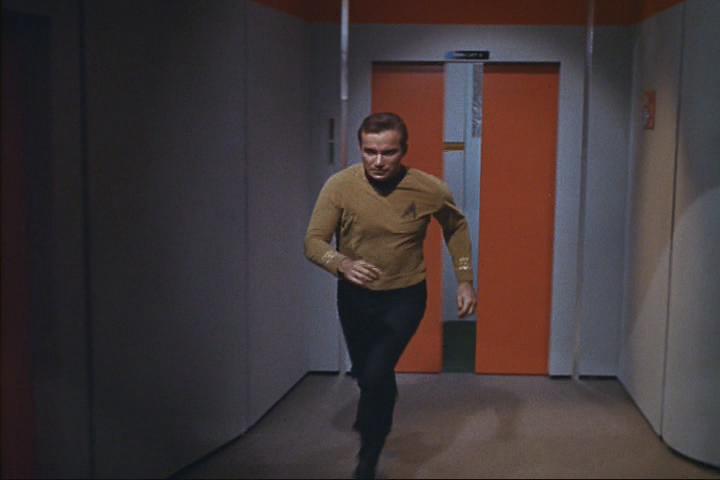
A pair of CSDs in action.

Here, Captain Kirk charges from a turbolift equipped with CSDs. Kirk's rate of speed is commensurate with the crisis he's managing, but the smart doors have no trouble opening and closing in perfect time with his passage.

Context-sensitive doors offer a silent welcome to a distraught officer.
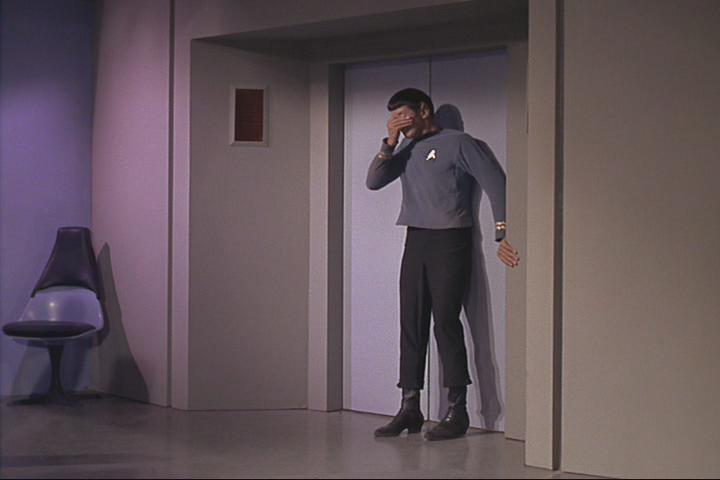
Meanwhile, Mister Spock must deal with an emotional crisis. Here, he emerges from a door, which quietly opens with the soft, comforting "swish" that is so identified with CSDs.

Mister Spock regains his composure - thanks in no small part to the bulwark provided by the CSDs.
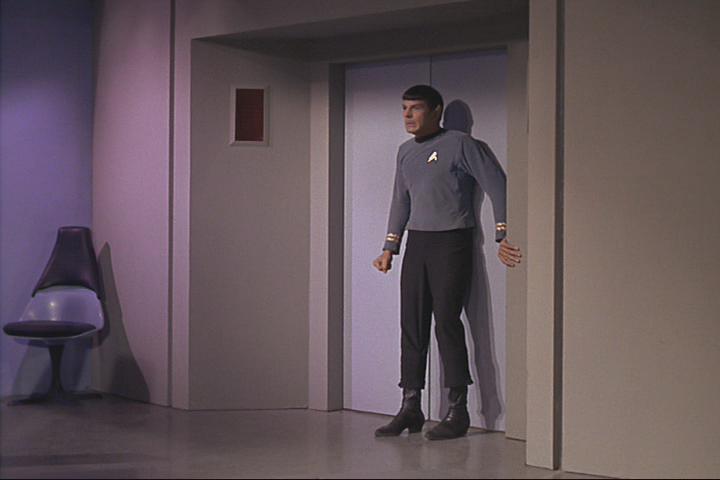
Were these doors controlled via simple motion sensor, Spock's next action, pictured above, would be impossible: as soon as the first officer leaned back, the doors would open, and the stoic Vulcan would take a most undigified fall.

Even Vulcans get the blues, but a good set of doors at your back will bring the good times back.
But context-sensitive doors understand that sometimes, even Vulcans need emotional - and physical - support. Using state-of-the-art 23rd century sensors, the clever doors remain shut until Mr. Spock can regain control of his emotions.

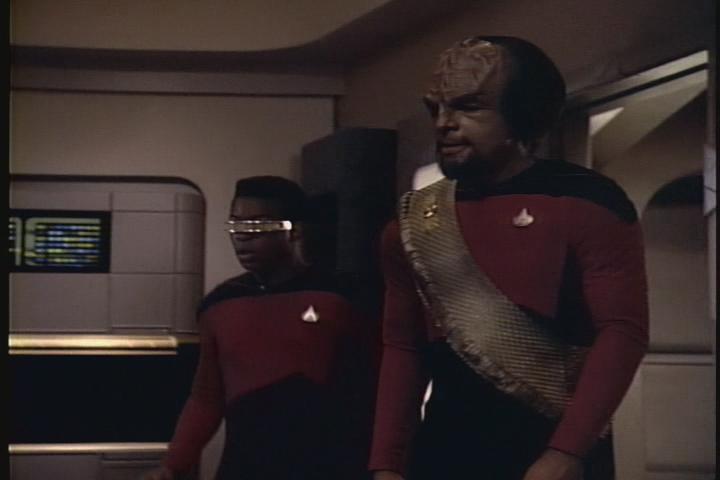
CSDs (at right) are on the job on the Enterprise-D.
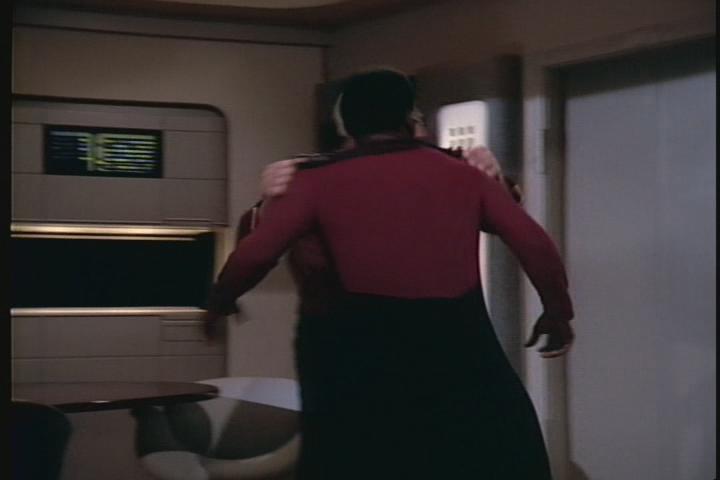
Context-sensitive doors remain in active service in the 24th century. Here, we see Geordi La Forge and Mister Worf respond to a distress call. The CSDs snap open with alacrity in response to the urgency of the situation.

As we see in the following sequence of photos, CSDs are often called upon to make snap judgements. When an intruder infiltrates the ship and starts throwing your crew around, should you remain open or closed? Here's one door's bold decision:

The CSD prepares to make a command decision.

The intruder, inhabiting the body of a Starfleet Admiral, prepares to throw Geordi through the doors. The doors have only a split-second to assess the situation.

The CSD stands firm.

The CSD makes its choice: remain closed. The doors can absorb some of the impact of Geordi's flight, reducing the chance that the officer will be injured. But it's a choice with serious implications for the CSD, as seen in the following sequence:

In this view from the corridor, we see the CSD bulging slightly from Geordi's impact.

An instant later, the impact drives the doors from their hinges - a noble but necessary sacrifice to spare a valuable officer from serious injury.

One of the doors thrusts itself beneath Geordi's rump, saving his ass - literally!

"Thank goodness for Context Sensitive Doors!" is the thought no doubt running through Lieutenant La Forge's mind.
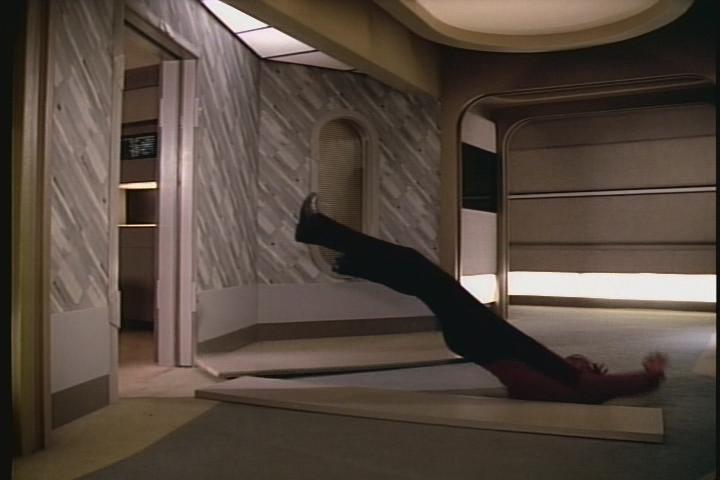
Just another day of service for Starfleet's unrecognized heroes: the Context-Sensitive Doors.

The stated goal of the Enterprise's mission is to seek out new worlds and new civilizations, to boldly go where none have gone before. In short, they seek out the unknown. Well, as a 20th century explorer might have said, had he lived to see the wondrous days to come, "There are things known and things unknown, and in between are the context-sensitive doors."

Wednesday, December 15, 2004

The Long Shadows

The Long Shadows
By Earl J. Woods

The man in the long brown trenchcoat staggered down the deserted street. There was a sudden gust of wind, and a newspaper somersaulted carelessly towards him, then veered away at the last second, dancing into a back alley, out of sight, its shadow close behind. Sheets of dust blew down the street, and the man winced as the grit abraded his eyes. He coughed and canted to the right, crashing heavily into a boarded-up storefront window.

The wind died, and the man rested. His right hand, wedged between his torso and the storefront, was buried deep in a trenchcoat pocket. His left moved halfway towards his face to shield his eyes, then fell back down as the wind’s absence sunk in.

The man breathed deep. He wasn’t quite panting; the chase had really ended long ago, and he spent most of his time jogging now, rather than running. Nonetheless, there was a painful hitch in his gait, a deep burning in his lungs. Sweat clouded his vision more often than not.

He was twenty-eight. His black goatee was already streaked with grey. His skin, once bronzed and clear, was now pale, greyish. His shoes were worn, the soles thin, ready to give way.

He rested for a moment, then moved on. The stagger was gone, but his pace was slow, measured, right hand still in his pocket, left swinging free. He wished, not for the first time, that his footfalls would echo, just a little; but the deserted city was silent as always, not even acknowledging his presence with echoes. He once spent an entire day screaming into the emptiness, demanding some kind of response: the flurry of a frightened bird’s wings, the snarl of a feral dog, or during that delirious half-hour when he dared dream of it, the answering call of another human being. Male or female, child or adult, friend or foe, he didn’t care; even a shouted curse from some anonymous, cowering soul would have been sweet.

The days were longer now; it was just after midnight, and the sun still loitered above the horizon. The detritus of the streets cast longer and longer shadows, lampposts and mailboxes (many overturned, some still standing, waiting patiently for their long-lost guardians) painting the asphalt and concrete with stark, angular sketches, art that was both ephemeral and timeless, appearing and disappearing with the rise and fall of the sun.

“Hello,” the voice said from behind him, and the man jumped, nearly screamed, his right hand very nearly coming out of his pocket. He spun around, eyes wild, but saw no one.

“Hello,” said the voice, “Quench your thirst with an ice-cold Ozone!”

The man saw the soda machine and relaxed. He nearly smiled as he approached it, the familiar green-on-black logo stirring up old memories.

“Hello,” the machine said, “Insert coins or debit stick, please.”

The man could hardly believe the machine was still running, but even now, some clung stubbornly to life, or at least to the semblance of life that most machines had. He looked through the glass door of the machine, saw a stack of clean, glistening, Ozone-filled bottles primly awaiting his selection.

“Glass bottles,” he said, “Will you look at that.”

Suddenly he wanted one very badly. He wasn’t particularly thirsty, but his left hand slid into his other pocket, searching for change; his debit stick, even if he still had it, was worse than useless now. He pulled out a quarter, a dime, a one-Euro piece, an American penny and – aha! - a single golden Loonie, shiny and smooth as the day it was minted in Winnipeg.

He looked at the coin. 2015; Loon on one side, Mad King William on the other. Two Loons for Sister Sarah, he thought.

“Please insert coins or debit stick,” the machine said, “Ozone breathes life into your personal atmosphere!”

The man stared at King Willy for a while, then jammed the coin into the slot with one quick, stabbing motion. Deep inside the machine, something clicked softly. The man pulled the dispenser door open, kept it open with his right shoulder, and used his left hand to pull the top bottle free.

“Thank you for choosing Ozone,” the machine said, “Thank you!”

The bottle was ice cold, and condensation formed on the bottle immediately. He twisted the cap, but it wouldn’t budge; then he spotted the bottle opener built into the machine. He inserted the bottle, pried off the cap, and drank deeply. The soda was as sweet and good as he remembered.

“You’re welcome!” he said to the machine, smiling for the first time in months.

“Choose Ozone for your next gathering!” the machine said.

The man laughed, turning away, resuming his journey. “That’ll be a long time coming, my friend.”

“Are you certain?” asked the machine.

The man froze. Every muscle went rigid as a shock of cold dread crept along every nerve.

“Ozone will liven up that party atmosphere!” the machine said.

The man relaxed. It was simple voice recognition, combined with rudimentary artificial intelligence, not a possessed soda machine, nor the first sign that he was losing his mind. He’d heard of such robotic hucksters before, but had never actually run into one; as far as he knew, they’d only been rolled out to the largest markets before the calamity struck.

“You almost had me there, champ,” he laughed, turning to face the machine once more.

“Have another Ozone!”

The man shook his head and downed the rest of the drink. He threw the bottle into the street, grimacing in annoyance when it refused to shatter or even provide a satisfying clunk.

“No thanks,” he said, “I think I’ve probably had my last Ozone.”

“In blind taste tests, seven out of ten people agreed that Ozone was more refreshing than the other leading carbonated beverages.”

“Oh, so I shouldn’t be so hasty, eh?”

“Indeed not.”

Smart machine. The man knew he should leave, pick up the pace, increase his lead, but it had been an age since he’d enjoyed even the simplest conversation.

“What makes Ozone so great, huh? I was always a Coke man, myself.”

“Ozone refreshes with a secret combination of flavour factors – factors that create tingling tangles of tempting, terrific taste.”

“Mmm-hmm. Can you talk about anything except Ozone?”

“I can talk about anything you want, Charlie.”

Charlie smiled thinly. So he was losing his mind after all. He clutched the object in his pocket a little more tightly.

“How’s the weather in Addis Ababa right now?”

“Currently, the temperature is minus five degrees Celsius, with light flurries.”

Charlie snorted. If he stayed any longer, he knew he’d spiral down into delirium. He started to turn away again, but the machine understood his intentions.

“You’ve already stayed too long. Your pursuer is now only six kilometres away.”

“It’s the fear manifesting itself,” Charlie said, “You’re saying something else. You’re telling me to buy another Ozone, or you’re spouting an ad line.”

“Perhaps,” the machine said, “You’re the doctor.”

“I’m not an MD.”

“No.”

Charlie pulled his right hand from his pocket. His fist was wrapped around a blue-white sphere, a sphere bisected at the equator with a streaming row of shifting, luminescent cobalt-blue text.

“What does it say?” the machine asked.

Charlie didn’t look at the sphere. His gaze remained fixed on the soda machine.

“Are you afraid?” the machine asked.

“Yes,” Charlie said.

The text on the sphere ceased its trek across the equator. It went dark, then reappeared, flashing, then freezing solid. The sphere vibrated in Charlie’s hand, demanding attention.

“Your pursuer is four kilometers away and closing.”

“Can you help me?” Charlie said.

“Your imagination can help you.”

The sphere’s vibrations grew stronger. The text started to flash again, brighter, more insistent.

“I’m not responsible for surviving; I didn’t want any of this; I’m not responsible; I’m not.”

“If not you, who?” the machine asked. “Shouldn’t someone be responsible? Shouldn’t some representative answer for humanity? Defend humanity? Pass judgment on humanity? Make reparations to humanity? Make reparations on humanity’s behalf?”

“I’m not that man. I have to be who I am, no one else.”

“You have to be who you are: no one else.”

“We are all prisoners of circumstance. Choice is the great illusion.”

“The Charlottetown Address, 2009.”

“Evil is a social construct. We are only masses of disparate particles, temporarily joined by natural forces, forces that determine our every action.”

“Inaugural address, 2013. Your pursuers are two kilometers distant and closing.”

Charlie was sweating, and cold. The rim of the sun was just beginning to brush against the horizon. The shadows grew longer.

“Charlie, will you resume flight now?” the machine asked.

“Was I really so bad?”

“You are only a mass of disparate particles. Natural forces have determined your every action. You are not responsible. Your pursuers are five hundred meters distant and closing.”

He could hear them now. The sphere in his hand started to wail, a high, warbling shriek that hurt his ears. The text was spinning again, whirring around the sphere faster than anything human could read. There was a button at the sphere’s north pole; his thumb moved to hover over it, but did not descend.

“I’m sorry,” he said. One tear fell, but it was genuine.

“Natural forces have determined your level of sorrow precisely. Your pursuers - ”

“ – are here,” Charlie said. Suddenly, it was dark, except for the lights all around him, the cold, white lights. He dropped the sphere, and it rolled into the gutter, then down a storm drain. He looked up to face his accusers, and their eyes, their eyes - .

Questions for Discussion
1. Who is Charlie?
2. Was Charlie really talking to a soda machine?
3. Who or what was Charlie running from?
4. What was the device in Charlie’s pocket?
5. Why did the author use an imaginary soda?
6. A “shadow” is another name for someone who is following someone else. Does this add significance to the title?
7. Charlie thinks the race “really ended long ago,” and yet by the story’s end, his pursuers capture him. What did Charlie mean?
8. What is the significance of the newspaper?
9. What would have happened if Charlie had pressed the button on the sphere? Why didn’t he press it?
10. Do we live in a deterministic universe, or do individual human beings have the ability to choose?
11. Will you stop to enjoy a refreshing Ozone carbonated beverage?
12. Are you afraid?
13. Were you really so bad?
14. If not you, who?