A while back, I created a guide to all the
Star Trek episodes (save those of the fifth series,
Enterprise) featuring time travel. Before tonight, the list has been available only to whichever lucky (?) souls received it via email. Now, let the world behold...
Time Treks
The
Star Trek Time Travel Episode Guide!
Each episode is rated thusly
Time Bomb: The very worst time travel episodes.
Time Out: Pretty bad, but not a bomb.
Time Waster: Fair-to-middling effort.
Time Honoured: A good way to spend an hour.
Timeless: The very best time travel episodes.
Each series will also receive a TTQ, or Time Travel Quotient, to indicate what percentage of the show's episodes involved time travel.
PART ONE: The Original Series
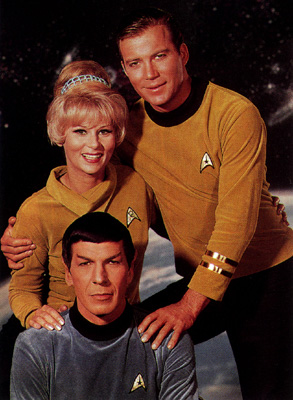 Getting ready to trek back and forth through time.
Season One
Getting ready to trek back and forth through time.
Season One
"The Naked Time"
The very first episode in the Trek canon to involve time travel, and the seventh episode of the show. However, said travel plays only a very minor role at the end of the story. It's really about a disease that drives everyone on the ship whacko. Classic moments include Kevin Riley's stirring rendition of "Kathleen," and a rock-em-sock-em-play-that-funky-fight-music battle between Kirk and Spock. And the "how did this ever make it past the censors?" moment when a sword-wielding Sulu, drunk with mania, grabs Uhura and says, "I'll protect you, fair maiden!"
Her reply: "Sorry, neither!"
Originally, the brief trip back in time - three days - was to have been a much longer jump, into the late 1960s. Originally, this episode was planned as part one of a two-part story (see "Tomorrow is Yesterday," below).
Rating: Time Honoured
"Tomorrow is Yesterday"
...in which the Enterprise is tossed back in time via a "black star." The ship has also been tossed into Earth's atmosphere, and Air Force pilot John Christopher reports the Enterprise as a UFO. Wacky shenanigans ensue, and to put things right again, Kirk must play around with time some more. During the course of the episode, we discover that 23rd century flashlights look exactly like their 20th century counterparts.
RATING: Time Honoured
"The City on the Edge of Forever"
Universally hailed as Star Trek's best episode, this is the one where Kirk must sacrifice the woman he loves for the sake of the future of humanity. "Doubtless you're wondering about my friend's ears. It's really quite easy to explain. You see, he...had an accident with a...mechanical rice picker."
RATING: Timeless
Season Two
"Assignment: Earth"
No time travel in the second season until the very last episode. Still, Kirk and company are already being a bit casual about time travel; in this episode, they journey to the 1960s purely out of curiosity, to see how the primitive humans of the day managed to avoid nuclear destruction. (They can't find this information in the history books, because "records of the period are fragmentary.")
Turns out that a Mr. Gary Seven, a human being raised by benevolent aliens, is doing most of the work to keep human history on track. He's a sort of secret agent, making sure that the Cold War doesn't turn hot, and his mission is to stop an American orbital nuclear weapons platform from becoming operational, since this would tilt the balance of power too far in America's favour and possibly trigger a nuclear war.
This episode was intended as a "backdoor pilot" for a show called
Assignment: Earth, in which Gary Seven and his secretary, Roberta Lincoln (Terri Garr) would have more Cold War adventures. It never happened, which is too bad - it's an interesting premise.
RATING: Time Honoured
Season Three
"All Our Yesterdays"
Only one time travel story in season three, and it's the second last episode of the series. An unremarkable episode, falling into the mid-range of the typically disappointing third-season stories. You get to see Spock eat meat, though, because somehow, being thrown into the past makes him go nuts, theoretically because he's now closer to his savage ancestors. You're not a real scientist, are you? Still, the concept of temporal refugees, escaping a nova by traveling to the past of their own world, is pretty cool.
RATING: Time Waster
Star Trek: The Animated Series
"Yesteryear"
Yay! Cartoons! This tale returns us to the Guardian of Forever, seen in the timeless "City On the Edge of Forever." Mr. Spock visits his own childhood on Vulcan, and becomes a kind of mentor to his younger self. "Yesteryear" would have made a fine live-action episode, with its focus on growing up and making difficult choices.
RATING: Timeless
"The Counter-Clock Incident"
The Enterprise gets pulled into a universe where time runs backward, so visiting Commodore Robert April, the ship's elderly first captain, is the only one who can save the crew when everyone starts to get younger and younger...too young to run things. Restored to vigorous young adulthood, April saves the day. Cool.
RATING: Time Honoured
The Star Trek Original Series Movies
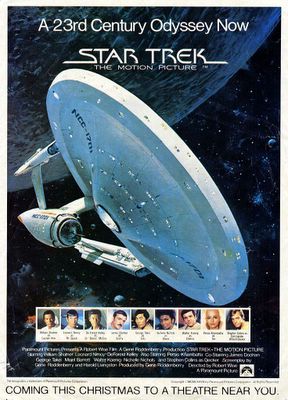 Paramount invites audiences to take a time trek of their own - to the 23rd century.
Star Trek IV: The Voyage Home
Paramount invites audiences to take a time trek of their own - to the 23rd century.
Star Trek IV: The Voyage Home
Or, "Star Trek IV: Save the Whales." Goofy fun in 1980s San Francisco, featuring "A double dumb-ass on you," "Where are the nuclear wessels?" "How do ye know he dinna invent the thing?" and many other fun bits. Despite the film's good humour and worthy conservation theme, this film hasn't aged as well as its original popularity might suggest. It's too much of a hodgepodge of elements, for one thing - a time travel story tossed into the middle of a string of serious events for the lives of our heroes, namely the death and rebirth of Spock, the death of Kirk's son, and the theft and destruction of the Enterprise. Given the gravity of the events in the previous films, the sudden turn to mirth seems a bit off-kilter. Still a fun film, though, if you're in the right mood for it.
RATING: Time Honoured
Time Travel Quotient:
Out of 107 episodes (including the animated series and the movies), only eight involve time travel, for a Time Travel Quotient of 7.47%.
RATINGS BREAKDOWN
Time Bomb: 0 episodes
Time Out: 0 episodes
Time Waster: 1 episode
Time Honoured: 5 episodes
Timeless: 2 episodes
The original
Star Trek, then, has a reasonably successful time travel track record.
PART TWO: Star Trek: The Next Generation
Season One
“We’ll Always Have Paris”
A forgettable episode with a minimal time travel element.
RATING: Time Out
Season Two
“Time Squared”
Mysterious space whirlpool opens and threatens to suck the Enterprise into oblivion. Can a ranting Picard from the future avert catastrophe? Who cares? Originally intended to lead into “Q Who,” the episode that introduced the Borg.
RATING: Time Bomb
Season Three
“Yesterday’s Enterprise”
For many, this episode marks a turning point in Star Trek: The Next Generation: it’s the point where the show actually became worth watching. This is the one with the Enterprise-C and the big space battle. More importantly, it also presents Picard and his pals with a wrenching moral dilemma.
RATING: Timeless
“Captain’s Holiday”
Captain Picard goes spelunking, but aliens from the 27th century come back in time to look for a thingy that can make suns explode. An amusing romp.
RATING: Time Waster
Season Four
An amazing ZERO time travel episodes!
Season Five
“A Matter of Time”
Con man Matt Frewer uses his stolen time travel machine to steal technology. Ho hum.
RATING: Time Out
“Cause and Effect”
The Enterprise is caught in a time loop, and not one of those nice time loops when you’re having sex with a pair of twins over and over for eternity! Nope, it’s one of those time loops where your ship is lost with all hands over and over and over. How can you beat a show where, without warning, the ship explodes in the opening ten seconds of the episode?
RATING: Timeless
“Time’s Arrow”
Archeologists find Data’s head in a cave in San Francisco, only it’s five hundred years old, and besides, Data is alive and well on the Enterprise. Oh oh, sounds like some kind of paradox. An intriguing setup, with special guest stars Samuel Clemens and Jack London. Part one of two.
RATING: Time Honoured
Season Six
“Time’s Arrow, Part Two”
Meh. Disappointing resolution. Time traveling vampire snakes?
RATING: Time Waster
“Timescape”
Time is freezing, speeding up, or slowing down thanks to “temporal pockets” in space. Yikes! Picard needs to get his nails trimmed after his hand passes through a pocket and ages a few months. Ouch! Features a laugh-out-loud moment when a delirious Picard draws a happy face in the frozen cloud of vapour that signals a warp-core breach.
RATING: Time Honoured
Season Seven
“Firstborn”
Worf’s son, all grown up now, travels to the present from the future to warn his dad about something. I forget what.
RATING: Time Waster
“All Good Things…”
Okay, maybe this is just all a Q fantasy, but it’s hard to be sure. I include it as a time-travel episode anyway, since the plot relies so heavily on the interconnection of the three eras of Picard’s life on display here. A pretty good series finale, but just a couple of steps away from outstanding.
RATING: Time Honoured
Star Trek: The Next Generation Movies
“Star Trek: Generations”
Killing Kirk off in the lamest of all possible ways makes this an automatic bomb. Bah!
RATING: Time Bomb
“Star Trek: First Contact”
Action-packed race to the past to save our future! Scary Borg! Stoic Vulcans! Drunk Deanna! Grinning Riker! What more can you ask for?
RATING: Timeless
Time Travel Quotient
Out of 179 episodes (including the movies), only 13 featured time travel in any significant way. That’s a TTQ of 7.26%, only a fraction lower than the original series.
RATINGS BREAKDOWN
Time Bomb: 2 episodes
Time Out: 2 episodes
Time Waster: 3 episodes
Time Honoured: 3 episodes
Timeless: 3 episodes
In terms of quality,
Star Trek: The Next Generation’s time travel record covers the entire scale fairly evenly, though slightly tilted towards quality.
PART THREE: Star Trek: Deep Space Nine
Season One
“Emissary”
Time travel plays an important role in the mythology of Deep Space Nine, since it revolves around a space station that’s situated next to a wormhole inhabited by a species of aliens who live outside linear time. We find all this out in the very first episode, an excellent beginning to an excellent series.
RATING: Timeless
Season Two
An amazing ZERO time travel episodes!
Season Three
“Past Tense, Part I”
Sisko, Bashir, and Dax are thrown into Earth’s past by a transporter accident. That’s bad enough, but it’s the early 21st century, and they’ve wound up in a sealed-off compound for the homeless during the historical Bell Riots. Fantastic commentary on real-world social problems and the widening gap between rich and poor.
RATING: Timeless
“Past Tense, Part II”
Second verse, just as good as the first.
RATING: Timeless
“Visionary”
Poor Chief O’Brien. Nothing good ever happens to this guy, and now he’s being jerked back and forth between the present and the near future. Not only that, but he discovers that the space station is about to be destroyed! Can he alter the course of the future?
RATING: Timeless
Season Four
“The Visitor”
A heart-wrenching episode: Jake Sisko is tortured by his father’s death, and spends his entire life trying to undo the past. One of only a handful of episodes to move me to tears.
RATING: Timeless
“Little Green Men”
The Three Stooges – er, make that the three Ferengi, Quark, Rom, and Nog – have a time travel accident and wind up in Roswell, New Mexico, 1947. They are, of course, responsible for the persistent rumors that aliens crash-landed there…This episode also gives a fun nod to “Past Tense” with a clever in-joke.
Rating: Timeless
Season Five
“Trials and Tribble-ations”
A villain from the past steals the Bajoran Orb of Time in an attempt to reverse a past defeat…and only Captain Sisko can save the legendary Captain Kirk from dying a decidedly untimely death. A classic.
Rating: Timeless
“Children of Time”
Another standout episode. Sisko and company must trade their own lives for 10,000 of their descendants…but the Odo of the future has other ideas.
RATING: Timeless
Season Six
“Far Beyond the Stars”
A black science fiction writer has trouble getting his stories published in the 1950s…and no wonder, considering he writes about an outlandish space station with a black man as its captain. Another high concept, winning episode.
RATING: Timeless
“Wrongs Darker Than Death or Night”
Great title, not-so-great episode. Major Kira borrows the Orb of Time to see if her mom was really a collaborating whore or not. She was.
RATING: Time Out
“Time’s Orphan”
Little Molly O’Brien wanders into a time portal and spends over a decade there, emerging as a young woman. Her parents don’t know what to do. Meh. Disappointing.
RATING: Time Out
“The Sound of Her Voice”
Time travel as plot twist. Good enough to pass the, er, time.
RATING: Time Waster
Season Seven
No time travel!
Time Travel Quotient
Out of 174 episodes, time travel plays a part in twelve episodes, for a TTQ of 6.89%, lowest of the four series.
RATINGS BREAKDOWN
Time Bomb: 0 episodes
Time Out: 2 episodes
Time Waster: 0 episodes
Time Honoured: 0 episodes
Timeless: 10 episodes
An amazing result – ten out of twelve DS9 time travel episodes are timeless classics, with only two disappointments.
PART FOUR: Star Trek: Voyager
Season One
“Parallax”
Voyager responds to a distress signal from…itself, as it turns out, trapped in a quantum singularity in the ship’s near-future. Good thing technobabble can save them!
RATING: Time Bomb
“Time and Again”
After a promising premiere episode, “Voyager” gave us two time-travel episodes in a row. “Time and Again” is the second, a heavy-handed morality play about the importance of following the Prime Directive. Voyager runs across a planet that has recently suffered some kind of technological disaster. Beaming down to investigate, Captain Janeway and Mr. Paris fall through subspace ruptures into the past, to a time just before the accident. Turns out that it was their presence in the past that triggered the disaster all along! Oops. That’ll teach you to seek out strange new worlds and new civilizations.
RATING: Time Bomb
“Eye of the Needle”
Voyager discovers a teeny-weeny wormhole that leads back to the Alpha Quadrant; into Romulan territory, to be specific. The ship can’t fit through, but at least they can send a message back to the friendly Romulan who promises to pass on the news of their survival to the Federation. But oh-oh – they discover that the wormhole is a tunnel not just through space, but also back in time fifty years. One of the few decent Voyager episodes, with a nice touch of pathos.
RATING: Time Honoured
Season Two
“Death Wish”
Well, you knew Q had to show up sometime, and you knew it was going to involve time travel. With a suicidal member of the Q on trial, the Q we know and love calls up witnesses from the past to prove that the suicidal Q’s life has meaning after all. Includes a gratuitous cameo by Commander Riker of the Enterprise.
RATING: Time Waster
Season Three
“Future’s End”
A time-ship from the 29th century Federation appears before Voyager, and its captain isn’t happy. Apparently, Voyager is about to be responsible for a catastrophe that will have far-reaching repercussions. To prevent that, Voyager must be destroyed. There’s a fight, and Voyager winds up getting flung through time and space to Earth of the year 1996…
RATING: Time Waster
“Future’s End, Part II”
In which the intrepid crew (of an Intrepid-class ship, no less) resolve the paradox and wind up right back where they started. Plus, you get to see a shuttlecraft blow up a semi.
RATING: Time Waster
“Before and After”
Kes is exposed to radiation that sends her leaping back and forth through time, right back to her very birth. A high-concept time travel episode that actually – shock – works!
RATING: Time Honoured
Season Four
“Year of Hell”
Kurtwood Smith (Red from “That 70s Show”) plays an obsessed Krenim scientist who wants to restore his fallen empire and recover his lost wife. He has a ship armed with a powerful weapon – a “temporal cannon” that erases the Krenim Empire’s enemies from history. Can Voyager stop countless billions of sentient beings from being erased?
RATING: Timeless
“Year of Hell, Part II”
The conclusion. Not quite as good as part one, if only because in the end, the famous Voyager reset button is pushed and you discover that the events of the story…never happened. Sigh. Still, the coda where Smith’s character is finally reunited with his wife is very moving.
RATING: Time Honoured
Season Five
“Timeless”
An experiment to get Voyager home goes horribly awry, and only Commander Chakotay and Ensign Kim make it back to Earth. But their failure weighs heavily, and the two surviving officers spend years figuring out how to cheat fate, traveling back in time to prevent the accident before it occurs. One of Voyager’s few good episodes, guest-starring LeVar Burton as Captain Geordi LaForge.
RATING: Timeless
“Relativity”
The 29th century Federation is back, and this time they want to know who destroyed Voyager with a time bomb! Originally titled, amusingly, “Time Bomb.” I’m almost sorry the episode is too good to warrant that rating.
RATING: Time Honoured
Season Six
“Fury”
Kes, who left the ship in the fourth season, comes back, and she’s pissed, using her telekinetic abilities to wreck Voyager. Quick! Only time travel can save us!
RATING: Time Bomb
Season Seven
“Shattered”
Holy Cow! A space-time anomaly has shattered Voyager into different eras! The bridge is set in the days before Voyager got tossed back into the Delta Quadrant, engineering is being occupied by Kazon from the second season…it’s chaos, and only Chuckles – er, that is, First Officer Chakotay – can put things right. Now you know we’re in trouble.
RATING: Time Bomb
“Endgame”
Voyager’s final episode involves the show’s two most overused elements: time travel and the Borg. In the future, we see that psychotic Admiral Janeway, celebrating the 10-year anniversary of Voyager’s arrival home (after a 23 year trip), decides that history just didn’t unfold the way it should have, and steals a time travel device from a Klingon scientist. She lost a few crewmembers along the way, you see, including Seven of Nine, and, well, damn it, erasing 33 years of history is justifiable for the sake of those lives. Holy cow! Where are those 29th century time cops when you need them? Voyager gets Batmobile armour, the Borg seem to get destroyed for all time, and future technology falls into the hands of the Federation. Oh, the big homecoming? You get ten seconds worth as the final credits roll. No resolution of character arcs, we don’t find out what happens to all those Maquis crewmembers (who are, as far as we’ve been told, still criminals in the eyes of the Federation)…oy. Possibly Voyager’s worst episode, and that’s really saying something.
RATING: Time Bomb
Time Travel Quotient
Out of 168 episodes,
Star Trek: Voyager told time travel stories 14 times. That gives Voyager a TTQ of 8.33%, the highest of all four completed incarnations of
Star Trek.
RATINGS BREAKDOWN
Time Bomb: 5 episodes
Time Out: 0 episodes
Time Waster: 3 episodes
Time Honoured: 4 episodes
Timeless: 2 episodes
Not surprisingly,
Voyager features the fewest Timeless episodes and the most Time Bombs. Still, there are a surprisingly high number of decent
Voyager time travel episodes.
PART FIVE: CONCLUSION
Thus far, there have been 628 episodes of
Star Trek, not counting the newest series,
Enterprise. Of these 628 episodes, 47 have featured time travel, for a complete Time Travel Quotient of 7.48%, a surprisingly low number. What about quality?
RATINGS BREAKDOWN (TOTAL)
Time Bomb: 7 episodes
Time Out: 4 episodes
Time Waster: 7 episodes
Time Honoured: 12 episodes
Timeless: 17 episodes
Surprisingly,
Star Trek has been pretty successful at tackling time travel. They’ve had a few bombs – mostly thanks to
Voyager – but their fair share of classics as well.
Has the time travel well, then, been dipped into too often? Only in the fullness of time shall we discover the answer…